From the Department of Epidemiology and Biostatistics (Z.W., J.W., X.Q., W.X.), School of Public Health, Tianjin Medical University, China; Aging Research Center, Department of Neurobiology (J.G., A.D., W.X.), Care Sciences and Society, Karolinska Institutet, Stockholm, Sweden; Rush Alzheimer's Disease Center (K.A., D.A.B.), Rush University Medical Center, Chicago, IL; and Department of Biomedical Engineering (K.A.), Illinois Institute of Technology, Chicago.
Neurology. 2023 Oct 24;101(17):e1718-e1728. doi: 10.1212/WNL.0000000000207745. Epub 2023 Sep 1.
The association of motor function with cognitive health remains controversial, and the mechanisms underlying this relationship are unclear. We aimed to examine the association between motor function and long-term cognitive trajectories and further explore the underlying mechanisms using brain MRI.
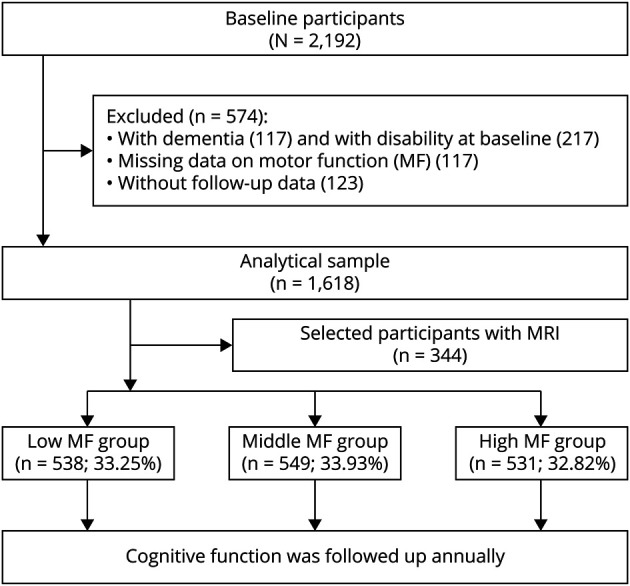
In the Rush Memory and Aging Project, a prospective cohort study, a total of 2,192 volunteers were recruited from the communities in northeastern Illinois and followed up for up to 22 years (from 1997 to 2020). Individuals with dementia, disability, missing data on motor function at baseline, and missing follow-up data on cognitive function were excluded. At baseline, global motor function was evaluated using the averaged scores of 10 motor tests covering dexterity, gait, and hand strength; the composite score was tertiled as low, moderate, or high. Global and domain-specific cognitive functions-including episodic memory, semantic memory, working memory, visuospatial ability, and perceptual speed-were measured annually through 19 cognitive tests. A subsample (n = 401) underwent brain MRI scans and regional brain volumes were measured. Data were analyzed using linear mixed-effects models and linear regression.
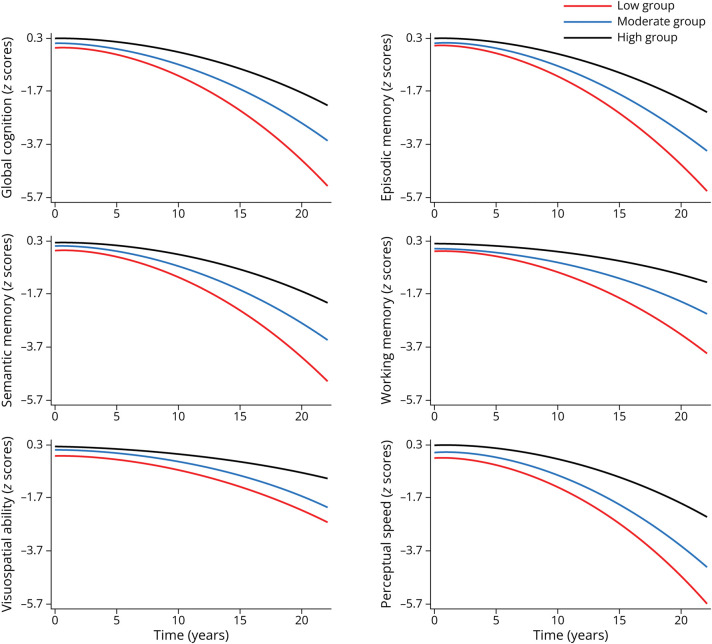
Among the 1,618 participants (mean age 79.45 ± 7.32 years) included in this study, baseline global motor function score ranged from 0.36 to 1.82 (mean 1.03 ± 0.22). Over the follow-up (median 6.03 years, interquartile range 3.00-10.01 years), low global motor function and its subcomponents were related to significantly faster declines in global cognitive function (β = -0.005, 95% CI -0.006 to -0.005) and each of the 5 cognitive domains. Of the 344 participants with available MRI data, low motor function was also associated with smaller total brain (β = -25.848, 95% CI -44.902 to -6.795), total white matter (β = -18.252, 95% CI -33.277 to -3.226), and cortical white matter (β = -17.503, 95% CI -32.215 to -2.792) volumes, but a larger volume of white matter hyperintensities (β = 0.257, 95% CI 0.118-0.397).
Low motor function is associated with an accelerated decline in global and domain-specific cognitive functions. Both neurodegenerative and cerebrovascular pathologies might contribute to this association.
运动功能与认知健康之间的关联仍存在争议,其潜在机制尚不清楚。我们旨在通过脑 MRI 检查运动功能与长期认知轨迹之间的关联,并进一步探讨潜在机制。
在 Rush 记忆与衰老项目(一项前瞻性队列研究)中,共招募了来自伊利诺伊州东北部社区的 2192 名志愿者,并进行了长达 22 年的随访(1997 年至 2020 年)。排除了痴呆症、残疾、基线时运动功能缺失数据以及认知功能随访数据缺失的个体。基线时,通过涵盖灵巧性、步态和手部力量的 10 项运动测试的平均得分来评估整体运动功能;综合评分为低、中或高。通过 19 项认知测试,每年测量包括情景记忆、语义记忆、工作记忆、视空间能力和知觉速度在内的整体和特定领域认知功能。一个亚组(n=401)进行了脑 MRI 扫描,并测量了局部脑容量。使用线性混合效应模型和线性回归进行数据分析。
在这项研究中,共纳入了 1618 名参与者(平均年龄 79.45±7.32 岁),基线时的整体运动功能评分范围为 0.36 至 1.82(平均 1.03±0.22)。在随访期间(中位数为 6.03 年,四分位间距为 3.00-10.01 年),低整体运动功能及其子成分与整体认知功能(β=-0.005,95%置信区间-0.006 至-0.005)以及 5 个认知领域的显著快速下降相关。在 344 名有可用 MRI 数据的参与者中,低运动功能也与总脑容量(β=-25.848,95%置信区间-44.902 至-6.795)、总白质(β=-18.252,95%置信区间-33.277 至-3.226)和皮质白质(β=-17.503,95%置信区间-32.215 至-2.792)体积减少相关,但与白质高信号体积增加(β=0.257,95%置信区间 0.118-0.397)相关。
低运动功能与整体和特定领域认知功能的快速下降相关。神经退行性和血管性病变都可能导致这种关联。