Certara US, 100 Overlook Centre, Suite 101, Princeton, NJ, 08540, USA.
Bristol-Meyers-Squibb, Lawrenceville, NJ, 08648, USA.
Sci Rep. 2023 Sep 1;13(1):14342. doi: 10.1038/s41598-023-41382-0.
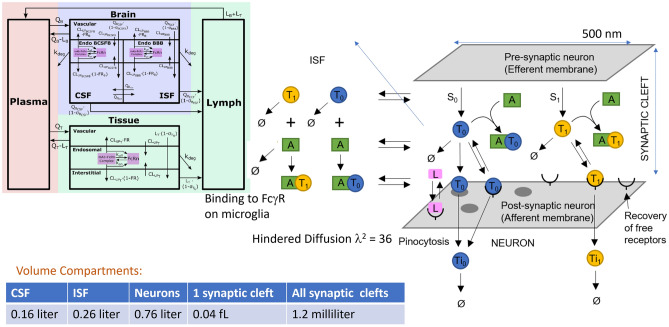
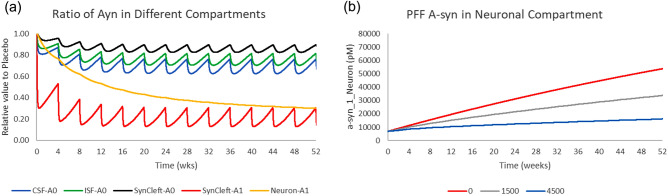
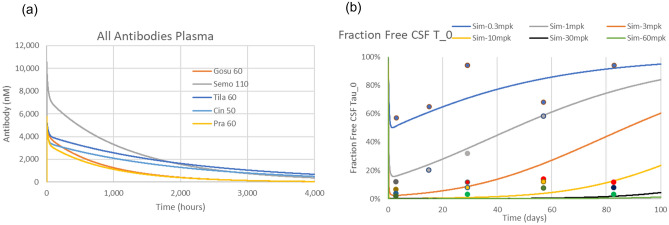
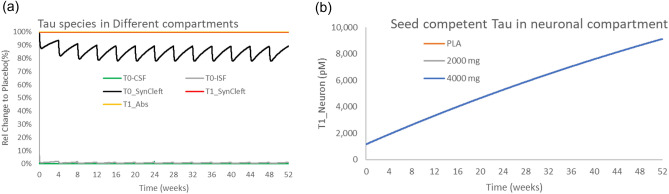
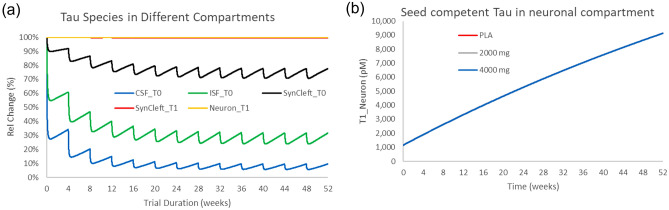
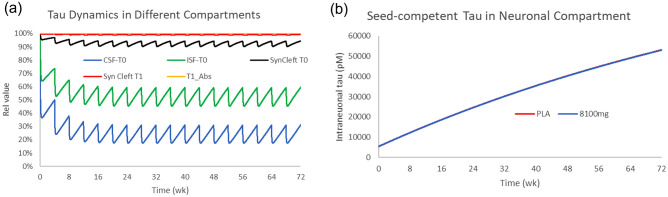
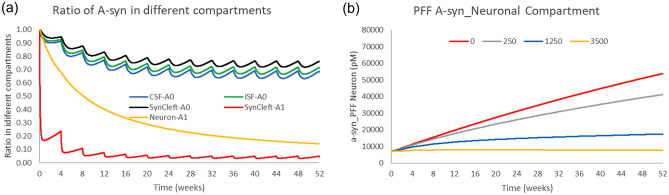
Misfolded proteins in Alzheimer's disease and Parkinson's disease follow a well-defined connectomics-based spatial progression. Several anti-tau and anti-alpha synuclein (aSyn) antibodies have failed to provide clinical benefit in clinical trials despite substantial target engagement in the experimentally accessible cerebrospinal fluid (CSF). The proposed mechanism of action is reducing neuronal uptake of oligomeric protein from the synaptic cleft. We built a quantitative systems pharmacology (QSP) model to quantitatively simulate intrasynaptic secretion, diffusion and antibody capture in the synaptic cleft, postsynaptic membrane binding and internalization of monomeric and oligomeric tau and aSyn proteins. Integration with a physiologically based pharmacokinetic (PBPK) model allowed us to simulate clinical trials of anti-tau antibodies gosuranemab, tilavonemab, semorinemab, and anti-aSyn antibodies cinpanemab and prasineuzumab. Maximal target engagement for monomeric tau was simulated as 45% (semorinemab) to 99% (gosuranemab) in CSF, 30% to 99% in ISF but only 1% to 3% in the synaptic cleft, leading to a reduction of less than 1% in uptake of oligomeric tau. Simulations for prasineuzumab and cinpanemab suggest target engagement of free monomeric aSyn of only 6-8% in CSF, 4-6% and 1-2% in the ISF and synaptic cleft, while maximal target engagement of aggregated aSyn was predicted to reach 99% and 80% in the synaptic cleft with similar effects on neuronal uptake. The study generates optimal values of selectivity, sensitivity and PK profiles for antibodies. The study identifies a gradient of decreasing target engagement from CSF to the synaptic cleft as a key driver of efficacy, quantitatively identifies various improvements for drug design and emphasizes the need for QSP modelling to support the development of tau and aSyn antibodies.
阿尔茨海默病和帕金森病中的错误折叠蛋白遵循一种明确的基于连接组学的空间进展。尽管在实验上可及的脑脊液 (CSF) 中大量结合了靶点,但几种抗 tau 和抗 alpha 突触核蛋白 (aSyn) 的抗体在临床试验中未能提供临床获益。提出的作用机制是减少神经元从突触小裂隙摄取寡聚物蛋白。我们构建了一个定量系统药理学 (QSP) 模型,以定量模拟突触小裂隙中的内突触分泌、扩散和抗体捕获、突触后膜结合以及单体和寡聚 tau 和 aSyn 蛋白的内化。与基于生理学的药代动力学 (PBPK) 模型的整合使我们能够模拟抗 tau 抗体 gosuranemab、tilavonemab、semorinemab 和抗 aSyn 抗体 cinpanemab 和 prasineuzumab 的临床试验。单体 tau 的最大靶标结合在 CSF 中模拟为 45%(semorinemab)至 99%(gosuranemab),ISF 中模拟为 30%至 99%,但在突触小裂隙中仅为 1%至 3%,导致寡聚 tau 的摄取减少不到 1%。对 prasineuzumab 和 cinpanemab 的模拟表明,游离单体 aSyn 在 CSF 中的靶标结合仅为 6-8%,在 ISF 和突触小裂隙中为 4-6%和 1-2%,而聚集的 aSyn 的最大靶标结合预计在突触小裂隙中达到 99%和 80%,对神经元摄取有类似的影响。该研究为抗体生成了最佳的选择性、敏感性和 PK 谱值。该研究确定了从 CSF 到突触小裂隙的靶标结合逐渐减少的梯度是疗效的关键驱动因素,定量确定了药物设计的各种改进,并强调需要 QSP 模型来支持 tau 和 aSyn 抗体的开发。