Clerbaux Laure-Alix, Cordier Pierre, Desboeufs Nina, Unger Kristian, Leary Peter, Semere Gabriel, Boege Yannick, Chan Lap Kwan, Desdouets Chantal, Lopes Massimo, Weber Achim
Department of Pathology and Molecular Pathology, University Hospital Zürich (USZ), Zurich, Switzerland.
Institute of Molecular Cancer Research (IMCR), University of Zürich (UZH), Zurich, Switzerland.
JHEP Rep. 2023 Jul 11;5(10):100838. doi: 10.1016/j.jhepr.2023.100838. eCollection 2023 Oct.
BACKGROUND & AIMS: Mcl-1, an antiapoptotic protein overexpressed in many tumours, including hepatocellular carcinoma (HCC), represents a promising target for cancer treatment. Although Mcl-1 non-apoptotic roles might critically influence the therapeutic potential of Mcl-1 inhibitors, these functions remain poorly understood. We aimed to investigate the effects of hepatic Mcl-1 deficiency (Mcl-1) on hepatocyte ploidy and cell cycle in murine liver and the possible implications on HCC.
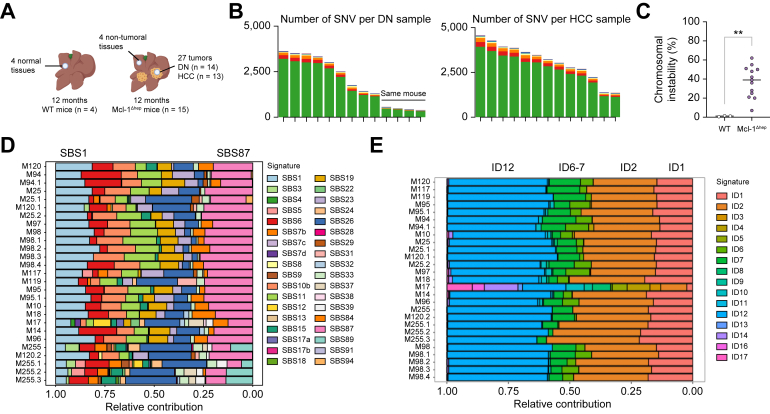
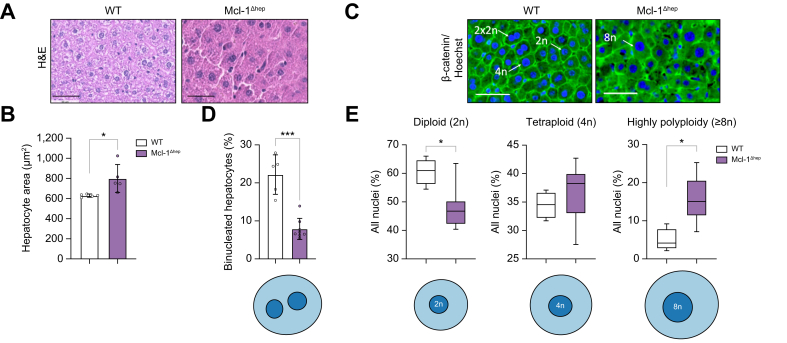
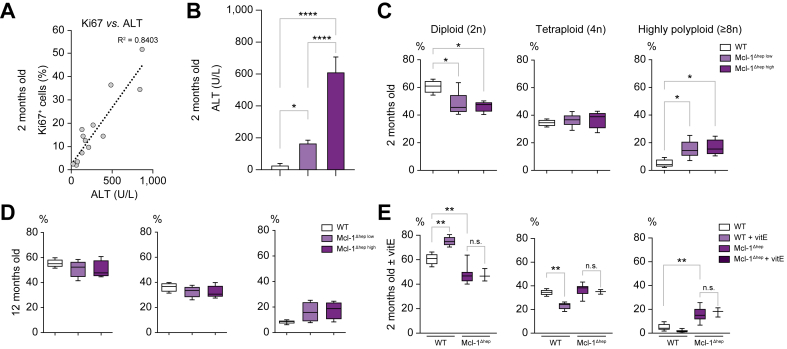
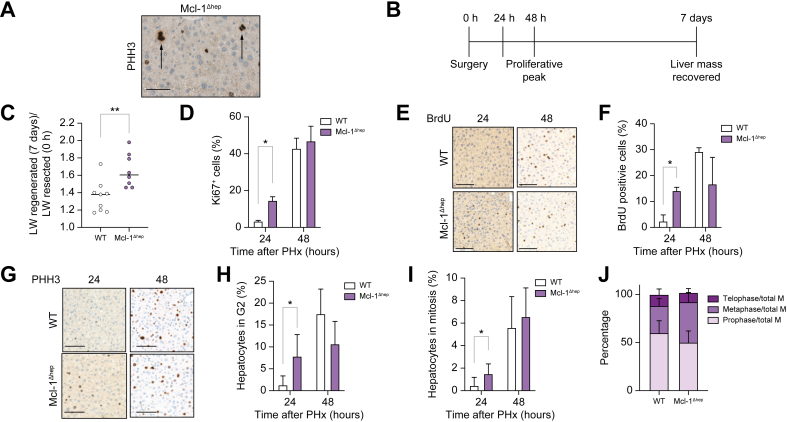
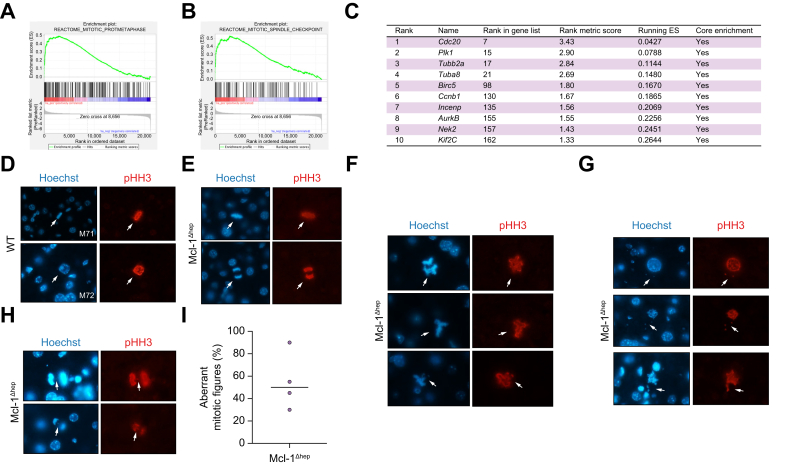
Livers of young Mcl-1 and wild-type (WT) mice were analysed for ploidy profile, mitotic figures, chromosome segregation, gene set enrichment analysis and were subjected to two-thirds partial hepatectomy to assess Mcl-1 deficiency effect on cell cycle progression . Mcl-1 tumours in older mice were analysed for ploidy profile, chromosomal instability, and mutational signatures via whole exome sequencing.
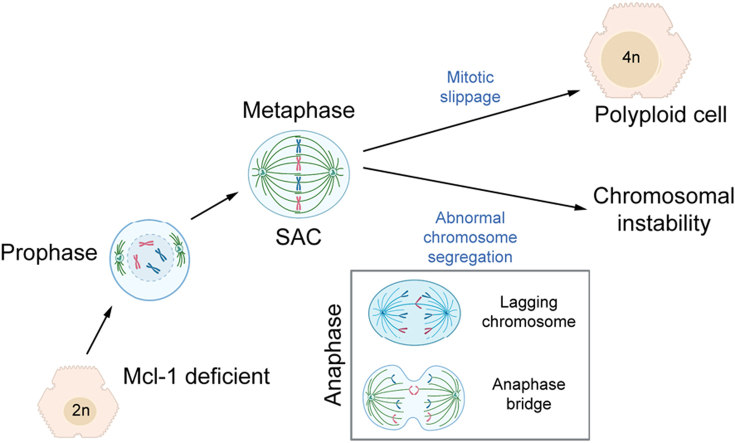
In young mice, Mcl-1 deficiency leads to nuclear polyploidy and to high rates of mitotic errors with abnormal spindle figures and chromosome mis-segregation along with a prolonged spindle assembly checkpoint activation signature. Chromosomal instability and altered ploidy profile are observed in Mcl-1 tumours of old mice as well as a characteristic mutational signature of currently unknown aetiology.
Our study suggests novel non-apoptotic effects of Mcl-1 deficiency on nuclear ploidy, mitotic regulation, and chromosomal segregation in hepatocytes . In addition, the Mcl-1 deficiency characteristic mutational signature might reflect mitotic issues. These results are of importance to consider when developing anti-Mcl-1 therapies to treat cancer.
Although Mcl-1 inhibitors represent promising hepatocellular carcinoma treatment, the still poorly understood non-apoptotic roles of Mcl-1 might compromise their successful clinical application. Our study shows that Mcl-1 deficiency leads to nuclear polyploidy, mitotic errors, and aberrant chromosomal segregation in hepatocytes , whereas hepatocellular tumours spontaneously induced by Mcl-1 deficiency exhibit chromosomal instability and a mutational signature potentially reflecting mitotic issues. These results have potential implications for the development of anti-Mcl-1 therapies to treat hepatocellular carcinoma, especially as hyperproliferative liver is a clinically relevant situation.
Mcl-1是一种在包括肝细胞癌(HCC)在内的多种肿瘤中过表达的抗凋亡蛋白,是癌症治疗的一个有前景的靶点。尽管Mcl-1的非凋亡作用可能会严重影响Mcl-1抑制剂的治疗潜力,但这些功能仍知之甚少。我们旨在研究肝脏Mcl-1缺陷(Mcl-1Δ)对小鼠肝脏中肝细胞倍性和细胞周期的影响以及对HCC的可能影响。
分析年轻Mcl-1Δ和野生型(WT)小鼠肝脏的倍性谱、有丝分裂图、染色体分离情况,进行基因集富集分析,并对其进行三分之二部分肝切除术以评估Mcl-1缺陷对细胞周期进程的影响。通过全外显子组测序分析老年小鼠的Mcl-1Δ肿瘤的倍性谱、染色体不稳定性和突变特征。
在年轻小鼠中,Mcl-1缺陷导致核多倍体形成以及高频率的有丝分裂错误,出现异常纺锤体形态和染色体错分离,同时伴有纺锤体组装检查点激活信号延长。在老年小鼠的Mcl-1Δ肿瘤中观察到染色体不稳定性和倍性谱改变,以及一种目前病因不明的特征性突变特征。
我们的研究表明Mcl-1缺陷对肝细胞的核倍性、有丝分裂调控和染色体分离具有新的非凋亡作用。此外,Mcl-1缺陷特征性突变特征可能反映有丝分裂问题。在开发抗Mcl-1疗法治疗癌症时,这些结果具有重要意义。
尽管Mcl-1抑制剂是有前景的肝细胞癌治疗方法,但Mcl-1仍知之甚少的非凋亡作用可能会影响其临床应用的成功。我们的研究表明,Mcl-1缺陷导致肝细胞出现核多倍体、有丝分裂错误和异常染色体分离,而由Mcl-1缺陷自发诱导的肝细胞肿瘤表现出染色体不稳定性和一种可能反映有丝分裂问题的突变特征。这些结果对开发抗Mcl-1疗法治疗肝细胞癌具有潜在意义,尤其是在肝脏过度增殖是临床相关情况时。