Wu Zixuan, Li Xiaohuan, Gu Zhenchang, Xia Xinhua, Yang Jing
School of Pharmacy, Hunan University of Chinese Medicine, Changsha, China.
The Second Affiliated Hospital of Guangzhou University of Chinese Medicine, Guangzhou, China.
Front Oncol. 2023 Aug 17;13:1102518. doi: 10.3389/fonc.2023.1102518. eCollection 2023.
Bladder cancer (BLCA) is a common urinary system malignancy with a significant morbidity and death rate worldwide. Non-muscle invasive BLCA accounts for over 75% of all BLCA cases. The imbalance of tumor metabolic pathways is associated with tumor formation and proliferation. Pyrimidine metabolism (PyM) is a complex enzyme network that incorporates nucleoside salvage, nucleotide synthesis, and catalytic pyrimidine degradation. Metabolic reprogramming is linked to clinical prognosis in several types of cancer. However, the role of pyrimidine metabolism Genes (PyMGs) in the BLCA-fighting process remains poorly understood.
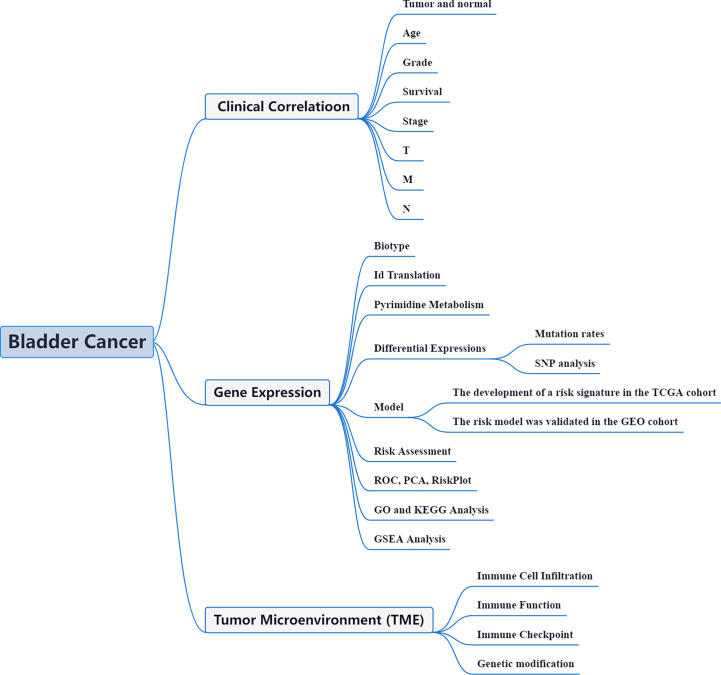
Predictive PyMGs were quantified in BLCA samples from the TCGA and GEO datasets. TCGA and GEO provided information on stemness indices (mRNAsi), gene mutations, CNV, TMB, and corresponding clinical features. The prediction model was built using Lasso regression. Co-expression analysis was conducted to investigate the relationship between gene expression and PyM.
PyMGs were overexpressed in the high-risk sample in the absence of other clinical symptoms, demonstrating their predictive potential for BLCA outcome. Immunological and tumor-related pathways were identified in the high-risk group by GSWA. Immune function and m6a gene expression varied significantly between the risk groups. In BLCA patients, DSG1, C6orf15, SOST, SPRR2A, SERPINB7, MYBPH, and KRT1 may participate in the oncology process. Immunological function and m6a gene expression differed significantly between the two groups. The prognostic model, CNVs, single nucleotide polymorphism (SNP), and drug sensitivity all showed significant gene connections.
BLCA-associated PyMGs are available to provide guidance in the prognostic and immunological setting and give evidence for the formulation of PyM-related molecularly targeted treatments. PyMGs and their interactions with immune cells in BLCA may serve as therapeutic targets.
膀胱癌(BLCA)是一种常见的泌尿系统恶性肿瘤,在全球范围内具有较高的发病率和死亡率。非肌层浸润性膀胱癌占所有膀胱癌病例的75%以上。肿瘤代谢途径的失衡与肿瘤的形成和增殖有关。嘧啶代谢(PyM)是一个复杂的酶网络,包括核苷补救、核苷酸合成和催化嘧啶降解。代谢重编程与几种癌症的临床预后相关。然而,嘧啶代谢基因(PyMGs)在对抗膀胱癌过程中的作用仍知之甚少。
在来自TCGA和GEO数据集的膀胱癌样本中对预测性PyMGs进行定量。TCGA和GEO提供了干性指数(mRNAsi)、基因突变、拷贝数变异(CNV)、肿瘤突变负荷(TMB)以及相应临床特征的信息。使用套索回归建立预测模型。进行共表达分析以研究基因表达与嘧啶代谢之间的关系。
在没有其他临床症状的高危样本中,PyMGs过度表达,表明它们对膀胱癌预后具有预测潜力。通过基因集变异分析(GSWA)在高危组中鉴定出免疫和肿瘤相关途径。免疫功能和m6A基因表达在不同风险组之间有显著差异。在膀胱癌患者中,桥粒芯糖蛋白1(DSG1)、6号染色体开放阅读框15(C6orf15)、硬化蛋白(SOST)、丝聚蛋白2A(SPRR2A)、丝氨酸蛋白酶抑制剂B7(SERPINB7)、肌球蛋白结合蛋白H(MYBPH)和角蛋白1(KRT1)可能参与肿瘤发生过程。两组之间免疫功能和m6A基因表达有显著差异。预后模型、CNV、单核苷酸多态性(SNP)和药物敏感性均显示出显著的基因关联。
与膀胱癌相关的PyMGs可在预后和免疫方面提供指导,并为制定与嘧啶代谢相关的分子靶向治疗提供依据。PyMGs及其在膀胱癌中与免疫细胞的相互作用可能成为治疗靶点。