Chokshi Aditi, Demory Beckler Michelle, Laloo Anita, Kesselman Marc M
Dermatology, Nova Southeastern University Dr. Kiran C. Patel College of Osteopathic Medicine, Davie, USA.
Microbiology and Immunology, Nova Southeastern University Dr. Kiran C. Patel College of Allopathic Medicine, Davie, USA.
Cureus. 2023 Aug 1;15(8):e42791. doi: 10.7759/cureus.42791. eCollection 2023 Aug.
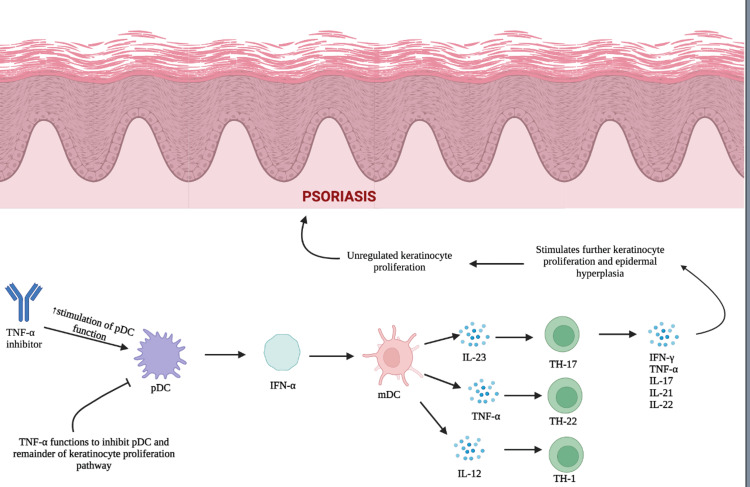
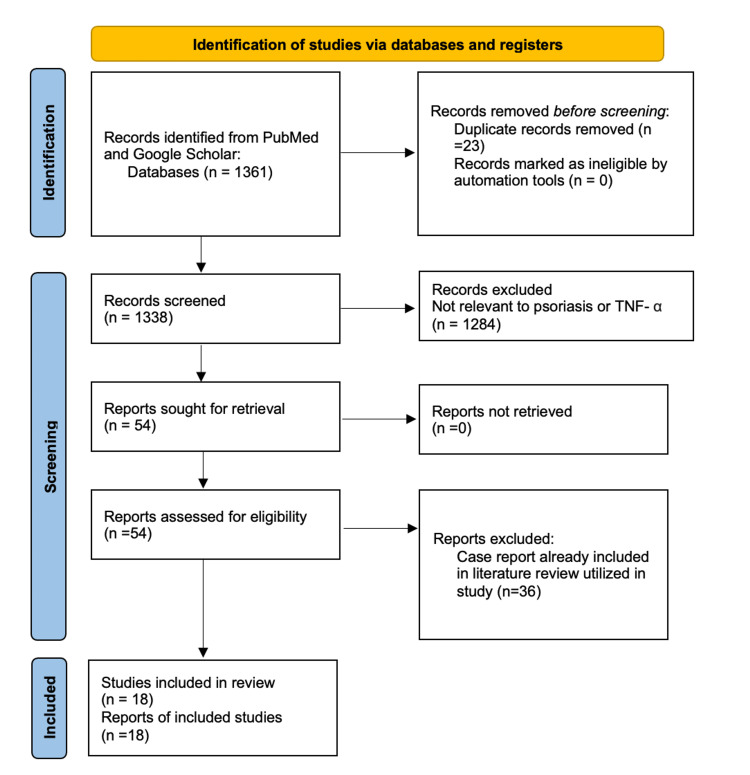
Tumor necrosis factor-alpha (TNF-α) inhibitors have been shown to be well tolerated among patients with rheumatoid arthritis, inflammatory bowel disease, and psoriasis. Meanwhile, more recently, clinical practice and research efforts have uncovered increasing cases of psoriatic lesion development tied to initiating treatment with a TNF-α inhibitor. The underlying mechanisms associated with this occurrence have yet to be fully elucidated. A review and analysis of cases of paradoxical psoriasis currently published in the literature is warranted. In addition, exploring possible mechanisms of action and potential treatment options associated with favorable outcomes is much needed. A systematic literature review was performed utilizing PubMed and Google Scholar databases (1992-present), in which 106 cases of paradoxical psoriasis were reviewed. The most common morphology developed was plaque psoriasis vulgaris. There was a female predominance (61.3%), and the most common underlying autoimmune disease was rheumatoid arthritis (45.3%). In addition, the most commonly associated drug with the onset of psoriatic lesions was infliximab (62.3%). Furthermore, the findings suggest that the most well-supported mechanism of action involves the uncontrolled release of interferon-alpha (IFN-α) from plasmacytoid dendritic cells (pDCs) after TNF-α inhibition. While TNF-α inhibitors have been shown to have great benefits to patients with rheumatologic diseases, cases of paradoxical psoriasis demonstrate the importance of close monitoring of patients on TNF-α inhibitors to allow for early recognition, treatment, and potentially change to a different mechanism of action of the medication used to prevent further progression of the inflammatory lesions.
肿瘤坏死因子-α(TNF-α)抑制剂已被证明在类风湿性关节炎、炎症性肠病和银屑病患者中耐受性良好。与此同时,最近临床实践和研究发现,越来越多的银屑病皮损发生与开始使用TNF-α抑制剂治疗有关。与此现象相关的潜在机制尚未完全阐明。有必要对目前文献中发表的矛盾性银屑病病例进行综述和分析。此外,迫切需要探索与良好预后相关的可能作用机制和潜在治疗方案。利用PubMed和谷歌学术数据库(1992年至今)进行了系统的文献综述,其中回顾了106例矛盾性银屑病病例。最常见的形态是寻常型斑块状银屑病。女性占优势(61.3%),最常见的潜在自身免疫性疾病是类风湿性关节炎(45.3%)。此外,与银屑病皮损发作最常相关的药物是英夫利昔单抗(62.3%)。此外,研究结果表明,最有依据的作用机制涉及TNF-α抑制后浆细胞样树突状细胞(pDCs)中干扰素-α(IFN-α)的失控释放。虽然TNF-α抑制剂已被证明对风湿病患者有很大益处,但矛盾性银屑病病例表明,密切监测使用TNF-α抑制剂的患者非常重要,以便早期识别、治疗,并可能更换所用药物的作用机制,以防止炎症性病变进一步发展。