Division of Psychiatry, University College London, London, UK.
Key Laboratory of Public Health Safety, NHC Key Laboratory of Health Technology Assessment, School of Public Health, Fudan University, Shanghai, China.
BMC Psychiatry. 2023 Sep 4;23(1):652. doi: 10.1186/s12888-023-05069-0.
Loneliness and social isolation are increasingly recognised as prevalent among people with mental health problems, and as potential targets for interventions to improve quality of life and outcomes, as well as for preventive strategies. Understanding the relationship between quality and quantity of social relationships and a range of mental health conditions is a helpful step towards development of such interventions.
Our aim was to give an overview of associations between constructs related to social relationships (including loneliness and social isolation) and diagnosed mental conditions and mental health symptoms, as reported in systematic reviews of observational studies.
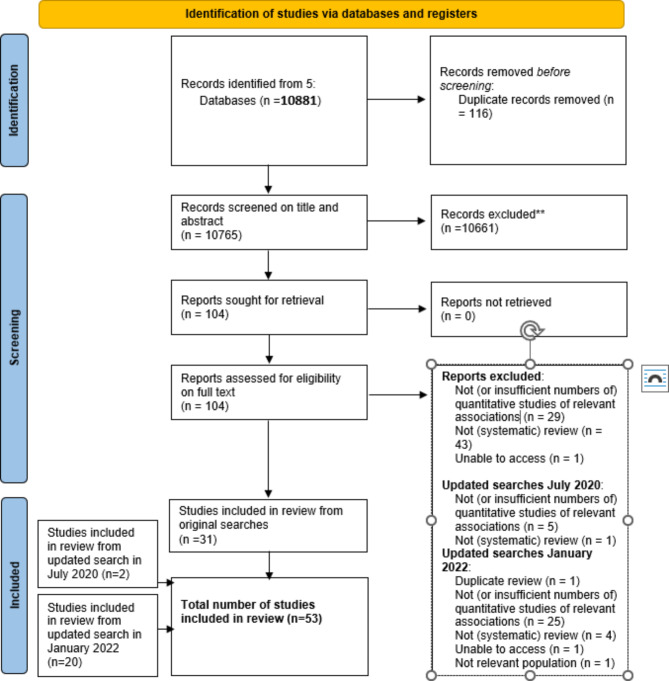
For this umbrella review (systematic review of systematic reviews) we searched five databases (PsycINFO, MEDLINE, EMBASE, CINAHL, Web of Science) and relevant online resources (PROSPERO, Campbell Collaboration, Joanna Briggs Institute Evidence Synthesis Journal). We included systematic reviews of studies of associations between constructs related to social relationships and mental health diagnoses or psychiatric symptom severity, in clinical or general population samples. We also included reviews of general population studies investigating the relationship between loneliness and risk of onset of mental health problems.
We identified 53 relevant systematic reviews, including them in a narrative synthesis. We found evidence regarding associations between (i) loneliness, social isolation, social support, social network size and composition, and individual-level social capital and (ii) diagnoses of mental health conditions and severity of various mental health symptoms. Depression (including post-natal) and psychosis were most often reported on, with few systematic reviews on eating disorders or post-traumatic stress disorder (PTSD), and only four related to anxiety. Social support was the most commonly included social construct. Our findings were limited by low quality of reviews and their inclusion of mainly cross-sectional evidence.
Good quality evidence is needed on a wider range of social constructs, on conditions other than depression, and on longitudinal relationships between social constructs and mental health symptoms and conditions.
孤独和社会隔离在心理健康问题人群中越来越普遍,被认为是提高生活质量和改善预后的潜在干预目标,也是预防策略的目标。了解社会关系的质量和数量与一系列心理健康状况之间的关系,有助于制定此类干预措施。
我们旨在综述观察性研究系统评价中报告的与社会关系(包括孤独和社会隔离)相关的结构与诊断精神状况和精神健康症状之间的关联。
本综述(系统评价的系统评价)检索了五个数据库(PsycINFO、MEDLINE、EMBASE、CINAHL、Web of Science)和相关在线资源(PROSPERO、坎贝尔协作、乔安娜布里格斯研究所循证综合杂志)。我们纳入了与社会关系结构与精神健康诊断或精神症状严重程度之间关联的研究系统评价,包括临床或一般人群样本。我们还纳入了调查孤独与精神健康问题发病风险之间关系的一般人群研究综述。
我们确定了 53 项相关的系统评价,对其进行了叙述性综合。我们发现了与以下方面相关的证据:(i)孤独、社会隔离、社会支持、社会网络规模和组成以及个人层面的社会资本,以及(ii)精神健康状况的诊断和各种精神健康症状的严重程度。抑郁(包括产后)和精神病最常被报道,饮食障碍或创伤后应激障碍(PTSD)的系统评价较少,只有四项与焦虑有关。社会支持是最常纳入的社会结构。我们的发现受到综述质量低以及纳入主要是横断面证据的限制。
需要针对更广泛的社会结构、除抑郁以外的其他状况以及社会结构与精神健康症状和状况之间的纵向关系,提供高质量的证据。