Department of Psychiatry College of Medicine and Health Science, University of Gondar, Gondar, Ethiopia.
Department of Epidemiology and Biostatics, Institute of Public Health College of Medicine and Health Sciences, University of Gondar, Gondar, Ethiopia.
PLoS One. 2021 Feb 19;16(2):e0247005. doi: 10.1371/journal.pone.0247005. eCollection 2021.
Globally, post-partum depression is a major public health problem and is associated with a harmful effect on the infant, child, and mothers' mental, physical, and social health. Although a few post-partum depression studies have been published, we still lack an accurate estimated pooled prevalence of national PPD and associated factors.
This study aims to show the estimated pooled prevalence of PPD and associated factors in Ethiopia.
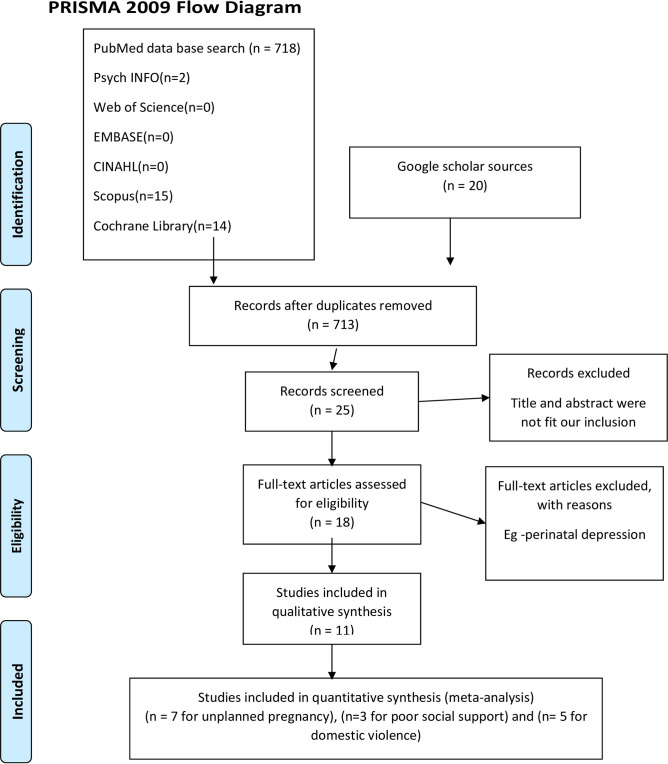
We conduct the extensive search of articles as indicated in the guideline (PRISMA), reporting systematic review and meta-analysis. Databases like MEDLINE, PubMed, psych INFO, Web of Science, EMBASE, CINAHL, Scopus, and The Cochrane Library. All publications and grey literature were addressed by using MeSH terms and keywords. The pooled estimated effect of post-partum depression and associated factors was analyzed using the random effect model meta-analysis, and 95% CI was also considered.
PROSPERO 2020 CRD42020176769 Available from https://www.crd.york.ac.uk/prospero/display_record.php?ID=CRD42020176769.
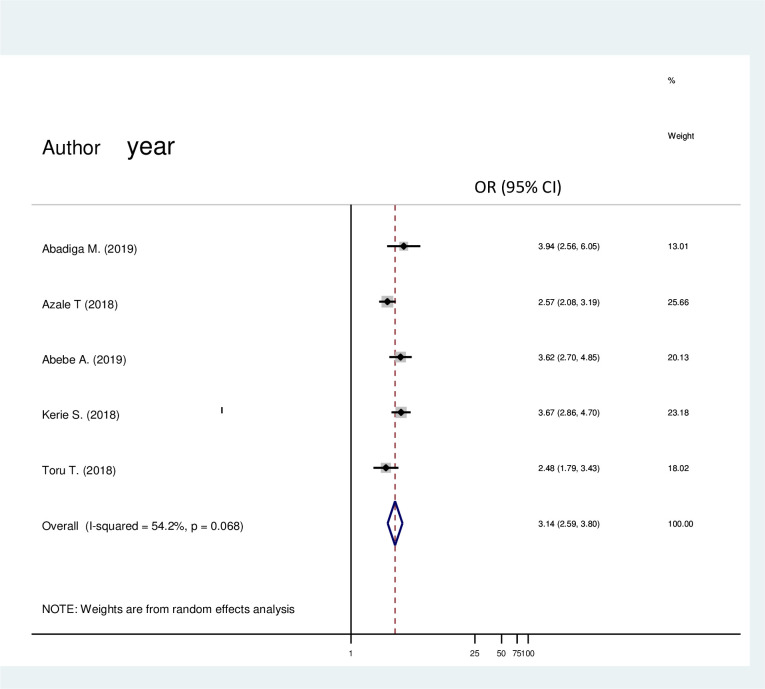
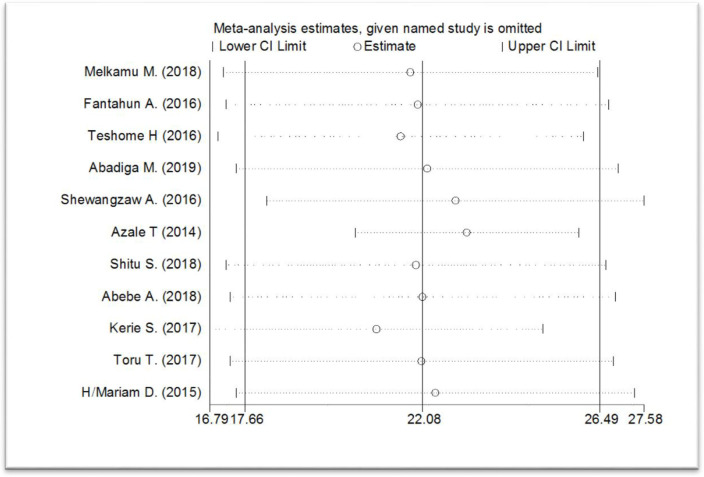
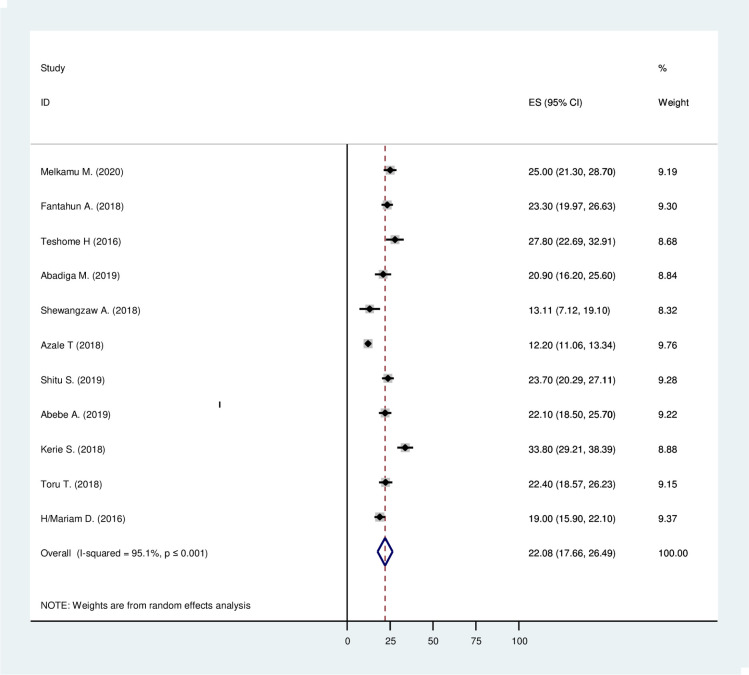
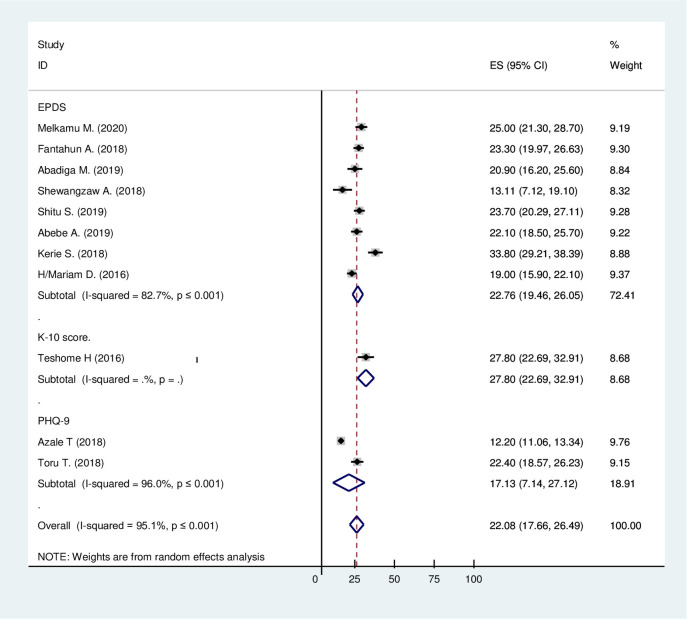
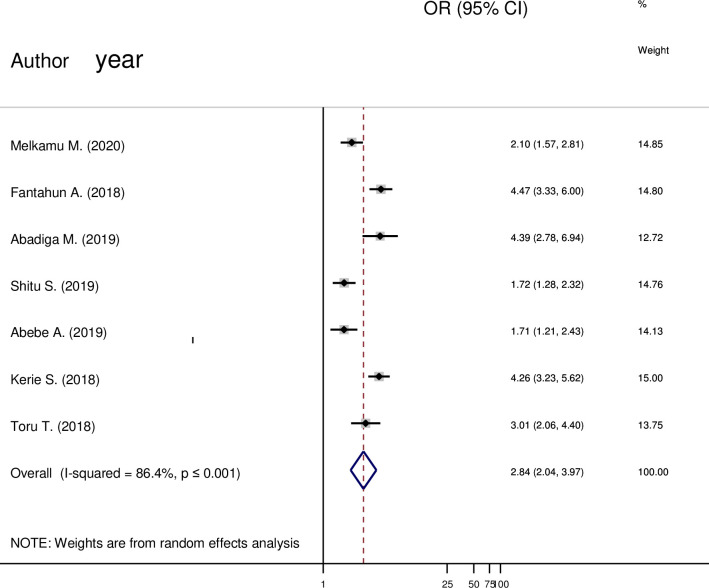
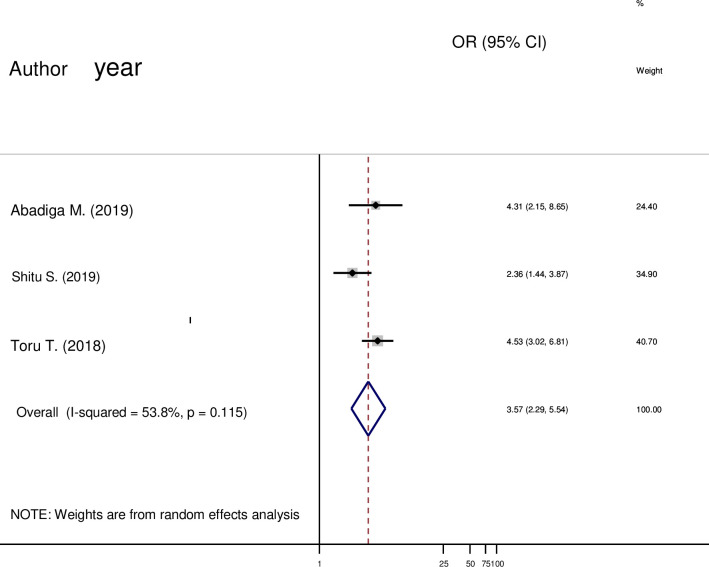
A total of 11 studies with 7,582 participants were included in this meta-analysis. The estimated pooled prevalence of post-partum depression (PPD) was 22.08%, with a 95% CI (17.66%, 26.49). For factors associated with post-partum depression, a random effect size model was used during meta-analysis; unplanned pregnancy [(OR = 2.84; 95% CI (2.04, 3.97)], domestic violence [OR = 3.14; 95% CI (2.59, 3.80)], and poor social support [OR = 3.57;95% CI (2.29,5.54) were positively associated factors with post-partum depression.
The estimated pooled prevalence of post-partum depression was high in Ethiopia. Unplanned pregnancy, poor social support, and domestic violence were factors affecting PPD. Therefore, the Ethiopian policymakers and health personnel better give more emphasis to mothers who had a history of unplanned pregnancy, domestic violence, and poor social support.
全球范围内,产后抑郁症是一个主要的公共卫生问题,对婴儿、儿童以及母亲的心理、生理和社会健康都有不良影响。尽管已经发表了一些产后抑郁症的研究,但我们仍然缺乏全国产后抑郁症的准确患病率及其相关因素的综合估计。
本研究旨在展示埃塞俄比亚产后抑郁症的估计综合患病率及其相关因素。
我们按照指南(PRISMA)进行了广泛的文献检索,报告了系统评价和荟萃分析。使用 MeSH 术语和关键词检索了 MEDLINE、PubMed、心理信息、Web of Science、EMBASE、CINAHL、Scopus 和 Cochrane 图书馆等数据库。通过使用 MeSH 术语和关键词,解决了所有出版物和灰色文献。使用随机效应模型荟萃分析分析了产后抑郁症及其相关因素的综合估计效应,并考虑了 95%置信区间(CI)。
PROSPERO 2020 CRD42020176769 可从 https://www.crd.york.ac.uk/prospero/display_record.php?ID=CRD42020176769 获得。
共有 11 项研究纳入了本荟萃分析,涉及 7582 名参与者。产后抑郁症(PPD)的估计综合患病率为 22.08%,95%CI(17.66%,26.49%)。对于与产后抑郁症相关的因素,荟萃分析中使用了随机效应模型;无计划妊娠[比值比(OR)=2.84;95%CI(2.04,3.97)]、家庭暴力[OR=3.14;95%CI(2.59,3.80)]和较差的社会支持[OR=3.57;95%CI(2.29,5.54)]是与产后抑郁症相关的正向因素。
埃塞俄比亚产后抑郁症的估计综合患病率较高。无计划妊娠、较差的社会支持和家庭暴力是影响 PPD 的因素。因此,埃塞俄比亚政策制定者和卫生人员应更加关注有意外妊娠、家庭暴力和较差社会支持史的母亲。