Laboratory of Translational Neuropharmacology, Department of Clinical Neuroscience, Karolinska Institutet, Stockholm, Sweden.
Old Age Psychiatry, Institute of Psychiatry, Psychology and Neuroscience, King's College London, London, UK.
Transl Neurodegener. 2023 Sep 4;12(1):42. doi: 10.1186/s40035-023-00374-w.
There is a need for biomarkers to support an accurate diagnosis of Parkinson's disease (PD). Cerebrospinal fluid (CSF) has been a successful biofluid for finding neurodegenerative biomarkers, and modern highly sensitive multiplexing methods offer the possibility to perform discovery studies. Using a large-scale multiplex proximity extension assay (PEA) approach, we aimed to discover novel diagnostic protein biomarkers allowing accurate discrimination of PD from both controls and atypical Parkinsonian disorders (APD).
CSF from patients with PD, corticobasal syndrome (CBS), progressive supranuclear palsy (PSP), multiple system atrophy and controls, were analysed with Olink PEA panels. Three cohorts were used in this study, comprising 192, 88 and 36 cases, respectively. All samples were run on the Cardiovascular II, Oncology II and Metabolism PEA panels.
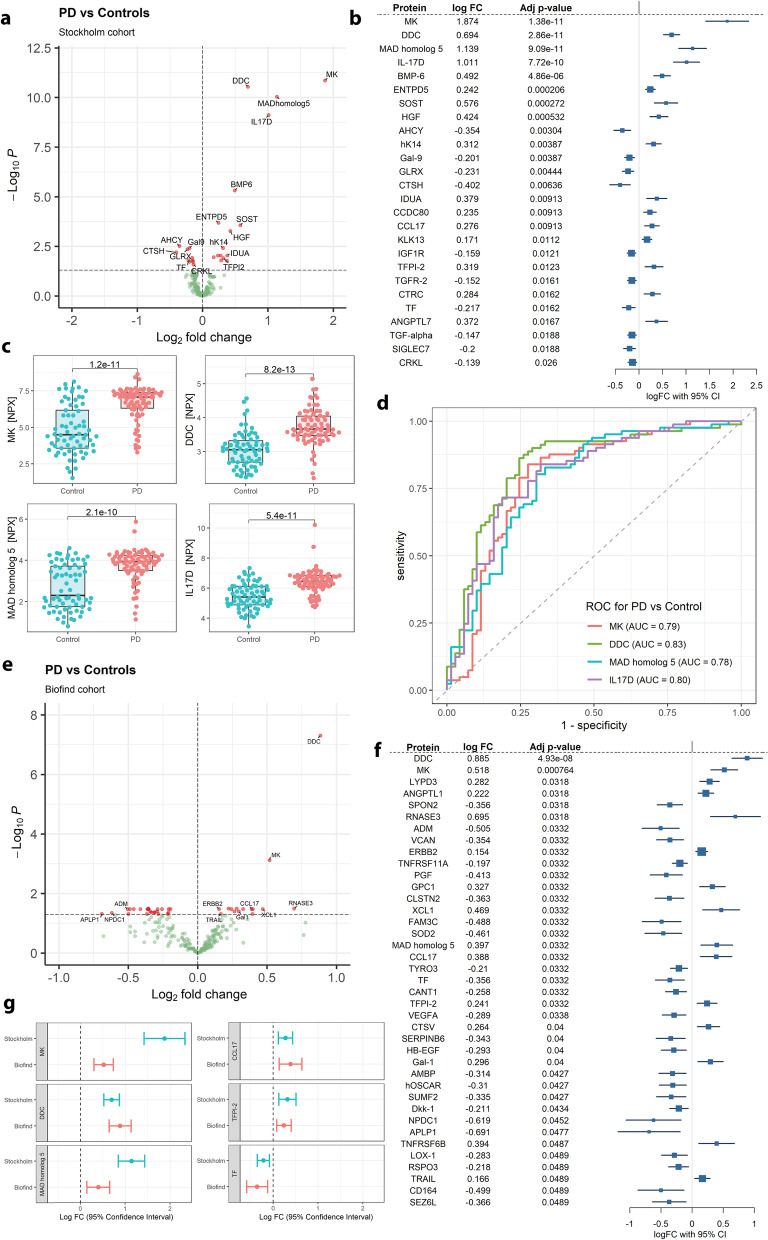
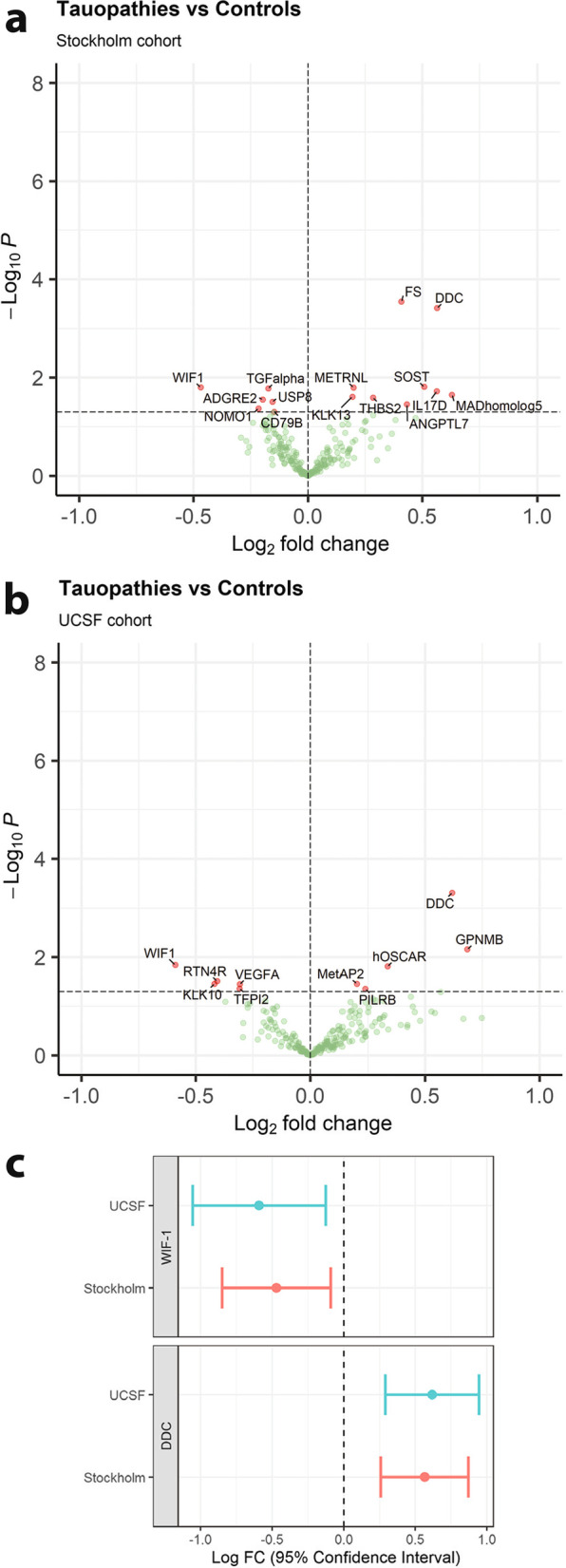
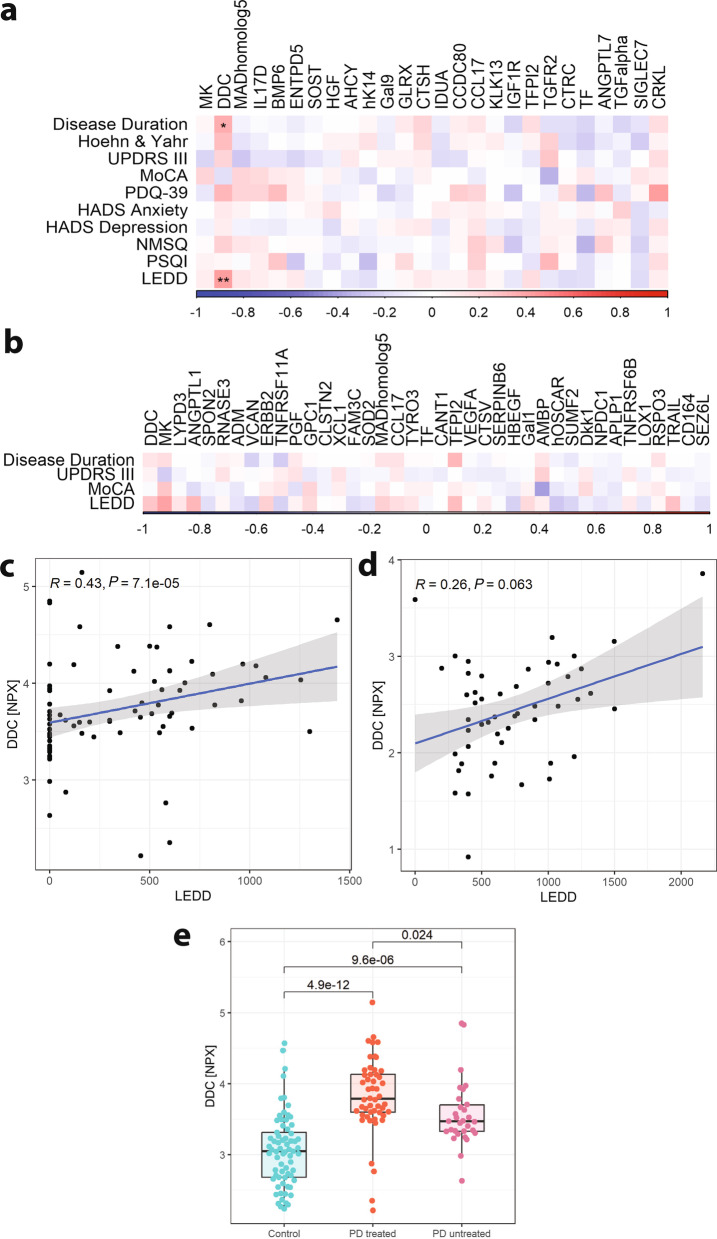
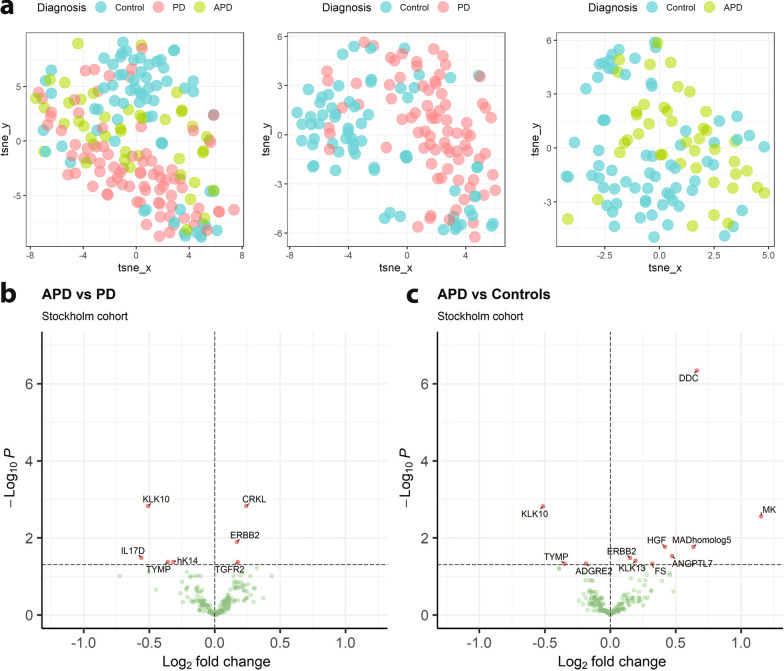
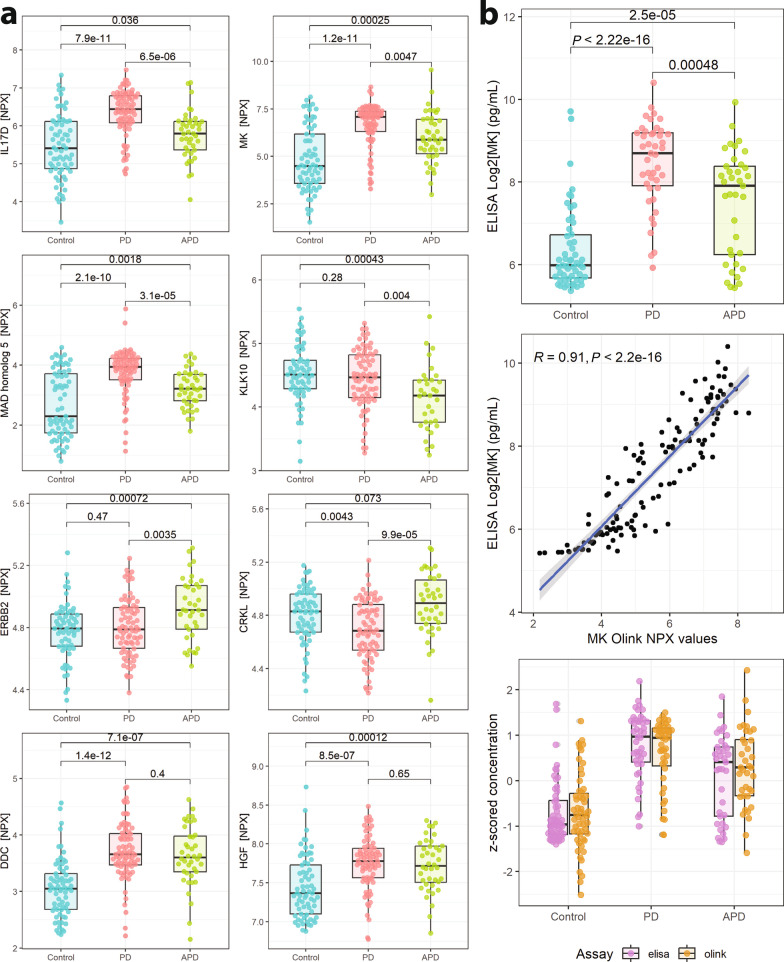
Our analysis revealed that 26 and 39 proteins were differentially expressed in the CSF of test and validation PD cohorts, respectively, compared to controls. Among them, 6 proteins were changed in both cohorts. Midkine (MK) was increased in PD with the strongest effect size and results were validated with ELISA. Another most increased protein in PD, DOPA decarboxylase (DDC), which catalyses the decarboxylation of DOPA (L-3,4-dihydroxyphenylalanine) to dopamine, was strongly correlated with dopaminergic treatment. Moreover, Kallikrein 10 was specifically changed in APD compared with both PD and controls, but unchanged between PD and controls. Wnt inhibitory factor 1 was consistently downregulated in CBS and PSP patients in two independent cohorts.
Using the large-scale PEA approach, we have identified potential novel PD diagnostic biomarkers, most notably MK and DDC, in the CSF of PD patients.
需要生物标志物来支持帕金森病 (PD) 的准确诊断。脑脊液 (CSF) 一直是发现神经退行性生物标志物的成功生物流体,而现代高灵敏度的多重分析方法提供了进行发现研究的可能性。使用大规模的多重邻近延伸分析 (PEA) 方法,我们旨在发现新的诊断蛋白生物标志物,以便能够准确区分 PD 与对照组和非典型帕金森病 (APD)。
使用 Olink PEA 试剂盒分析 PD、皮质基底节综合征 (CBS)、进行性核上性麻痹 (PSP)、多系统萎缩和对照组患者的 CSF。本研究使用了三个队列,分别包含 192、88 和 36 例病例。所有样本均在心血管 II、肿瘤学 II 和代谢 PEA 试剂盒上运行。
与对照组相比,我们的分析显示,在测试和验证 PD 队列的 CSF 中,分别有 26 和 39 种蛋白差异表达。其中,有 6 种蛋白在两个队列中都发生了改变。中期因子 (MK) 在 PD 中增加,其效应大小最强,并用 ELISA 进行了验证。另一种在 PD 中增加最多的蛋白,多巴脱羧酶 (DDC),它催化 DOPA (L-3,4-二羟基苯丙氨酸) 的脱羧作用生成多巴胺,与多巴胺治疗有很强的相关性。此外,激肽释放酶 10 仅在 APD 中与 PD 和对照组相比发生改变,而在 PD 和对照组之间没有改变。在两个独立的队列中,激肽释放酶 10 在 CBS 和 PSP 患者中均持续下调。
使用大规模 PEA 方法,我们在 PD 患者的 CSF 中鉴定出了潜在的新型 PD 诊断生物标志物,尤其是 MK 和 DDC。