Perioperative and Critical Care Research Group, Southampton NIHR Biomedical Research Centre, University Hospital Southampton NHS Foundation Trust, Southampton SO16 6YD, UK.
Clinical and Experimental Sciences, Faculty of Medicine, University of Southampton, Southampton, SO16 6YD, UK.
Open Biol. 2023 Sep;13(9):230151. doi: 10.1098/rsob.230151. Epub 2023 Sep 6.
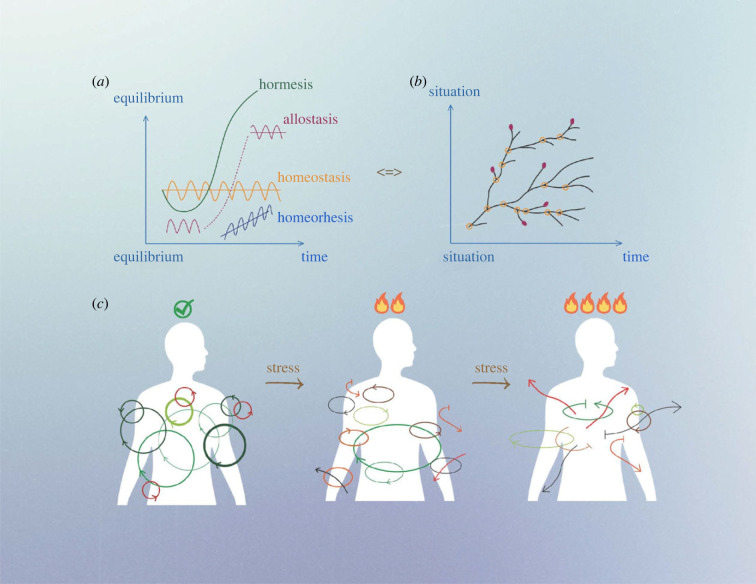
Diurnal and seasonal rhythmicity, entrained by environmental and nutritional cues, is a vital part of all life on Earth operating at every level of organization; from individual cells, to multicellular organisms, whole ecosystems and societies. Redox processes are intrinsic to physiological function and circadian regulation, but how they are integrated with other regulatory processes at the whole-body level is poorly understood. Circadian misalignment triggered by a major stressor (e.g. viral infection with SARS-CoV-2) or recurring stressors of lesser magnitude such as shift work elicit a complex stress response that leads to desynchronization of metabolic processes. This in turn challenges the system's ability to achieve redox balance due to alterations in metabolic fluxes (redox rewiring). We infer that the emerging 'alternative redox states' do not always revert readily to their evolved natural states; 'Long COVID' and other complex disorders of unknown aetiology are the clinical manifestations of such rearrangements. To better support and successfully manage bodily resilience to major stress and other redox challenges needs a clear perspective on the pattern of the hysteretic response for the interaction between the redox system and the circadian clock. Characterization of this system requires repeated (ideally continuous) recording of relevant clinical measures of the stress responses and whole-body redox state (temporal redox phenotyping). The human/animal body is a complex 'system of systems' with multi-level buffering capabilities, and it requires consideration of the wider dynamic context to identify a limited number of stress-markers suitable for routine clinical decision making. Systematically mapping the patterns and dynamics of redox biomarkers along the stressor/disease trajectory will provide an operational model of whole-body redox regulation/balance that can serve as basis for the identification of effective interventions which promote health by enhancing resilience.
昼夜节律和季节性节律受环境和营养线索的影响,是地球上所有生命的重要组成部分,在组织的各个层面上运作;从单个细胞到多细胞生物、整个生态系统和社会。氧化还原过程是生理功能和昼夜节律调节的内在组成部分,但它们如何与全身水平的其他调节过程整合在一起,人们知之甚少。由主要应激源(例如 SARS-CoV-2 病毒感染)或较小程度的反复应激源(例如轮班工作)引发的昼夜节律失调会引发复杂的应激反应,导致代谢过程不同步。这反过来又挑战了系统实现氧化还原平衡的能力,因为代谢通量发生了变化(氧化还原重布线)。我们推断,新兴的“替代氧化还原状态”并不总是容易恢复到其进化的自然状态;“长新冠”和其他病因不明的复杂疾病就是这种重排的临床表现。要更好地支持和成功管理身体对重大压力和其他氧化还原挑战的弹性,需要清楚了解氧化还原系统与昼夜节律钟相互作用的滞后响应模式。该系统的特征在于反复(理想情况下是连续)记录应激反应和全身氧化还原状态的相关临床测量(时间氧化还原表型)。人体/动物是一个具有多层次缓冲能力的复杂“系统的系统”,需要考虑更广泛的动态环境,以确定适合常规临床决策的少数应激标志物。系统地绘制沿着应激源/疾病轨迹的氧化还原生物标志物的模式和动态将提供全身氧化还原调节/平衡的操作模型,可作为识别有效干预措施的基础,这些干预措施通过增强弹性来促进健康。