Albarus Ivonne, Fleischmann Giorgia, Aigner Patrick, Ciais Philippe, Denier van der Gon Hugo, Droge Rianne, Lian Jinghui, Narvaez Rincon Miguel Andrey, Utard Hervé, Lauvaux Thomas
Laboratoire des Sciences du Climat et de l'Environnement (LSCE), IPSL, CEA-CNRS-UVSQ, Université Paris-Saclay, 91191, Gif sur Yvette Cedex, France.
Origins.earth, Suez Group, 92040, Paris La Défense, France.
Carbon Balance Manag. 2023 Sep 6;18(1):18. doi: 10.1186/s13021-023-00236-y.
Urban agglomerates play a crucial role in reaching global climate objectives. Many cities have committed to reducing their greenhouse gas emissions, but current emission trends remain unverifiable. Atmospheric monitoring of greenhouse gases offers an independent and transparent strategy to measure urban emissions. However, careful design of the monitoring network is crucial to be able to monitor the most important sectors as well as adjust to rapidly changing urban landscapes.
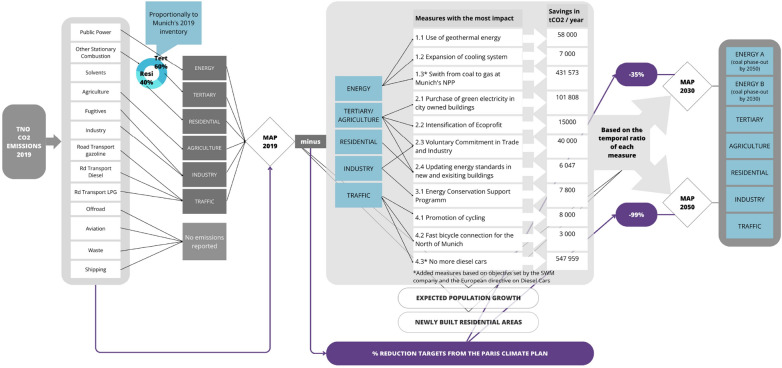
Our study of Paris and Munich demonstrates how climate action plans, carbon emission inventories, and urban development plans can help design optimal atmospheric monitoring networks. We show that these two European cities display widely different trajectories in space and time, reflecting different emission reduction strategies and constraints due to administrative boundaries. The projected carbon emissions rely on future actions, hence uncertain, and we demonstrate how emission reductions vary significantly at the sub-city level.
We conclude that quantified individual cities' climate actions are essential to construct more robust emissions trajectories at the city scale. Also, harmonization and compatibility of plans from various cities are necessary to make inter-comparisons of city climate targets possible. Furthermore, dense atmospheric networks extending beyond the city limits are needed to track emission trends over the coming decades.
城市群在实现全球气候目标方面发挥着关键作用。许多城市已承诺减少其温室气体排放,但目前的排放趋势仍无法核实。对温室气体进行大气监测提供了一种独立且透明的策略来测量城市排放。然而,精心设计监测网络对于能够监测最重要的部门以及适应快速变化的城市景观至关重要。
我们对巴黎和慕尼黑的研究展示了气候行动计划、碳排放清单和城市发展规划如何有助于设计最佳的大气监测网络。我们表明,这两个欧洲城市在空间和时间上呈现出截然不同的轨迹,反映了由于行政边界导致的不同减排策略和限制。预计的碳排放依赖于未来的行动,因此具有不确定性,并且我们证明了减排在城市次区域层面差异显著。
我们得出结论,量化各个城市的气候行动对于在城市尺度构建更稳健的排放轨迹至关重要。此外,各城市规划的协调与兼容对于进行城市气候目标的相互比较是必要的。此外,需要延伸至城市边界之外的密集大气网络来追踪未来几十年的排放趋势。