Jiangsu Key Laboratory of Molecular Biology for Skin Diseases and STIs, Institute of Dermatology, Chinese Academy of Medical Sciences & Peking Union Medical College, Nanjing, 210042, China.
Key Laboratory of Basic and Translational Research on Immune-Mediated Skin diseases, Institute of Dermatology, Chinese Academy of Medical Sciences & Peking Union Medical College, Nanjing, 210042, China.
Cell Death Dis. 2023 Sep 7;14(9):595. doi: 10.1038/s41419-023-06094-3.
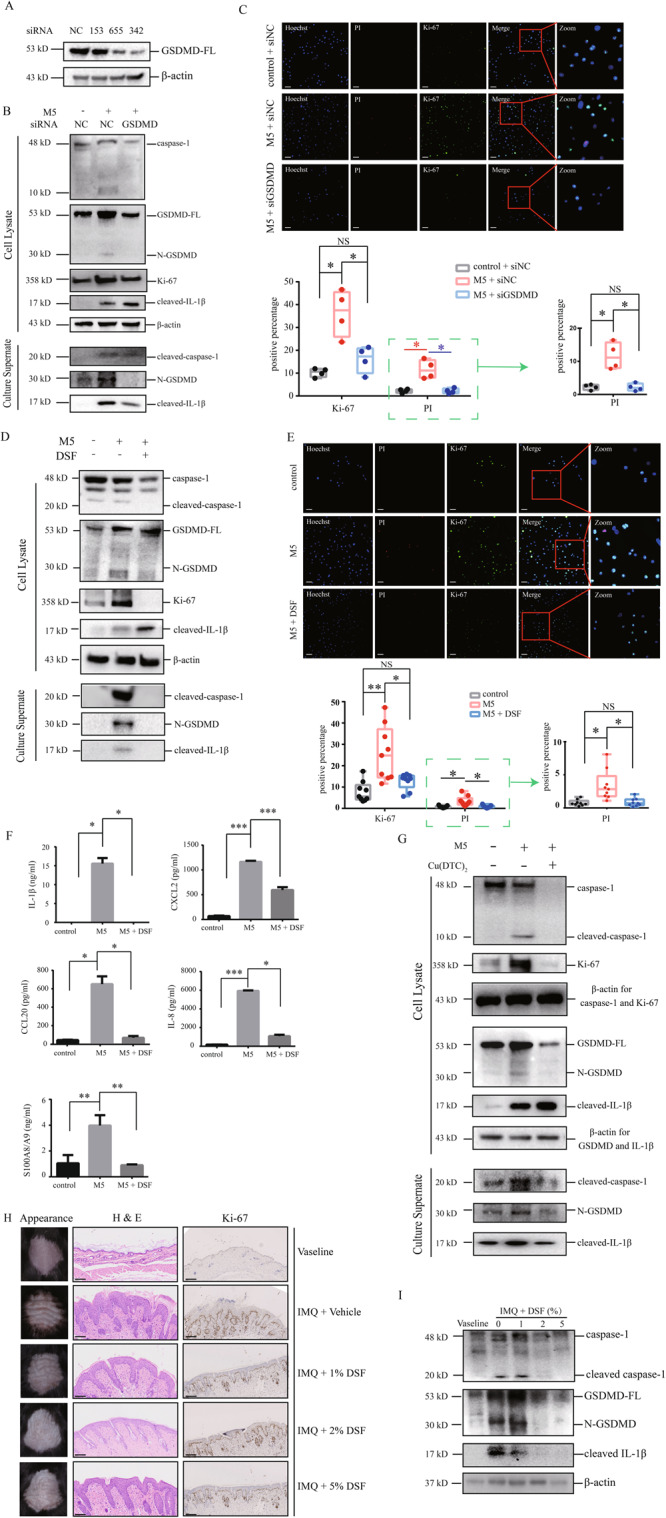
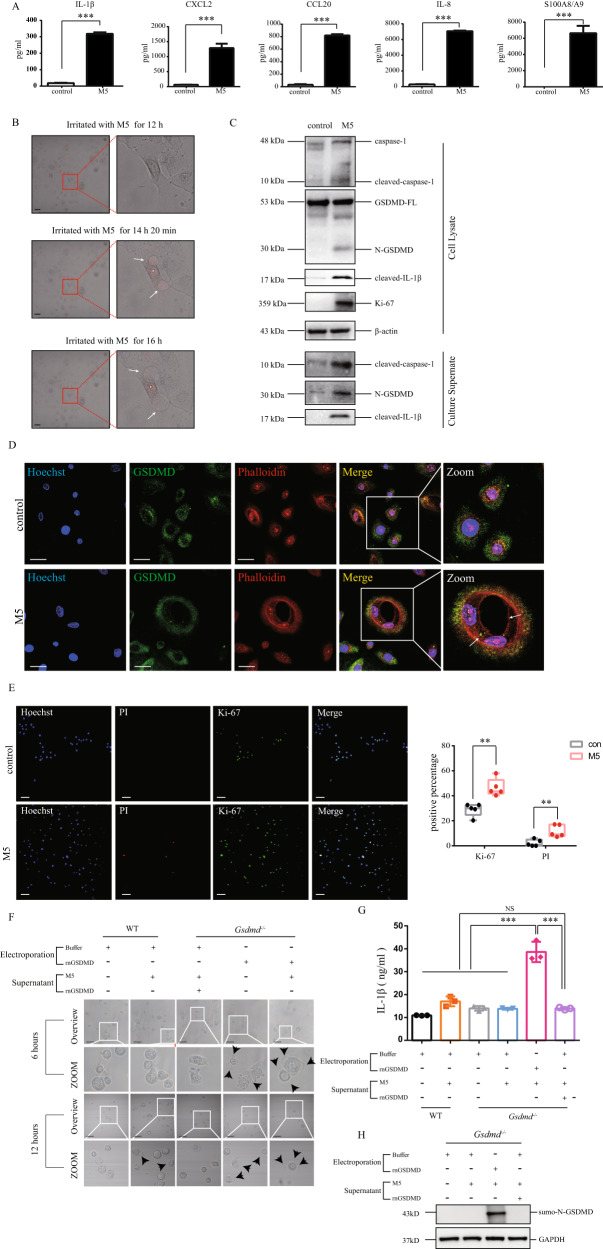
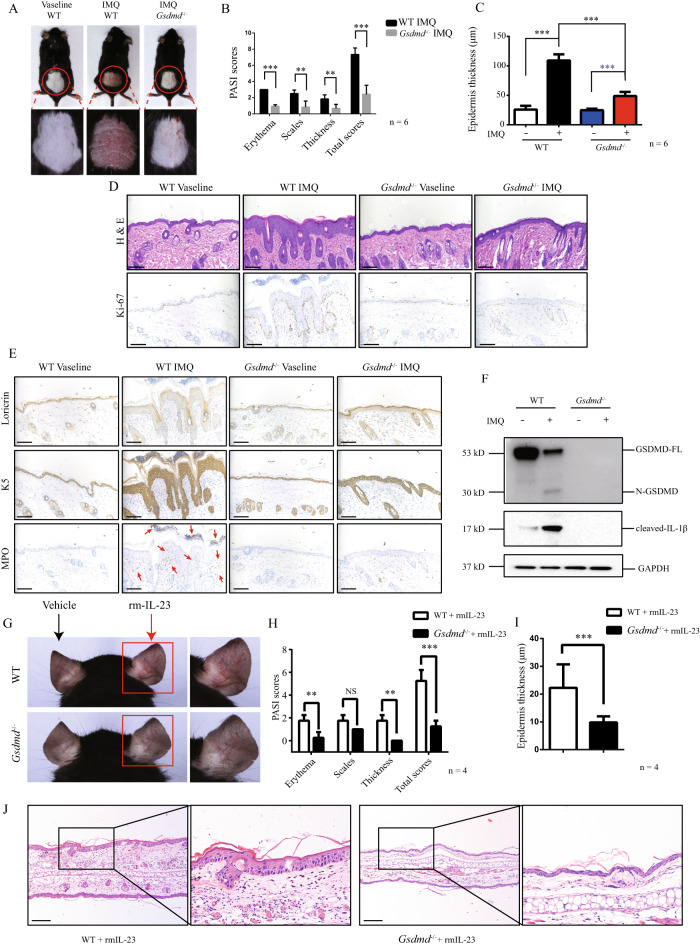
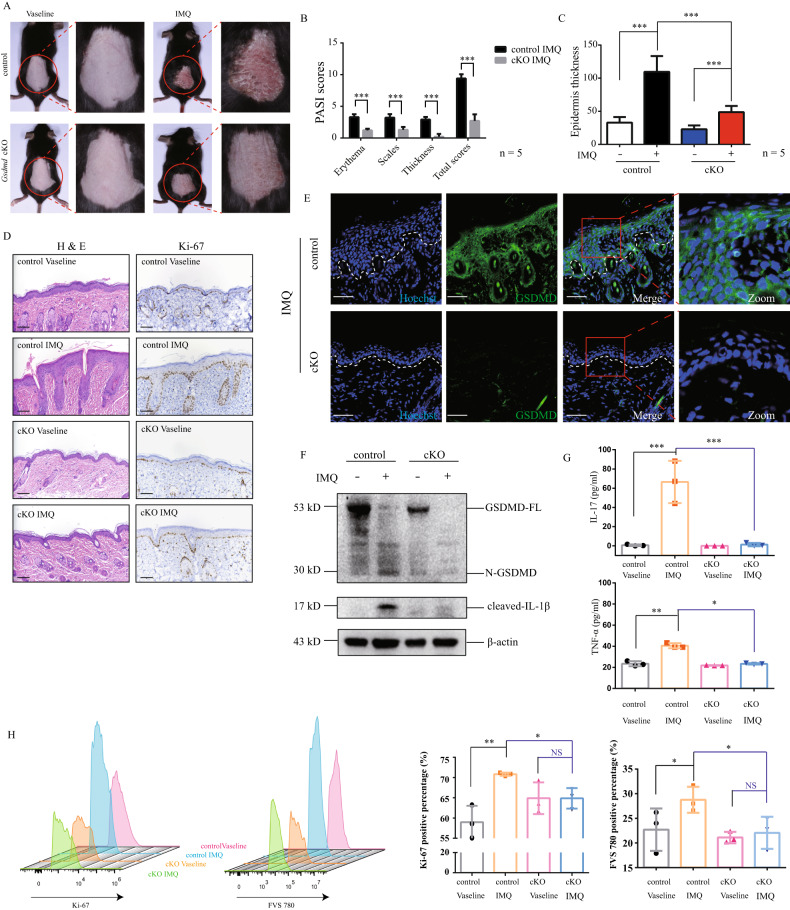
Gasdermin D (GSDMD)-mediated pyroptosis has a significant pro-inflammation characteristic due to dramatic secretion of pro-inflammatory substances. However, its role remains unclear in psoriasis as one chronic inflammatory skin disorder with high prevalence. We found that N-terminal GSDMD (N-GSDMD) was aberrantly expressed in epidermis of skin lesion in psoriasis patients and imiquimod-induced psoriasis-like dermatitis (IIPLD) mice. In epidermis of IIPLD mice and M5 (simulating psoriatic inflammatory challenge)-treated keratinocytes cultured in vitro, cleavage products of caspase-1, GSDMD and IL-1β were increased. M5-stimulated keratinocyte presented typical pyroptosis morphology accompanied with PI-staining. Gsdmd keratinocytes could not present pyroptosis morphology while stimulated with M5. Electroporation of recombinant N-GSDMD could make the pyroptosis morphology reappear. In Gsdmd mice or keratinocyte-specific Gsdmd conditional knockout mice, we observed the alleviation of psoriatic inflammation and epidermal aberrant expression of Ki-67 and differentiation markers (loricrin and keratin 5) after imiquimod stimulation. Transplanting skin tissue from control mice to Gsdmd mice can evoke the response to imiquimod stimulation in the background of Gsdmd mice (not limited in transplanting area). In M5-stimulated keratinocytes, disulfiram or GSDMD siRNA transfection can inhibit pyroptosis and eliminate disproportionate increases of Ki-67 and PI. We further validated that topically application of disulfiram (pyroptosis inhibitor) also alleviated IIPLD in mice. These findings indicate a novel mechanism that GSDMD-mediated keratinocyte pyroptosis facilitates hyperproliferation and aberrant differentiation induced by immune microenvironment in psoriatic skin inflammation, which contributes to pathogenesis of psoriasis. Our study provides an innovative insight that targeting pyroptosis can be considered as a therapeutic strategy against psoriasis.
Gasdermin D (GSDMD)-介导的细胞焦亡因其剧烈分泌促炎物质而具有显著的促炎特征。然而,在一种慢性炎症性皮肤病——银屑病中,其作用尚不清楚。我们发现,银屑病患者皮损表皮和咪喹莫特诱导的银屑病样皮炎(IIPLD)小鼠表皮中存在异常表达的 N 端 GSDMD(N-GSDMD)。在 IIPLD 小鼠表皮和体外 M5(模拟银屑病炎症刺激)处理的角质形成细胞中,caspase-1、GSDMD 和 IL-1β的裂解产物增加。M5 刺激的角质形成细胞呈现典型的细胞焦亡形态,并伴有 PI 染色。而在 M5 刺激下,Gsdmd 角质形成细胞不能呈现细胞焦亡形态。电穿孔转染重组 N-GSDMD 可使细胞焦亡形态重新出现。在 Gsdmd 小鼠或角质形成细胞特异性 Gsdmd 条件性敲除小鼠中,我们观察到在咪喹莫特刺激后,银屑病炎症减轻,Ki-67 和分化标志物(loricrin 和角蛋白 5)在表皮中的异常表达减轻。将来自对照小鼠的皮肤组织移植到 Gsdmd 小鼠中,可以在 Gsdmd 小鼠的背景下引发对咪喹莫特刺激的反应(不限于移植区域)。在 M5 刺激的角质形成细胞中,使用二硫化四乙基秋兰姆或 GSDMD siRNA 转染可以抑制细胞焦亡,并消除 Ki-67 和 PI 的不成比例增加。我们进一步验证了局部应用二硫化四乙基秋兰姆(细胞焦亡抑制剂)也可以减轻小鼠的 IIPLD。这些发现表明,GSDMD 介导的角质形成细胞细胞焦亡促进了银屑病皮肤炎症中免疫微环境诱导的过度增殖和异常分化,这有助于银屑病的发病机制。我们的研究提供了一个新的见解,即靶向细胞焦亡可以作为治疗银屑病的一种策略。