Department of Environmental & Molecular Toxicology, Oregon State University, Corvallis, OR, USA.
Pacific Northwest Center for Translational Environmental Health Research, Oregon State University, Corvallis, OR, USA.
BMC Public Health. 2023 Sep 6;23(1):1732. doi: 10.1186/s12889-023-16661-0.
As exposure assessment has shifted towards community-engaged research there has been an increasing trend towards reporting results to participants. Reports aim to increase environmental health literacy, but this can be challenging due to the many unknowns regarding chemical exposure and human health effects. This includes when reports encompass a wide-range of chemicals, limited reference or health standards exist for those chemicals, and/or incompatibility of data generated from exposure assessment tools with published reference values (e.g., comparing a wristband concentration to an oral reference dose).
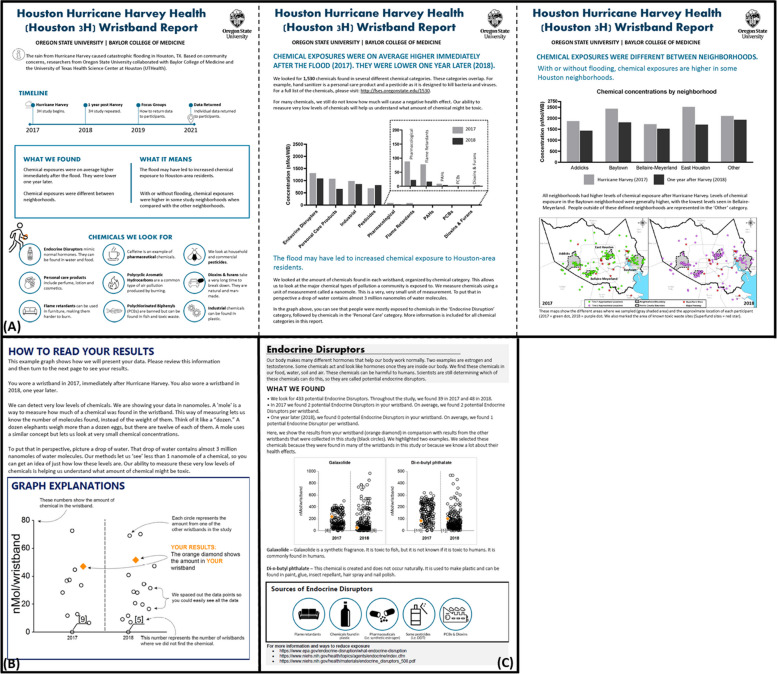
Houston Hurricane Harvey Health (Houston-3H) participants wore silicone wristbands that were analyzed for 1,530 organic compounds at two time-points surrounding Hurricane Harvey. Three focus groups were conducted in separate neighborhoods in the Houston metropolitan area to evaluate response to prototype community and individual level report-backs. Participants (n = 31) evaluated prototype drafts using Likert scales and discussion prompts. Focus groups were audio-recorded, and transcripts were analyzed using a qualitative data analysis program for common themes, and quantitative data (ranking, Likert scales) were statistically analyzed.
Four main themes emerged from analysis of the transcripts: (1) views on the report layout; (2) expression of concern over how chemicals might impact their individual or community health; (3) participants emotional response towards the researchers; and (4) participants ability to comprehend and evaluate environmental health information. Evaluation of the report and key concerns differed across the three focus groups. However, there was agreement amongst the focus groups about the desire to obtain personal exposure results despite the uncertainty of what the participant results meant.
The report-back of research results (RBRR) for community and individual level exposure assessment data should keep the following key principles in mind: materials should be accessible (language level, data visualization options, graph literacy), identify known information vs unknown (e.g., provide context for what exposure assessment data means, acknowledge lack of current health standards or guidelines), recognize and respect community knowledge and history, and set participant expectations for what they can expect from the report.
随着暴露评估向社区参与式研究转移,越来越倾向于向参与者报告结果。报告旨在提高环境健康素养,但由于化学暴露和人类健康影响方面存在许多未知因素,这可能具有挑战性。这包括报告涵盖广泛的化学物质、对于这些化学物质存在有限的参考或健康标准、以及暴露评估工具生成的数据与已发表的参考值不兼容(例如,将腕带浓度与口服参考剂量进行比较)等情况。
休斯顿飓风哈维健康(休斯顿-3H)参与者佩戴了硅树脂腕带,在哈维飓风前后两个时间点对其进行了 1530 种有机化合物的分析。在休斯顿大都市区的三个不同社区分别进行了三次焦点小组讨论,以评估针对社区和个人层面报告反馈的原型的反应。参与者(n=31)使用李克特量表和讨论提示对原型草案进行了评估。对焦点小组进行了录音,并使用定性数据分析程序对转录本进行了分析,以确定常见主题和量化数据(排名、李克特量表)的统计分析。
从对转录本的分析中得出了四个主要主题:(1)对报告布局的看法;(2)对化学物质可能如何影响个人或社区健康的关注表达;(3)参与者对研究人员的情绪反应;(4)参与者理解和评估环境健康信息的能力。三个焦点小组对报告和关键问题的评估有所不同。然而,三个焦点小组一致认为,尽管参与者结果的含义不确定,但希望获得个人暴露结果。
对于社区和个人层面暴露评估数据的研究结果报告反馈(RBRR),应牢记以下关键原则:材料应易于访问(语言水平、数据可视化选项、图表素养),确定已知信息与未知信息(例如,提供暴露评估数据含义的背景,承认缺乏当前的健康标准或准则),承认和尊重社区知识和历史,并为参与者设定对报告的期望。