• 文献检索
  • 文档翻译
  • 深度研究
  • 学术资讯
  • Suppr Zotero 插件Zotero 插件
  • 邀请有礼
  • 套餐&价格
  • 历史记录
应用&插件
Suppr Zotero 插件Zotero 插件浏览器插件Mac 客户端Windows 客户端微信小程序
定价
高级版会员购买积分包购买API积分包
服务
文献检索文档翻译深度研究API 文档MCP 服务
关于我们
关于 Suppr公司介绍联系我们用户协议隐私条款
关注我们

Suppr 超能文献

核心技术专利:CN118964589B侵权必究
粤ICP备2023148730 号-1Suppr @ 2026

文献检索

告别复杂PubMed语法,用中文像聊天一样搜索,搜遍4000万医学文献。AI智能推荐,让科研检索更轻松。

立即免费搜索

文件翻译

保留排版,准确专业,支持PDF/Word/PPT等文件格式,支持 12+语言互译。

免费翻译文档

深度研究

AI帮你快速写综述,25分钟生成高质量综述,智能提取关键信息,辅助科研写作。

立即免费体验

卤代海松烷类化合物与癌症:以卤代海松酸作为合成抗肿瘤药物的起始原料。

Halimanes and cancer: -halimic acid as a starting material for the synthesis of antitumor drugs.

作者信息

Roncero Alejandro M, Tobal Ignacio E, Moro Rosalina F, Diez David, Marcos Isidro S

机构信息

Departamento de Química Orgánica, Facultad de Ciencias Químicas, Universidad de Salamanca, Salamanca, Spain.

出版信息

Front Chem. 2023 Aug 22;11:1225355. doi: 10.3389/fchem.2023.1225355. eCollection 2023.

DOI:10.3389/fchem.2023.1225355
PMID:37674527
原文链接:https://pmc.ncbi.nlm.nih.gov/articles/PMC10477373/
Abstract

The development of new anti-cancer agents is an urgent necessity nowadays, as it is one of the major causes of mortality worldwide. Many drugs currently used are derived from natural products. Halimanes are a class of bicyclic diterpenoids present in various plants and microorganisms. Many of them exhibit biological activities such as antitumor, antimicrobial, or anti-inflammatory. Among them, -halimic acid is an easily accessible compound, in large quantities, from the ethyl acetate extract of the plant , and it has been used as a starting material in a number of bioactive molecules. In this work, we review all the natural halimanes with antitumor and related activities until date as well as the synthesis of antitumor compounds using -halimic acid as a starting material.

摘要

如今,开发新型抗癌药物迫在眉睫,因为癌症是全球主要的死亡原因之一。目前使用的许多药物都源自天然产物。海松烷是一类存在于各种植物和微生物中的双环二萜。它们中的许多具有抗肿瘤、抗菌或抗炎等生物活性。其中,α-海松酸是一种易于大量从植物的乙酸乙酯提取物中获得的化合物,它已被用作多种生物活性分子的起始原料。在这项工作中,我们综述了迄今为止所有具有抗肿瘤及相关活性的天然海松烷,以及以α-海松酸为起始原料合成抗肿瘤化合物的情况。
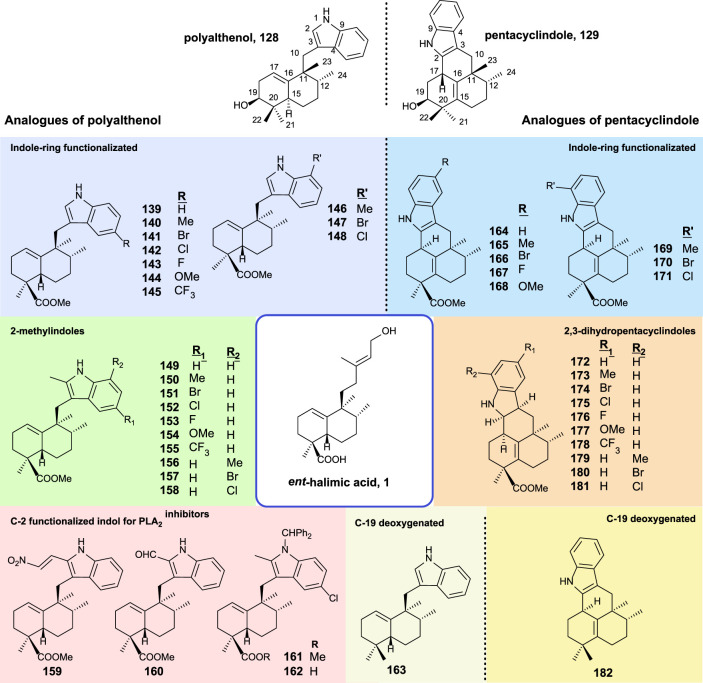
https://cdn.ncbi.nlm.nih.gov/pmc/blobs/5f80/10477373/43b024218211/fchem-11-1225355-g012.jpg
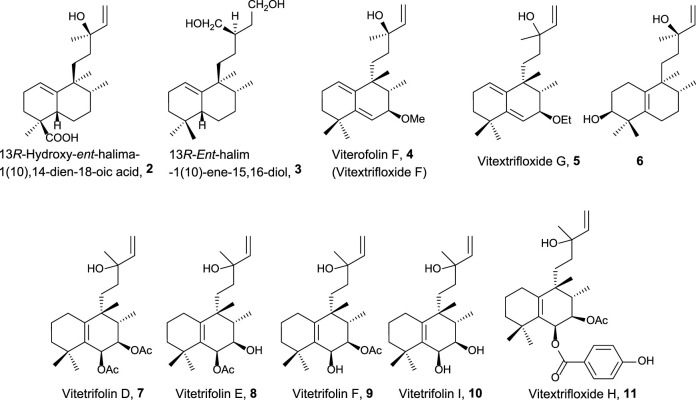
https://cdn.ncbi.nlm.nih.gov/pmc/blobs/5f80/10477373/411f54fae586/fchem-11-1225355-g001.jpg
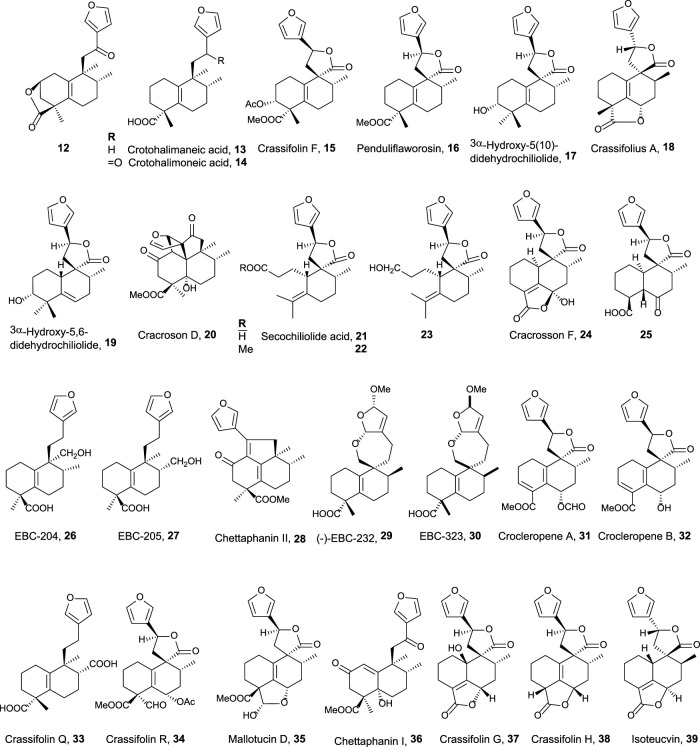
https://cdn.ncbi.nlm.nih.gov/pmc/blobs/5f80/10477373/3448984f4893/fchem-11-1225355-g002.jpg
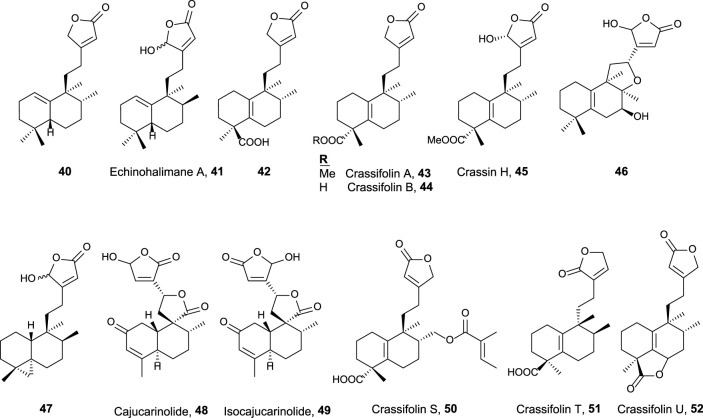
https://cdn.ncbi.nlm.nih.gov/pmc/blobs/5f80/10477373/38e2d2181fcd/fchem-11-1225355-g003.jpg
https://cdn.ncbi.nlm.nih.gov/pmc/blobs/5f80/10477373/4eb475087775/fchem-11-1225355-g004.jpg
https://cdn.ncbi.nlm.nih.gov/pmc/blobs/5f80/10477373/78d9567ac9a8/fchem-11-1225355-g005.jpg
https://cdn.ncbi.nlm.nih.gov/pmc/blobs/5f80/10477373/87c6bb1390f8/fchem-11-1225355-g006.jpg
https://cdn.ncbi.nlm.nih.gov/pmc/blobs/5f80/10477373/3aec5ad3a5f4/FCHEM_fchem-2023-1225355_wc_sch1.jpg
https://cdn.ncbi.nlm.nih.gov/pmc/blobs/5f80/10477373/368c818cbfa3/FCHEM_fchem-2023-1225355_wc_sch2.jpg
https://cdn.ncbi.nlm.nih.gov/pmc/blobs/5f80/10477373/6617d296126b/fchem-11-1225355-g007.jpg
https://cdn.ncbi.nlm.nih.gov/pmc/blobs/5f80/10477373/e1936d299536/FCHEM_fchem-2023-1225355_wc_sch3.jpg
https://cdn.ncbi.nlm.nih.gov/pmc/blobs/5f80/10477373/5a8f4ba20e17/FCHEM_fchem-2023-1225355_wc_sch4.jpg
https://cdn.ncbi.nlm.nih.gov/pmc/blobs/5f80/10477373/4a23aa9e3182/FCHEM_fchem-2023-1225355_wc_sch5.jpg
https://cdn.ncbi.nlm.nih.gov/pmc/blobs/5f80/10477373/2381205390e2/fchem-11-1225355-g008.jpg
https://cdn.ncbi.nlm.nih.gov/pmc/blobs/5f80/10477373/27c8121092ef/FCHEM_fchem-2023-1225355_wc_sch6.jpg
https://cdn.ncbi.nlm.nih.gov/pmc/blobs/5f80/10477373/14a05e0dc009/fchem-11-1225355-g009.jpg
https://cdn.ncbi.nlm.nih.gov/pmc/blobs/5f80/10477373/7e2d0aa32b44/fchem-11-1225355-g010.jpg
https://cdn.ncbi.nlm.nih.gov/pmc/blobs/5f80/10477373/0686af5947db/FCHEM_fchem-2023-1225355_wc_sch7.jpg
https://cdn.ncbi.nlm.nih.gov/pmc/blobs/5f80/10477373/b0f24af47eac/fchem-11-1225355-g011.jpg
https://cdn.ncbi.nlm.nih.gov/pmc/blobs/5f80/10477373/4f6f3b725c55/FCHEM_fchem-2023-1225355_wc_sch8.jpg
https://cdn.ncbi.nlm.nih.gov/pmc/blobs/5f80/10477373/0fdbb26f47ff/FCHEM_fchem-2023-1225355_wc_sch9.jpg
https://cdn.ncbi.nlm.nih.gov/pmc/blobs/5f80/10477373/d299f0c3c294/FCHEM_fchem-2023-1225355_wc_sch10.jpg
https://cdn.ncbi.nlm.nih.gov/pmc/blobs/5f80/10477373/43b024218211/fchem-11-1225355-g012.jpg
https://cdn.ncbi.nlm.nih.gov/pmc/blobs/5f80/10477373/411f54fae586/fchem-11-1225355-g001.jpg
https://cdn.ncbi.nlm.nih.gov/pmc/blobs/5f80/10477373/3448984f4893/fchem-11-1225355-g002.jpg
https://cdn.ncbi.nlm.nih.gov/pmc/blobs/5f80/10477373/38e2d2181fcd/fchem-11-1225355-g003.jpg
https://cdn.ncbi.nlm.nih.gov/pmc/blobs/5f80/10477373/4eb475087775/fchem-11-1225355-g004.jpg
https://cdn.ncbi.nlm.nih.gov/pmc/blobs/5f80/10477373/78d9567ac9a8/fchem-11-1225355-g005.jpg
https://cdn.ncbi.nlm.nih.gov/pmc/blobs/5f80/10477373/87c6bb1390f8/fchem-11-1225355-g006.jpg
https://cdn.ncbi.nlm.nih.gov/pmc/blobs/5f80/10477373/3aec5ad3a5f4/FCHEM_fchem-2023-1225355_wc_sch1.jpg
https://cdn.ncbi.nlm.nih.gov/pmc/blobs/5f80/10477373/368c818cbfa3/FCHEM_fchem-2023-1225355_wc_sch2.jpg
https://cdn.ncbi.nlm.nih.gov/pmc/blobs/5f80/10477373/6617d296126b/fchem-11-1225355-g007.jpg
https://cdn.ncbi.nlm.nih.gov/pmc/blobs/5f80/10477373/e1936d299536/FCHEM_fchem-2023-1225355_wc_sch3.jpg
https://cdn.ncbi.nlm.nih.gov/pmc/blobs/5f80/10477373/5a8f4ba20e17/FCHEM_fchem-2023-1225355_wc_sch4.jpg
https://cdn.ncbi.nlm.nih.gov/pmc/blobs/5f80/10477373/4a23aa9e3182/FCHEM_fchem-2023-1225355_wc_sch5.jpg
https://cdn.ncbi.nlm.nih.gov/pmc/blobs/5f80/10477373/2381205390e2/fchem-11-1225355-g008.jpg
https://cdn.ncbi.nlm.nih.gov/pmc/blobs/5f80/10477373/27c8121092ef/FCHEM_fchem-2023-1225355_wc_sch6.jpg
https://cdn.ncbi.nlm.nih.gov/pmc/blobs/5f80/10477373/14a05e0dc009/fchem-11-1225355-g009.jpg
https://cdn.ncbi.nlm.nih.gov/pmc/blobs/5f80/10477373/7e2d0aa32b44/fchem-11-1225355-g010.jpg
https://cdn.ncbi.nlm.nih.gov/pmc/blobs/5f80/10477373/0686af5947db/FCHEM_fchem-2023-1225355_wc_sch7.jpg
https://cdn.ncbi.nlm.nih.gov/pmc/blobs/5f80/10477373/b0f24af47eac/fchem-11-1225355-g011.jpg
https://cdn.ncbi.nlm.nih.gov/pmc/blobs/5f80/10477373/4f6f3b725c55/FCHEM_fchem-2023-1225355_wc_sch8.jpg
https://cdn.ncbi.nlm.nih.gov/pmc/blobs/5f80/10477373/0fdbb26f47ff/FCHEM_fchem-2023-1225355_wc_sch9.jpg
https://cdn.ncbi.nlm.nih.gov/pmc/blobs/5f80/10477373/d299f0c3c294/FCHEM_fchem-2023-1225355_wc_sch10.jpg
https://cdn.ncbi.nlm.nih.gov/pmc/blobs/5f80/10477373/43b024218211/fchem-11-1225355-g012.jpg

相似文献

1
Halimanes and cancer: -halimic acid as a starting material for the synthesis of antitumor drugs.卤代海松烷类化合物与癌症:以卤代海松酸作为合成抗肿瘤药物的起始原料。
Front Chem. 2023 Aug 22;11:1225355. doi: 10.3389/fchem.2023.1225355. eCollection 2023.
2
Antibacterial Natural Halimanes: Potential Source of Novel Antibiofilm Agents.抗菌天然半日花烷型二萜:新型抗生物膜剂的潜在来源。
Molecules. 2020 Apr 8;25(7):1707. doi: 10.3390/molecules25071707.
3
The Methylene-Cycloalkylacetate (MCA) Scaffold in Terpenyl Compounds with Potential Pharmacological Activities.萜类化合物中具有潜在药理活性的亚甲基环烷基乙酸盐(MCA)支架。
Molecules. 2019 Jun 5;24(11):2120. doi: 10.3390/molecules24112120.
4
Synthetic studies towards the ent-labdane diterpenoids: rearrangement of ent-halimanes.对映-贝壳杉烷二萜类化合物的合成研究:对映-卤代海松烷的重排反应
Molecules. 2006 Oct 24;11(10):792-807. doi: 10.3390/11100792.
5
Synthesis of an ent-halimanolide from ent-halimic acid.从对映-哈利米酸合成对映-哈利莫内酯。
Molecules. 2008 May 9;13(5):1120-34. doi: 10.3390/molecules13051120.
6
Recent advances in the synthesis of -kaurane diterpenoids.-贝壳杉烷二萜类化合物合成的最新进展。
Nat Prod Rep. 2022 Jan 26;39(1):119-138. doi: 10.1039/d1np00028d.
7
Minor diterpenoids from Halimium viscosum.来自粘毛岩蔷薇的次要二萜类化合物。
Nat Prod Lett. 2001;15(6):387-91. doi: 10.1080/10575630108041308.
8
BI- and tricyclic diterpenoids from Halimium viscosum.来自粘毛岩蔷薇的双环和三环二萜类化合物。
Nat Prod Lett. 2001;15(6):401-9. doi: 10.1080/10575630108041310.
9
Synthesis of bioactive sesterterpenolides from ent-halimic acid. 15-epi-ent-Cladocoran A and B.从对映-卤米酸合成生物活性的倍半萜内酯。15-表-对映-克拉多内酯A和B。
J Org Chem. 2003 Sep 19;68(19):7496-504. doi: 10.1021/jo034663l.
10
Cytotoxic terpenoids from Nardophyllum bryoides.岩黄连中的细胞毒萜类化合物。
Phytochemistry. 2010 Aug;71(11-12):1395-9. doi: 10.1016/j.phytochem.2010.04.019. Epub 2010 May 20.

本文引用的文献

1
Mallotucin D, a Clerodane Diterpenoid from , Suppresses HepG2 Cell Growth via Inducing Autophagic Cell Death and Pyroptosis.马鲁特醇 D,一种来自 的色酮二萜,通过诱导自噬性细胞死亡和细胞焦亡来抑制 HepG2 细胞生长。
Int J Mol Sci. 2022 Nov 17;23(22):14217. doi: 10.3390/ijms232214217.
2
Crassifolins Q-W: Clerodane Diterpenoids From With Anti-Inflammatory and Anti-Angiogenesis Activities.厚叶石韦素Q - W:具有抗炎和抗血管生成活性的克罗烷二萜类化合物。
Front Chem. 2021 Sep 20;9:733350. doi: 10.3389/fchem.2021.733350. eCollection 2021.
3
Phospholipase A Drives Tumorigenesis and Cancer Aggressiveness through Its Interaction with Annexin A1.
磷脂酶 A 通过与膜联蛋白 A1 的相互作用促进肿瘤发生和癌症侵袭性。
Cells. 2021 Jun 11;10(6):1472. doi: 10.3390/cells10061472.
4
Pseudo Natural Products-Chemical Evolution of Natural Product Structure.拟天然产物——天然产物结构的化学进化。
Angew Chem Int Ed Engl. 2021 Jul 12;60(29):15705-15723. doi: 10.1002/anie.202016575. Epub 2021 Mar 23.
5
Bridging the gap between natural product synthesis and drug discovery.弥合天然产物合成与药物发现之间的差距。
Nat Prod Rep. 2020 Nov 1;37(11):1436-1453. doi: 10.1039/d0np00048e. Epub 2020 Oct 26.
6
Phospholipase A2 superfamily in cancer.癌症中的磷脂酶A2超家族
Cancer Lett. 2021 Jan 28;497:165-177. doi: 10.1016/j.canlet.2020.10.021. Epub 2020 Oct 17.
7
EBC-232 and 323: A Structural Conundrum Necessitating Unification of Five In Silico Prediction and Elucidation Methods.EBC - 232和323:一个需要统一五种计算机预测和阐释方法的结构难题。
Chemistry. 2020 Sep 10;26(51):11862-11867. doi: 10.1002/chem.202001884. Epub 2020 Aug 30.
8
Two highly oxygenated -clerodane diterpenoids from .两种来自于……的高度氧化的克罗烷二萜类化合物。 (注:原文中“from”后面缺少具体来源信息)
J Asian Nat Prod Res. 2020 Oct;22(10):927-934. doi: 10.1080/10286020.2020.1751618. Epub 2020 Apr 15.
9
New Casbanes and the First trans-Cyclopropane seco-Casbane from the Australian Rainforest Plant Croton insularis.澳大利亚雨林植物海岛克罗顿中新 Casbane 和首个反式环丙基 secocasbane。
Chemistry. 2019 Jan 28;25(6):1525-1534. doi: 10.1002/chem.201804904. Epub 2019 Jan 2.
10
Halimane diterpenoids: sources, structures, nomenclature and biological activities.哈林曼二萜类化合物:来源、结构、命名和生物活性。
Nat Prod Rep. 2018 Sep 19;35(9):955-991. doi: 10.1039/c8np00016f.