Beneria Anna, Castell-Panisello Eudald, Sorribes-Puertas Marta, Forner-Puntonet Mireia, Serrat Laia, García-González Sara, Garriga Maria, Simon Carmen, Raya Consuelo, Montes Maria José, Rios Giuliana, Bosch Rosa, Citoler Bárbara, Closa Helena, Corrales Montserrat, Daigre Constanza, Delgado Mercedes, Dip Maria Emilia, Estelrich Neus, Jacas Carlos, Lara Benjamin, Lugo-Marin Jorge, Nieto-Fernández Zaira, Regales Christina, Ibáñez Pol, Blanco Eunice, Ramos-Quiroga Josep Antoni
Department of Psychiatry, Vall d'Hebron Hospital Universitari, Vall d'Hebron Barcelona Hospital Campus, Barcelona, Spain.
Group of Psychiatry, Mental Health and Addictions, Vall d'Hebron Research Institute, Barcelona, Spain.
Front Psychiatry. 2021 May 3;12:608973. doi: 10.3389/fpsyt.2021.608973. eCollection 2021.
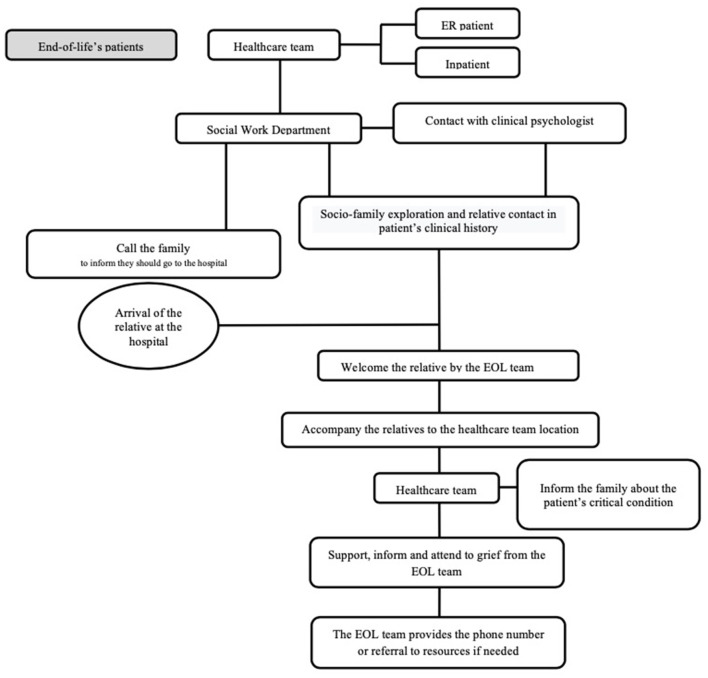
The coronavirus disease 19 (COVID-19) and its consequences have placed our societies and healthcare systems under pressure. Also, a major impact on the individual and societal experience of death, dying, and bereavement has been observed. Factors such as social distancing, unexpected death or not being able to say goodbye, which might predict Prolonged Grief Disorder (PGD), are taking place. Moreover, hospitals have become a habitual place for End of Life (EOL) situations but not in the usual conditions because, for example, mitigation measures prevent families from being together with hospitalized relatives. Therefore, we implemented an EOL program with a multidisciplinary team involving health social workers (HSW) and clinical psychologists (CP) in coordination with the medical teams and nursing staff. We aim to describe an EOL intervention program implemented during COVID-19 in the Vall d'Hebron University Hospital (HUVH). We present its structure, circuit, and functions. Descriptive analyses of the sample and the interventions that required psychological and social attention are reported. The total sample consists of 359 relatives of 219 EOL patients. Inclusion criteria were families cared for during the COVID-19 pandemic with family patients admitted to the HUVH in an EOL situation regardless of whether or not the patient was diagnosed with COVID-19. Our program is based on family EOL care perceptions and the COVID-19 context features that hinder EOL situations. The program attended 219 families, of which 55.3% were COVID-19 patients and 44.7% had other pathologies. The EOL intervention program was activated in most of the EOL situations, specifically, in 85% of cases, and 78% of relatives were able to come and say goodbye to their loved ones. An emotional impact on the EOL team was reported. It is necessary to dignify the EOL situation in the COVID-19 pandemic, and appropriate psychosocial attention is needed to try to minimize future complications in grief processes and mitigate PGD.
新型冠状病毒肺炎(COVID-19)及其后果给我们的社会和医疗系统带来了压力。此外,人们还观察到它对个人以及社会层面关于死亡、临终和丧亲之痛的体验产生了重大影响。诸如社交距离、意外死亡或无法道别等可能预示着持续性悲伤障碍(PGD)的因素正在出现。此外,医院已成为临终(EOL)情况的常见发生场所,但并非处于通常的条件下,例如,缓解措施使家属无法与住院亲属在一起。因此,我们与医疗团队和护理人员协调,组建了一个由健康社会工作者(HSW)和临床心理学家(CP)组成的多学科团队,实施了一项临终关怀计划。我们旨在描述在COVID-19期间于瓦尔德希伯伦大学医院(HUVH)实施的一项临终关怀干预计划。我们介绍其结构、流程和功能。报告了样本以及需要心理和社会关注的干预措施的描述性分析。总样本包括219名临终患者的359名亲属。纳入标准是在COVID-19大流行期间接受护理的家庭,其家庭患者因临终情况入住HUVH,无论患者是否被诊断为COVID-19。我们的计划基于家庭临终关怀护理观念以及阻碍临终情况的COVID-19背景特征。该计划服务了219个家庭,其中55.3%是COVID-19患者,44.7%患有其他疾病。临终关怀干预计划在大多数临终情况下被启动,具体而言,在85%的病例中启动,78%的亲属能够前来与他们所爱的人道别。报告称这对临终关怀团队产生了情感影响。在COVID-19大流行期间,有必要使临终情况更有尊严,并且需要适当的心理社会关注,以尽量减少悲伤过程中未来的并发症并减轻持续性悲伤障碍。