Zhai Hongfu, Ni Lihua, Wu Xiaoyan
Department of Nephrology, Zhongnan Hospital of Wuhan University, Wuhan, China.
Department of General Practice, Zhongnan Hospital of Wuhan University, Wuhan, China.
Front Nephrol. 2023 May 5;3:1156346. doi: 10.3389/fneph.2023.1156346. eCollection 2023.
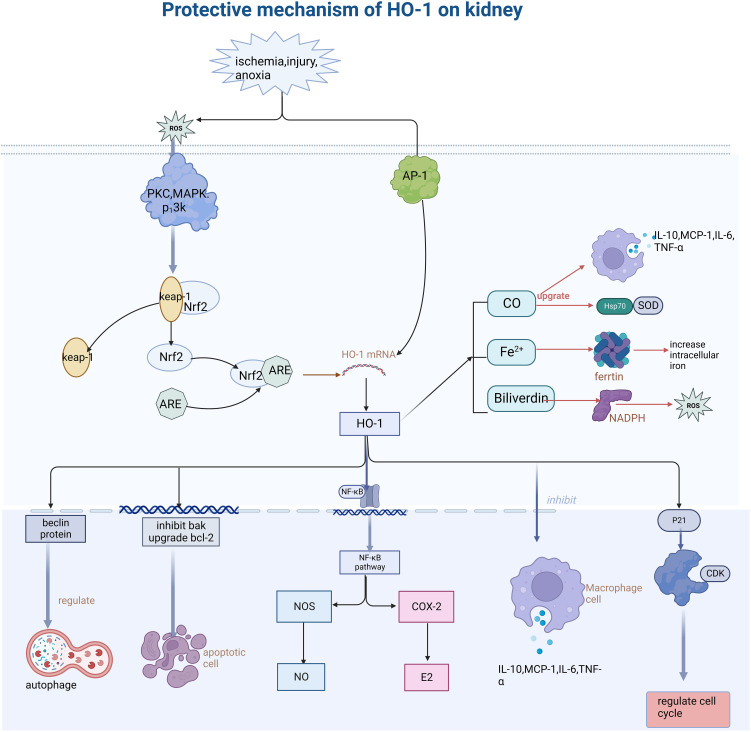
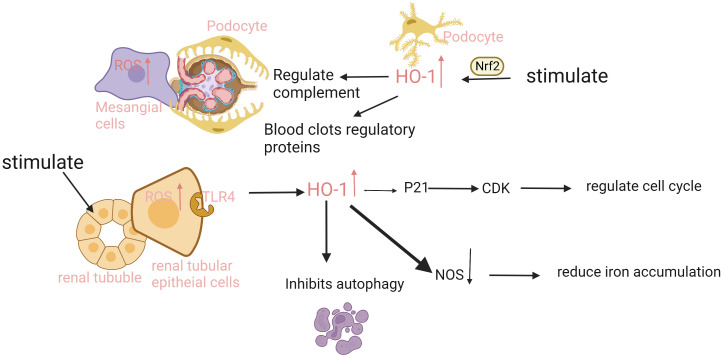
Heme oxygenase (HO), a heat shock protein containing hemoglobin, is an important enzyme in heme catabolism. It is involved in cell homeostasis and has anti-inflammatory, antioxidant, anti-apoptosis, immunomodulation, and other functions. It is expressed at a modest level in most normal tissues. When the body suffers from ischemia hypoxia, injury, toxins, and other nociceptive stimuli, the expression increases, which can transform the oxidative microenvironment into an antioxidant environment to promote tissue recovery from damage. In recent years, research has continued to verify its value in a variety of human bodily systems. It is also regarded as a key target for the treatment of numerous disorders. With the advancement of studies, its significance in renal disease has gained increasing attention. It is thought to have a significant protective function in preventing acute kidney injury and delaying the progression of chronic renal diseases. Its protective mechanisms include anti-inflammatory, antioxidant, cell cycle regulation, apoptosis inhibition, hemodynamic regulation, and other aspects, which have been demonstrated in diverse animal models. Furthermore, as a protective factor, its potential therapeutic efficacy in renal disease has recently become a hot area of research. Although a large number of preclinical trials have confirmed its therapeutic potential in reducing kidney injury, due to the problems and side effects of HO-1 induction therapy, its efficacy and safety in clinical application need to be further explored. In this review, we summarize the current state of research on the mechanism, location, and treatment of HO and its relationship with various renal diseases.
血红素加氧酶(HO)是一种含血红蛋白的热休克蛋白,是血红素分解代谢中的一种重要酶。它参与细胞稳态,具有抗炎、抗氧化、抗凋亡、免疫调节等功能。在大多数正常组织中,它以适度水平表达。当身体遭受缺血缺氧、损伤、毒素等伤害性刺激时,其表达会增加,可将氧化微环境转变为抗氧化环境,以促进组织从损伤中恢复。近年来,研究不断证实其在人体多种系统中的价值。它也被视为治疗多种疾病的关键靶点。随着研究的推进,其在肾脏疾病中的意义日益受到关注。人们认为它在预防急性肾损伤和延缓慢性肾脏疾病进展方面具有重要的保护作用。其保护机制包括抗炎、抗氧化、细胞周期调控、抑制凋亡、血流动力学调节等多个方面,已在多种动物模型中得到证实。此外,作为一种保护因子,其在肾脏疾病中的潜在治疗效果最近成为研究热点。尽管大量临床前试验已证实其在减轻肾损伤方面的治疗潜力,但由于HO-1诱导疗法存在的问题和副作用,其在临床应用中的疗效和安全性仍需进一步探索。在本综述中,我们总结了目前关于HO的机制、定位、治疗及其与各种肾脏疾病关系的研究现状。