Thorne Sarah J, Maathuis Frans J M
Department of Biology, University of Sheffield, Sheffield, S10 2TN, UK.
Department of Biology, University of York, York, YO1 5DD, UK.
Stress Biol. 2022 Nov 2;2(1):45. doi: 10.1007/s44154-022-00070-1.
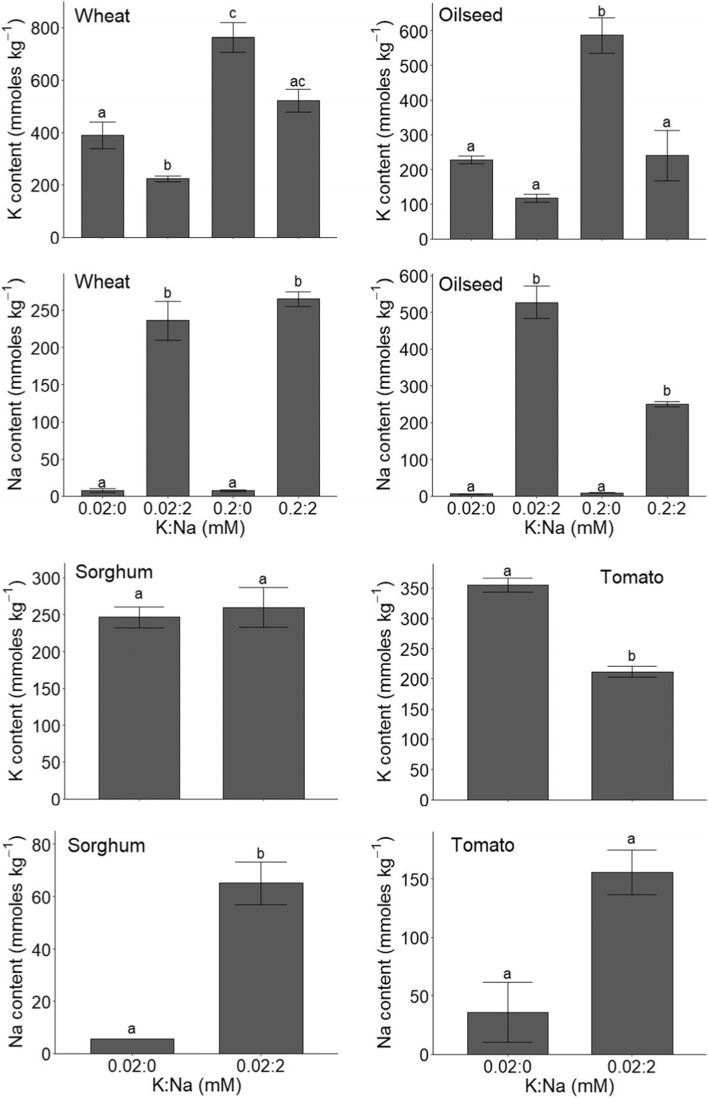
Potassium (K) is the most abundant cation in the vast majority of plants. It is required in large quantities which, in an agronomic context, typically necessitates application of K in the form of potash or other K fertilisers. Recently, the price of K fertiliser has risen dramatically, a situation that is paralleled by increasing K deficiency of soils around the globe. A potential solution to this problem is to reduce crop K fertiliser dependency by replacing it with sodium (Na) fertiliser which carries a much smaller price tag. In this paper we discuss the physiological roles of K and Na and the implications of Na fertilisation for crop cultivation and soil management. By using greenhouse growth assays we show distinct growth promotion after Na fertilisation in wheat, tomato, oilseed and sorghum. Our results also show that up to 60% of tissue K can be substituted by Na without growth penalty. Based on these data, simple economic models suggest that (part) replacement of K fertiliser with Na fertiliser leads to considerable savings.
钾(K)是绝大多数植物中含量最丰富的阳离子。植物对钾的需求量很大,在农业生产中,通常需要以钾肥或其他含钾肥料的形式施用钾。最近,钾肥价格大幅上涨,与此同时,全球土壤钾缺乏问题也日益严重。解决这一问题的一个潜在办法是用价格低得多的钠(Na)肥替代钾肥,以降低作物对钾肥的依赖。在本文中,我们讨论了钾和钠的生理作用以及施用钠肥对作物种植和土壤管理的影响。通过温室生长试验,我们发现施用钠肥后,小麦、番茄、油菜籽和高粱的生长有明显促进作用。我们的研究结果还表明,高达60%的组织钾可以被钠替代而不影响生长。基于这些数据,简单的经济模型表明,用钠肥(部分)替代钾肥可节省大量成本。