• 文献检索
  • 文档翻译
  • 深度研究
  • 学术资讯
  • Suppr Zotero 插件Zotero 插件
  • 邀请有礼
  • 套餐&价格
  • 历史记录
应用&插件
Suppr Zotero 插件Zotero 插件浏览器插件Mac 客户端Windows 客户端微信小程序
定价
高级版会员购买积分包购买API积分包
服务
文献检索文档翻译深度研究API 文档MCP 服务
关于我们
关于 Suppr公司介绍联系我们用户协议隐私条款
关注我们

Suppr 超能文献

核心技术专利:CN118964589B侵权必究
粤ICP备2023148730 号-1Suppr @ 2026

文献检索

告别复杂PubMed语法,用中文像聊天一样搜索,搜遍4000万医学文献。AI智能推荐,让科研检索更轻松。

立即免费搜索

文件翻译

保留排版,准确专业,支持PDF/Word/PPT等文件格式,支持 12+语言互译。

免费翻译文档

深度研究

AI帮你快速写综述,25分钟生成高质量综述,智能提取关键信息,辅助科研写作。

立即免费体验

基于智能手机的慢性耳鸣认知行为疗法的随机对照试验

Randomized controlled trial of a smartphone-based cognitive behavioral therapy for chronic tinnitus.

作者信息

Walter Uso, Pennig Stefan, Kottmann Tanja, Bleckmann Lothar, Röschmann-Doose Kristina, Schlee Winfried

机构信息

ENT Practice Walter & Zander, Duisburg and mynoise GmbH, Duisburg, Germany.

context, Essen-Kettwig, Germany.

出版信息

PLOS Digit Health. 2023 Sep 7;2(9):e0000337. doi: 10.1371/journal.pdig.0000337. eCollection 2023 Sep.

DOI:10.1371/journal.pdig.0000337
PMID:37676883
原文链接:https://pmc.ncbi.nlm.nih.gov/articles/PMC10484427/
Abstract

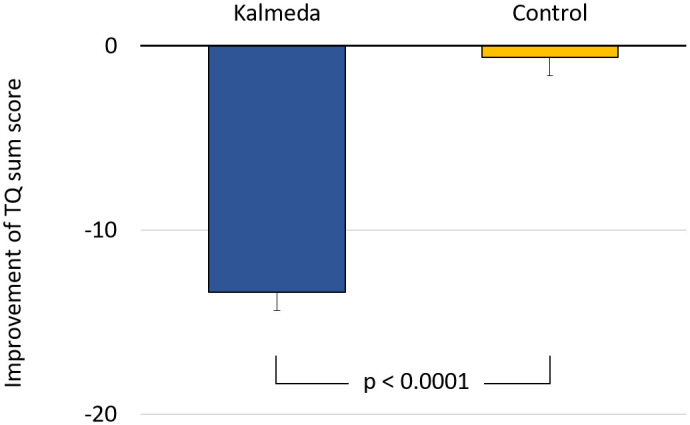
Tinnitus, the phantom perception of sounds, generates distress and anxiety in those affected. Cognitive behavioral treatment approaches reproducibly help patients in managing chronic tinnitus. This study systematically evaluated the usefulness of a tinnitus app (with areas of attention and relaxation, mindfulness, acceptance, self-efficacy), which is prescribed for a total of nine months. One hundred eighty-seven participants with chronic tinnitus were equally randomized to an intervention arm that used a smartphone-based intervention -marketed as Kalmeda Tinnitus app-. and a control arm with delayed onset of treatment by 3 months. The first 3 months of a 9-months prescribed intervention have been analyzed as primary outcome. The Tinnitus Questionnaire (TQ) was used as primary endpoint to determine the reduction of tinnitus distress. Following intervention, there was a statistically significant and clinically relevant reduction of the TQ sum score in the intervention group compared to the control group (p<0.001, Cohen's d effect size = 1.1). The secondary parameters, Patient Health Questionnaire-9 (PHQ9) and Perceived-Stress-Questionnaire (PSQ20) scores improved significantly in the intervention group whereas the Self Efficacy-Optimism-Pessimism short form (SWOP-K9) scores remained unchanged in both groups. Patients reported no treatment-related side effects. Taken together, use of this Tinnitus app lead to a significant decrease in tinnitus distress and a clinically relevant effect in the patients´ self-reported everyday management.

摘要

耳鸣,即对声音的虚幻感知,会给患者带来痛苦和焦虑。认知行为治疗方法能持续有效地帮助患者应对慢性耳鸣。本研究系统评估了一款耳鸣应用程序(包含注意力与放松、正念、接纳、自我效能等板块)的效用,该应用程序的使用时长总计为九个月。187名慢性耳鸣患者被平均随机分为两组,一组为干预组,使用一款基于智能手机的干预程序(名为Kalmeda耳鸣应用程序);另一组为对照组,治疗延迟3个月开始。对规定的9个月干预疗程中的前3个月进行了分析,并将其作为主要观察指标。耳鸣问卷(TQ)被用作主要终点指标,以确定耳鸣痛苦程度的减轻情况。干预后,与对照组相比,干预组的TQ总分在统计学上有显著降低,且具有临床意义(p<0.001,科恩d效应量=1.1)。次要参数方面,干预组的患者健康问卷-9(PHQ9)和感知压力问卷(PSQ20)得分显著改善,而两组的自我效能-乐观-悲观简表(SWOP-K9)得分均未发生变化。患者报告未出现与治疗相关的副作用。综上所述,使用这款耳鸣应用程序可显著减轻耳鸣痛苦,并在患者自我报告的日常管理中产生具有临床意义的效果。
https://cdn.ncbi.nlm.nih.gov/pmc/blobs/2160/10484427/47179794740c/pdig.0000337.g002.jpg
https://cdn.ncbi.nlm.nih.gov/pmc/blobs/2160/10484427/4b7f864359c6/pdig.0000337.g001.jpg
https://cdn.ncbi.nlm.nih.gov/pmc/blobs/2160/10484427/47179794740c/pdig.0000337.g002.jpg
https://cdn.ncbi.nlm.nih.gov/pmc/blobs/2160/10484427/4b7f864359c6/pdig.0000337.g001.jpg
https://cdn.ncbi.nlm.nih.gov/pmc/blobs/2160/10484427/47179794740c/pdig.0000337.g002.jpg

相似文献

1
Randomized controlled trial of a smartphone-based cognitive behavioral therapy for chronic tinnitus.基于智能手机的慢性耳鸣认知行为疗法的随机对照试验
PLOS Digit Health. 2023 Sep 7;2(9):e0000337. doi: 10.1371/journal.pdig.0000337. eCollection 2023 Sep.
2
Audiologist-Guided Internet-Based Cognitive Behavior Therapy for Adults With Tinnitus in the United Kingdom: A Randomized Controlled Trial.英国听力学指导的基于互联网的认知行为疗法治疗成年人耳鸣:一项随机对照试验。
Ear Hear. 2018 May/Jun;39(3):423-433. doi: 10.1097/AUD.0000000000000505.
3
Internet-Based Audiologist-Guided Cognitive Behavioral Therapy for Tinnitus: Randomized Controlled Trial.基于互联网的听力学医师指导的耳鸣认知行为疗法:随机对照试验。
J Med Internet Res. 2022 Feb 14;24(2):e27584. doi: 10.2196/27584.
4
Internet-delivered cognitive behavioral therapy for tinnitus compared to Internet-delivered mindfulness for tinnitus: a study protocol of a randomized controlled trial.互联网 delivered 认知行为疗法治疗耳鸣与互联网 delivered 正念治疗耳鸣的比较:一项随机对照试验的研究方案。
Trials. 2023 Apr 12;24(1):269. doi: 10.1186/s13063-023-07299-9.
5
MinT-trial: Mindfulness versus cognitive behavioural therapy in Tinnitus patients: protocol for a randomised controlled, non-inferiority trial.MinT-trial:耳鸣患者的正念疗法与认知行为疗法比较:一项随机对照、非劣效性试验的方案。
BMJ Open. 2020 Feb 25;10(2):e033210. doi: 10.1136/bmjopen-2019-033210.
6
The value of Eye Movement Desensitization Reprocessing in the treatment of tinnitus: study protocol for a randomized controlled trial.眼动脱敏再处理疗法在耳鸣治疗中的价值:一项随机对照试验的研究方案
Trials. 2019 Jan 9;20(1):32. doi: 10.1186/s13063-018-3121-6.
7
Internet-based guided self-help versus group cognitive behavioral therapy for chronic tinnitus: a randomized controlled trial.基于互联网的引导自助与团体认知行为疗法治疗慢性耳鸣的随机对照试验。
Psychother Psychosom. 2014;83(4):234-46. doi: 10.1159/000360705. Epub 2014 Jun 19.
8
A randomized single-blind controlled trial of a prototype digital polytherapeutic for tinnitus.一项针对耳鸣的数字多疗法原型的随机单盲对照试验。
Front Neurol. 2022 Aug 5;13:958730. doi: 10.3389/fneur.2022.958730. eCollection 2022.
9
Mindfulness-Based Cognitive Therapy as a Treatment for Chronic Tinnitus: A Randomized Controlled Trial.正念认知疗法治疗慢性耳鸣的随机对照试验。
Psychother Psychosom. 2017;86(6):351-361. doi: 10.1159/000478267. Epub 2017 Nov 3.
10
Auricular Acupressure Combined with Self-Help Intervention for Treating Chronic Tinnitus: A Longitudinal Observational Study.耳穴按压联合自助干预治疗慢性耳鸣:一项纵向观察研究
J Clin Med. 2021 Sep 16;10(18):4201. doi: 10.3390/jcm10184201.

引用本文的文献

1
Healthcare effects and evidence robustness of reimbursable digital health applications in Germany: a systematic review.德国可报销数字健康应用的医疗保健效果及证据稳健性:一项系统综述
NPJ Digit Med. 2025 Aug 1;8(1):495. doi: 10.1038/s41746-025-01879-6.
2
A Scoping Review of the Role of Attention in Tinnitus Management.注意力在耳鸣管理中作用的范围综述
Semin Hear. 2025 Mar 6;45(3-04):317-330. doi: 10.1055/s-0045-1804903. eCollection 2024 Aug.
3
Continuous Improvement of Chronic Tinnitus Through a 9-Month Smartphone-Based Cognitive Behavioral Therapy: Randomized Controlled Trial.

本文引用的文献

1
Tinnitus prevalence in Europe: a multi-country cross-sectional population study.欧洲耳鸣患病率:一项多国横断面人群研究。
Lancet Reg Health Eur. 2021 Nov 4;12:100250. doi: 10.1016/j.lanepe.2021.100250. eCollection 2022 Jan.
2
Factors associated with Self Rated Health in persons with tinnitus from the general population.普通人群中耳鸣患者自评健康状况的相关因素。
J Psychosom Res. 2022 Feb;153:110693. doi: 10.1016/j.jpsychores.2021.110693. Epub 2021 Dec 8.
3
Efficacy of sound therapy interventions for tinnitus management: A protocol for systematic review and network meta-analysis.
通过为期9个月的基于智能手机的认知行为疗法持续改善慢性耳鸣:随机对照试验
J Med Internet Res. 2025 Feb 18;27:e59575. doi: 10.2196/59575.
4
[Apps for tinnitus? A systematic review on quality, intervention components, and behavior change techniques].[耳鸣应用程序?关于质量、干预成分和行为改变技术的系统评价]
Bundesgesundheitsblatt Gesundheitsforschung Gesundheitsschutz. 2024 Feb;67(2):203-214. doi: 10.1007/s00103-023-03805-1. Epub 2023 Dec 12.
声疗干预治疗耳鸣的疗效:系统评价和网络荟萃分析方案。
Medicine (Baltimore). 2021 Oct 15;100(41):e27509. doi: 10.1097/MD.0000000000027509.
4
A State-of-Art Review of Digital Technologies for the Next Generation of Tinnitus Therapeutics.下一代耳鸣治疗数字技术的现状综述
Front Digit Health. 2021 Aug 10;3:724370. doi: 10.3389/fdgth.2021.724370. eCollection 2021.
5
Internet-based cognitive-behavioural therapy for tinnitus: secondary analysis to examine predictors of outcomes.基于互联网的认知行为疗法治疗耳鸣:二次分析以探讨结局的预测因素。
BMJ Open. 2021 Aug 20;11(8):e049384. doi: 10.1136/bmjopen-2021-049384.
6
On the relationship between tinnitus distress, cognitive performance and aging.耳鸣困扰、认知表现与衰老之间的关系。
Prog Brain Res. 2021;262:263-285. doi: 10.1016/bs.pbr.2021.01.028. Epub 2021 Mar 31.
7
The Neural Mechanisms of Tinnitus: A Perspective From Functional Magnetic Resonance Imaging.耳鸣的神经机制:来自功能磁共振成像的视角
Front Neurosci. 2021 Feb 11;15:621145. doi: 10.3389/fnins.2021.621145. eCollection 2021.
8
Psychosocial Variables That Predict Chronic and Disabling Tinnitus: A Systematic Review.预测慢性和致残性耳鸣的心理社会变量:系统评价。
Curr Top Behav Neurosci. 2021;51:361-380. doi: 10.1007/7854_2020_213.
9
Cognitive behavioural therapy for tinnitus.耳鸣的认知行为疗法。
Cochrane Database Syst Rev. 2020 Jan 8;1(1):CD012614. doi: 10.1002/14651858.CD012614.pub2.
10
A multidisciplinary European guideline for tinnitus: diagnostics, assessment, and treatment.欧洲耳鸣多学科指南:诊断、评估与治疗
HNO. 2019 Mar;67(Suppl 1):10-42. doi: 10.1007/s00106-019-0633-7.