Nagaraja K V, Khan Umair, Madhukesh J K, Hassan Ahmed M, Prasannakumara B C, Ben Kahla Nabil, Elattar Samia, Singh Chohan Jasgurpreet
Department of Mathematics, Amrita School of Engineering, Amrita Vishwa Vidyapeetham, Bengaluru, 560035, India.
Department of Mathematical Sciences, Faculty of Science and Technology, Universiti Kebangsaan Malaysia, UKM Bangi, 43600, Selangor, Malaysia.
Sci Rep. 2023 Sep 8;13(1):14795. doi: 10.1038/s41598-023-41916-6.
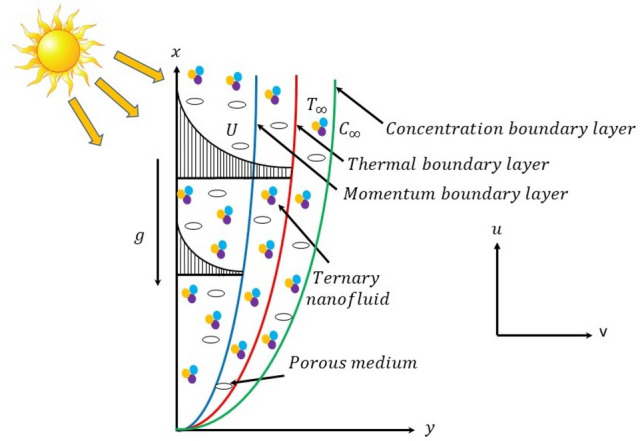
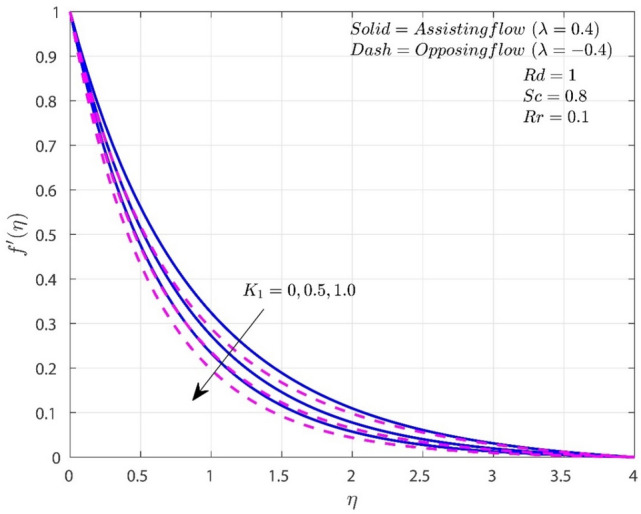
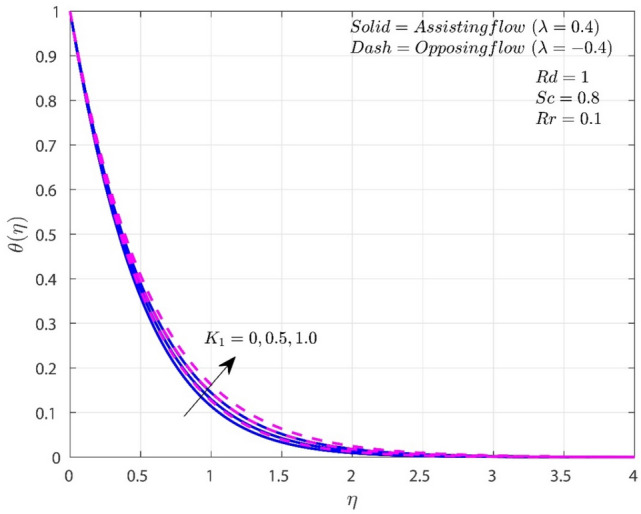
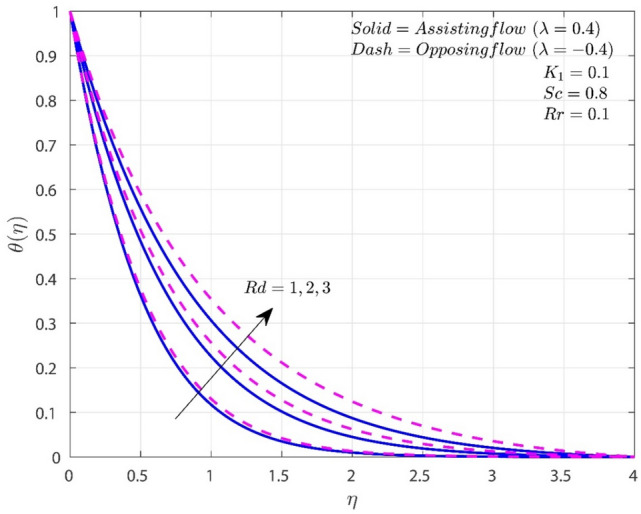
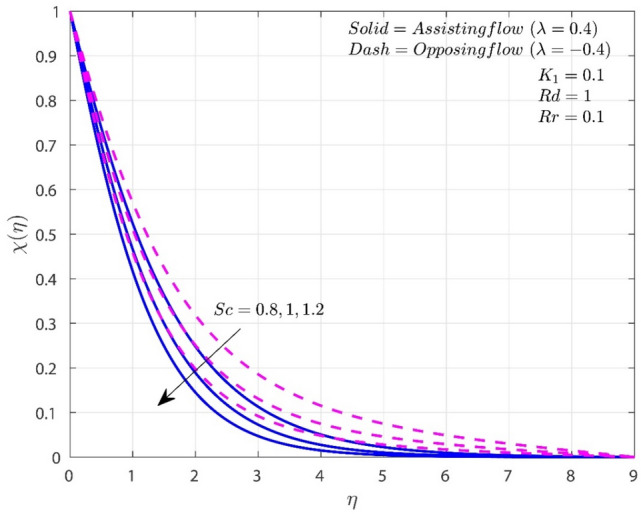
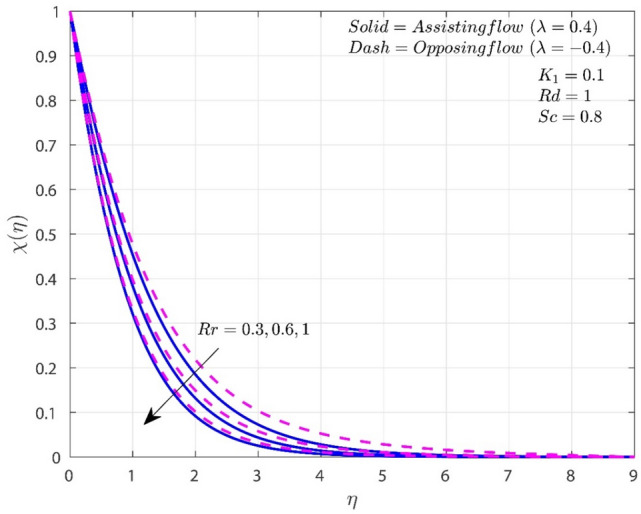
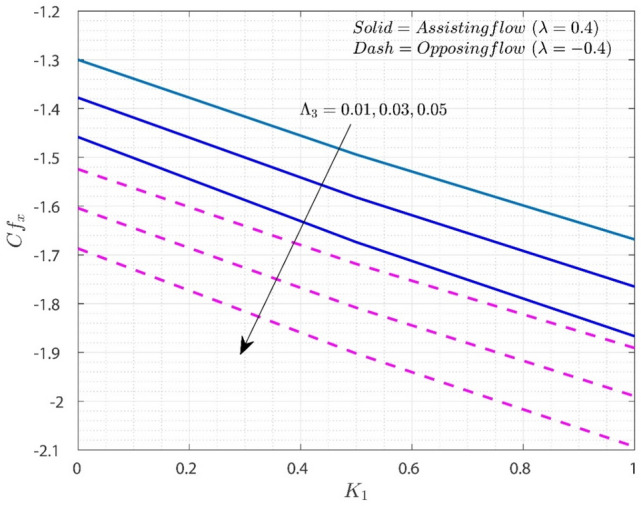
Access to dependable and environmentally friendly energy sources is critical to a country's economic growth and long-term development. As countries seek greener energy alternatives, the interaction of environmental elements, temperature, and sunlight becomes more critical in utilizing renewable energy sources such as wind and bioenergy. Solar power has received much attention due to extraordinary efficiency advances. under this context, the present work focus on solar radiation and chemical processes in the presence of modified ternary hybrid nanofluids (THNFs) circulating over an exponentially stretched surface in both aiding flow (A-F) and opposing flow (O-F) circumstances. The primary objective of this investigation is to dive into the complicated dynamics of these structures, which are distinguished by complex interactions involving radiation, chemical reactions, and the movement of fluids. We construct reduced ordinary differential equations from the governing equations using suitable similarity transformations, which allows for a more in-depth examination of the liquid's behavior. Numerical simulations using the Runge-Kutta Fehlberg (RKF) approach and shooting techniques are used to understand the underlying difficulties of these reduced equations. The results show that thermal radiation improves heat transmission substantially under O-F circumstances in contrast to A-F conditions. Furthermore, the reaction rate parameter has an exciting connection with concentration levels, with greater rates corresponding to lower concentrations. Furthermore, compared to the O-F scenario, the A-F scenario promotes higher heat transfer in the context of a modified nanofluid. Rising reaction rate and solid fraction volume enhanced mass transfer rate. The rate of thermal distribution in THNFs improves from 0.13 to 20.4% in A-F and 0.16 to 15.06% in O-F case when compared to HNFs. This study has real-world implications in several fields, including developing more efficient solar water heaters, solar thermal generating plants, and energy-saving air conditioners.
获得可靠且环保的能源对一个国家的经济增长和长期发展至关重要。随着各国寻求更绿色的能源替代方案,环境因素、温度和阳光在利用风能和生物能等可再生能源方面的相互作用变得更加关键。由于效率取得了显著进步,太阳能受到了广泛关注。在此背景下,目前的工作聚焦于在辅助流(A-F)和逆流(O-F)情况下,改性三元混合纳米流体(THNFs)在指数拉伸表面上循环时的太阳辐射和化学过程。本研究的主要目的是深入探究这些结构的复杂动力学,其特点是涉及辐射、化学反应和流体运动的复杂相互作用。我们使用合适的相似变换从控制方程构建简化的常微分方程,这使得能够更深入地研究液体的行为。使用龙格-库塔-费尔贝格(RKF)方法和打靶技术进行数值模拟,以理解这些简化方程背后的难题。结果表明,与A-F条件相比,在O-F条件下热辐射显著提高了热传递。此外,反应速率参数与浓度水平有着有趣的关联,较高的速率对应较低的浓度。此外,与O-F情况相比,在改性纳米流体的背景下,A-F情况促进了更高的热传递。反应速率和固体分数体积的增加提高了传质速率。与单组分纳米流体(HNFs)相比,在A-F情况下THNFs的热分布速率从0.13提高到20.4%,在O-F情况下从0.16提高到15.06%。这项研究在多个领域具有实际意义,包括开发更高效的太阳能热水器、太阳能热电厂和节能空调。