Li Tianhao, Wei Wensong, Xing Shujuan, Min Weiqing, Zhang Chunjiang, Jiang Shuqiang
The Key Laboratory of Intelligent Information Processing, Institute of Computing Technology, Chinese Academy of Sciences, Beijing 100190, China.
University of Chinese Academy of Sciences, Beijing 100049, China.
Foods. 2023 Aug 22;12(17):3145. doi: 10.3390/foods12173145.
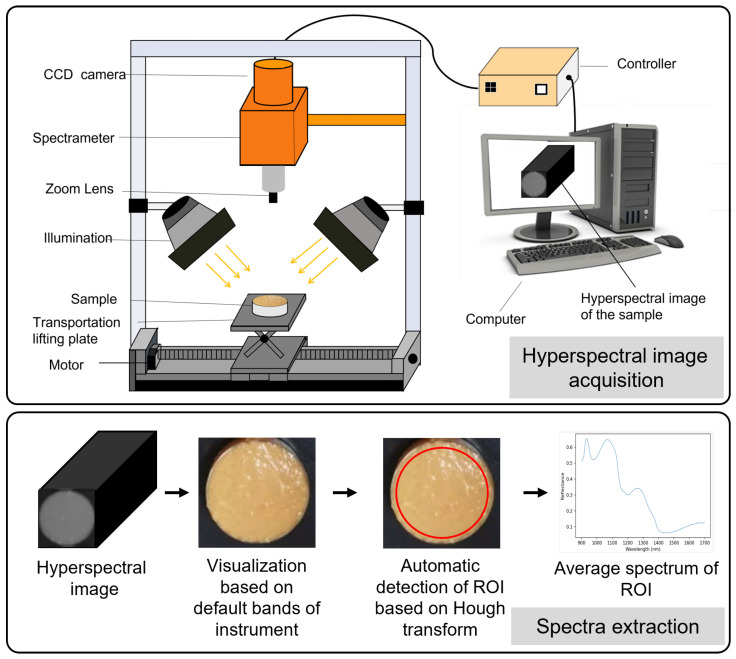
The limited nutritional information provided by external food representations has constrained the further development of food nutrition estimation. Near-infrared hyperspectral imaging (NIR-HSI) technology can capture food chemical characteristics directly related to nutrition and is widely used in food science. However, conventional data analysis methods may lack the capability of modeling complex nonlinear relations between spectral information and nutrition content. Therefore, we initiated this study to explore the feasibility of integrating deep learning with NIR-HSI for food nutrition estimation. Inspired by reinforcement learning, we proposed OptmWave, an approach that can perform modeling and wavelength selection simultaneously. It achieved the highest accuracy on our constructed scrambled eggs with tomatoes dataset, with a determination coefficient of 0.9913 and a root mean square error (RMSE) of 0.3548. The interpretability of our selection results was confirmed through spectral analysis, validating the feasibility of deep learning-based NIR-HSI in food nutrition estimation.
外部食物表征所提供的有限营养信息限制了食物营养估计的进一步发展。近红外高光谱成像(NIR-HSI)技术能够捕捉与营养直接相关的食物化学特征,并且在食品科学中得到了广泛应用。然而,传统的数据分析方法可能缺乏对光谱信息与营养成分之间复杂非线性关系进行建模的能力。因此,我们开展了这项研究,以探索将深度学习与近红外高光谱成像相结合用于食物营养估计的可行性。受强化学习的启发,我们提出了OptmWave,这是一种能够同时进行建模和波长选择的方法。在我们构建的番茄炒鸡蛋数据集上,它取得了最高的准确率,决定系数为0.9913,均方根误差(RMSE)为0.3548。通过光谱分析证实了我们选择结果的可解释性,验证了基于深度学习的近红外高光谱成像在食物营养估计中的可行性。