Sheikh Muhammad Abid, Alawathugoda Thilina T, Vyas Garima, Emerald Bright Starling, Ansari Suraiya A
Department of Biochemistry and Molecular Biology, College of Medicine and Health Sciences, United Arab Emirates University, Al Ain, Abu Dhabi, United Arab Emirates.
Department of Anatomy, College of Medicine and Health Sciences, United Arab Emirates University, Al Ain, Abu Dhabi, United Arab Emirates; Zayed Center for Health Sciences, United Arab Emirates University, Al Ain, Abu Dhabi, United Arab Emirates; Precision Medicine Research Institute Abu Dhabi (PMRIAD), United Arab Emirates University, Al Ain, Abu Dhabi, United Arab Emirates.
J Biol Chem. 2023 Oct;299(10):105235. doi: 10.1016/j.jbc.2023.105235. Epub 2023 Sep 9.
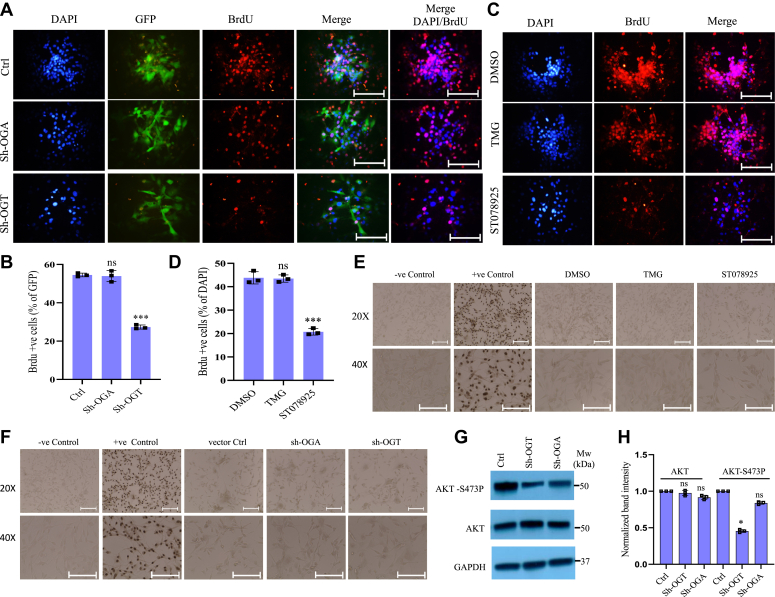
Metabolic reprogramming has emerged as one of the key hallmarks of cancer cells. Various metabolic pathways are dysregulated in cancers, including the hexosamine biosynthesis pathway. Protein O-GlcNAcylation is catalyzed by the enzyme O-GlcNAc transferase (OGT), an effector of hexosamine biosynthesis pathway that is found to be upregulated in most cancers. Posttranslational O-GlcNAcylation of various signaling and transcriptional regulators could promote cancer cell maintenance and progression by regulating gene expression, as gene-specific transcription factors and chromatin regulators are among the most highly O-GlcNAcylated proteins. Here, we investigated the role of OGT in glioblastoma. We demonstrate that OGT knockdown and chemical inhibition led to reduced glioblastoma cell proliferation and downregulation of many genes known to play key roles in glioblastoma cell proliferation, migration, and invasion. We show that genes downregulated due to OGT reduction are also known to be transcriptionally regulated by transcriptional initiation/elongation cofactor BRD4. We found BRD4 to be O-GlcNAcylated in glioblastoma cells; however, OGT knockdown/inhibition neither changed its expression nor its chromatin association on promoters. Intriguingly, we observed OGT knockdown led to reduced Pol II-Ser2P chromatin association on target genes without affecting other transcription initiation/elongation factors. Finally, we found that chemical inhibition of BRD4 potentiated the effects of OGT inhibition in reducing glioblastoma cell proliferation, invasion, and migration. We propose BRD4 and OGT act independently in the transcriptional regulation of a common set of genes and that combined inhibition of OGT and BRD4 could be utilized therapeutically for more efficient glioblastoma cell targeting than targeting of either protein alone.
代谢重编程已成为癌细胞的关键特征之一。癌症中多种代谢途径失调,包括己糖胺生物合成途径。蛋白质O-连接的N-乙酰葡糖胺化由O-葡糖胺基转移酶(OGT)催化,OGT是己糖胺生物合成途径的一个效应因子,在大多数癌症中上调。各种信号和转录调节因子的翻译后O-连接的N-乙酰葡糖胺化可通过调节基因表达促进癌细胞维持和进展,因为基因特异性转录因子和染色质调节因子是O-连接的N-乙酰葡糖胺化程度最高的蛋白质之一。在此,我们研究了OGT在胶质母细胞瘤中的作用。我们证明,OGT敲低和化学抑制导致胶质母细胞瘤细胞增殖减少,以及许多已知在胶质母细胞瘤细胞增殖、迁移和侵袭中起关键作用的基因下调。我们表明,由于OGT减少而下调的基因也已知受转录起始/延伸辅因子BRD4的转录调控。我们发现BRD4在胶质母细胞瘤细胞中被O-连接的N-乙酰葡糖胺化;然而,OGT敲低/抑制既不改变其表达,也不改变其在启动子上的染色质结合。有趣的是,我们观察到OGT敲低导致靶基因上Pol II-Ser2P染色质结合减少,而不影响其他转录起始/延伸因子。最后,我们发现化学抑制BRD4可增强OGT抑制在减少胶质母细胞瘤细胞增殖、侵袭和迁移方面的作用。我们提出,BRD4和OGT在一组共同基因的转录调控中独立发挥作用,联合抑制OGT和BRD4可用于治疗,比单独靶向任何一种蛋白质更有效地靶向胶质母细胞瘤细胞。