Department of Cardiology, Yueyang Hospital of Integrated Traditional Chinese and Western Medicine, Shanghai University of Traditional Chinese Medicine, Shanghai, China.
Lipids Health Dis. 2023 Sep 9;22(1):149. doi: 10.1186/s12944-023-01914-z.
This study aimed to investigate the association between the Dietary Inflammatory Index (DII) and dyslipidemia, as well as to evaluate the mortality risk associated with DII in participants with dyslipidemia.
Data from the National Health and Nutrition Examination Survey database were divided into dyslipidemia and non-dyslipidemia groups. The association between DII and dyslipidemia was investigated using the weighted chi-square test, weighted t-test, and weighted logistic regression. Weighted Cox proportional hazards models were used to estimate the hazard ratios and 95% confidence intervals for all-cause and cardiovascular disease-related mortality within the dyslipidemia group.
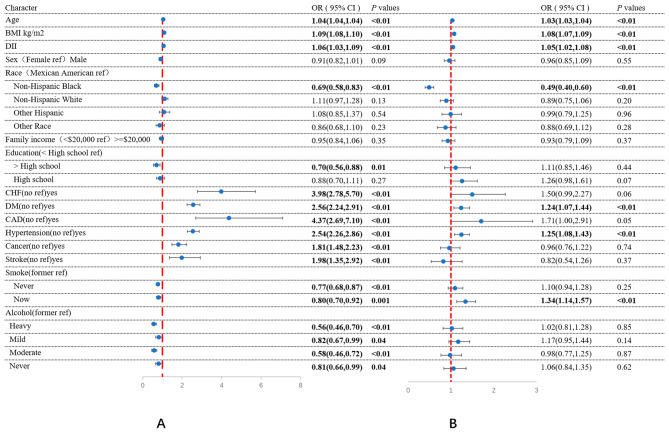
A total of 17,820 participants, including 4,839 without and 12,981 with dyslipidemia were analyzed in this study. The results showed that DII was higher in the dyslipidemia group compared to the non-dyslipidemia group (1.42 ± 0.03 vs. 1.23 ± 0.04, P < 0.01). However, for energy, protein, carbohydrates, total fat, saturated fat, and iron, DII was lower in participants with dyslipidemia. Logistic regression analysis revealed a strong positive association between DII and dyslipidemia. The odds ratios for dyslipidemia from Q1 to Q4 were 1.00 (reference), 1.12 (0.96-1.31), 1.23 (1.04-1.44), and 1.33 (1.11-1.59), respectively. In participants with dyslipidemia, a high DII was associated with high all-cause and cardiovascular mortality.
DII was closely associated with dyslipidemia. A pro-inflammatory diet may play a role in unfavorable consequences and is linked to both all-cause mortality and cardiovascular death in patients with dyslipidemia. Participants with dyslipidemia should pay attention to their anti-inflammatory dietary patterns.
本研究旨在探讨饮食炎症指数(DII)与血脂异常的关系,并评估血脂异常患者中 DII 与死亡率之间的相关性。
从国家健康和营养调查数据库中获取数据,将其分为血脂异常组和非血脂异常组。采用加权卡方检验、加权 t 检验和加权逻辑回归分析 DII 与血脂异常之间的关系。在血脂异常组中,采用加权 Cox 比例风险模型估计全因死亡率和心血管疾病相关死亡率的风险比(HR)和 95%置信区间(CI)。
本研究共纳入 17820 名参与者,其中 4839 名无血脂异常,12981 名有血脂异常。结果显示,与非血脂异常组相比,血脂异常组的 DII 更高(1.42±0.03 比 1.23±0.04,P<0.01)。然而,在能量、蛋白质、碳水化合物、总脂肪、饱和脂肪和铁方面,血脂异常组的 DII 较低。Logistic 回归分析显示,DII 与血脂异常之间存在强烈的正相关关系。从 Q1 到 Q4 的血脂异常比值比(OR)分别为 1.00(参考)、1.12(0.96-1.31)、1.23(1.04-1.44)和 1.33(1.11-1.59)。在血脂异常患者中,高 DII 与全因和心血管死亡率升高相关。
DII 与血脂异常密切相关。促炎饮食可能在不良后果中发挥作用,与血脂异常患者的全因死亡率和心血管死亡有关。血脂异常患者应注意抗炎饮食模式。