Institute of Biomedical Sciences, Academia Sinica, Taipei, Taiwan; Biomedical Translation Research Center, Academia Sinica, Taipei, Taiwan.
Institute of Biomedical Sciences, Academia Sinica, Taipei, Taiwan; Department of Clinical Laboratory Science and Medical Biotechnology, National Taiwan University, Taipei, Taiwan.
Mol Ther. 2023 Nov 1;31(11):3322-3336. doi: 10.1016/j.ymthe.2023.09.002. Epub 2023 Sep 9.
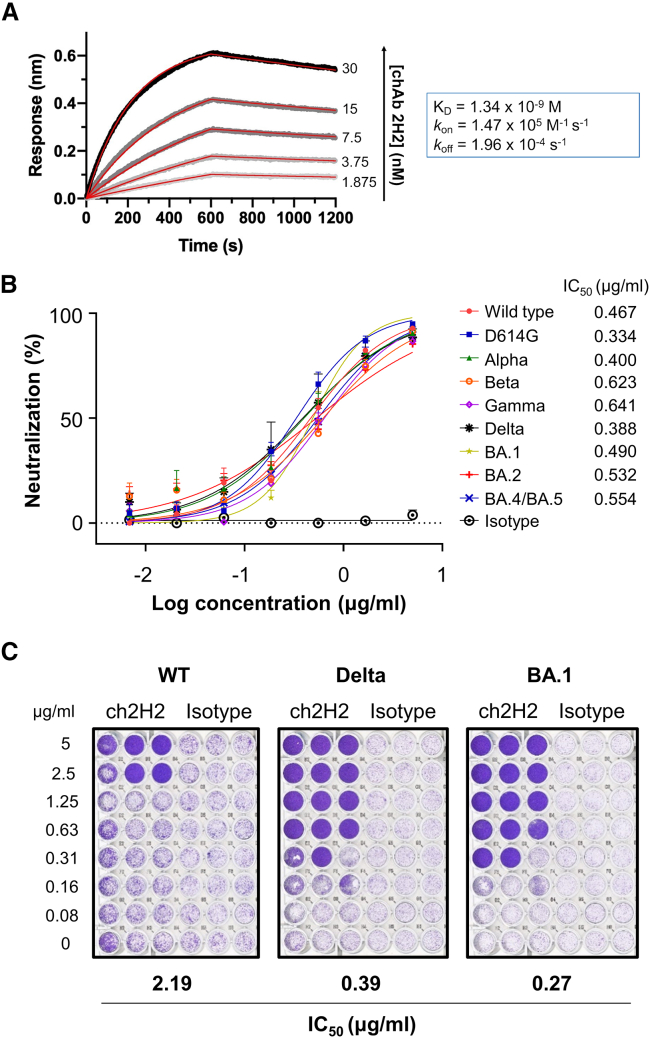
The ongoing evolution of severe acute respiratory syndrome coronavirus 2 (SARS-CoV-2), resulting in the emergence of new variants that are resistant to existing vaccines and therapeutic antibodies, has raised the need for novel strategies to combat the persistent global COVID-19 epidemic. In this study, a monoclonal anti-human angiotensin-converting enzyme 2 (hACE2) antibody, ch2H2, was isolated and humanized to block the viral receptor-binding domain (RBD) binding to hACE2, the major entry receptor of SARS-CoV-2. This antibody targets the RBD-binding site on the N terminus of hACE2 and has a high binding affinity to outcompete the RBD. In vitro, ch2H2 antibody showed potent inhibitory activity against multiple SARS-CoV-2 variants, including the most antigenically drifted and immune-evading variant Omicron. In vivo, adeno-associated virus (AAV)-mediated delivery enabled a sustained expression of monoclonal antibody (mAb) ch2H2, generating a high concentration of antibodies in mice. A single administration of AAV-delivered mAb ch2H2 significantly reduced viral RNA load and infectious virions and mitigated pulmonary pathological changes in mice challenged with SARS-CoV-2 Omicron BA.5 subvariant. Collectively, the results suggest that AAV-delivered hACE2-blocking antibody provides a promising approach for developing broad-spectrum antivirals against SARS-CoV-2 and potentially other hACE2-dependent pathogens that may emerge in the future.
严重急性呼吸综合征冠状病毒 2 (SARS-CoV-2)的持续进化导致新的变体出现,这些变体对现有疫苗和治疗性抗体具有耐药性,这就需要新的策略来对抗持续的全球 COVID-19 疫情。在这项研究中,分离并人源化了一种单克隆抗人血管紧张素转换酶 2 (hACE2)抗体 ch2H2,以阻断病毒受体结合域(RBD)与 SARS-CoV-2 的主要进入受体 hACE2 的结合。该抗体针对 hACE2 N 端的 RBD 结合位点,具有高结合亲和力,可以竞争 RBD 的结合。在体外,ch2H2 抗体对多种 SARS-CoV-2 变体表现出强大的抑制活性,包括抗原漂移和免疫逃避能力最强的变体奥密克戎。在体内,腺相关病毒(AAV)介导的递送使单克隆抗体(mAb)ch2H2 的持续表达成为可能,在小鼠中产生高浓度的抗体。单次给予 AAV 递送的 mAb ch2H2 可显著降低 SARS-CoV-2 奥密克戎 BA.5 亚变体感染小鼠的病毒 RNA 载量和感染性病毒颗粒,并减轻肺部病理变化。总之,这些结果表明,AAV 递送的 hACE2 阻断抗体为开发针对 SARS-CoV-2 的广谱抗病毒药物提供了一种有前途的方法,也可能为未来可能出现的其他依赖 hACE2 的病原体提供了一种方法。