Rush Alzheimer's Disease Center, Rush University Medical Center, Chicago, IL, USA.
Department of Internal Medicine, Rush University Medical Center, Chicago, IL, USA.
J Alzheimers Dis. 2023;95(4):1417-1425. doi: 10.3233/JAD-230013.
We have limited evidence for the relationship of high sugar intake with dementia risk.
To determine whether high sugar intake is associated with an increased risk of dementia in community-dwelling older adultsMethods:This study included 789 participants of the Rush Memory and Aging Project (community-based longitudinal cohort study of older adults free of known dementia at enrollment), with annual clinical assessments and complete nutrient data (obtained by validated food frequency questionnaire). Clinical diagnosis of dementia is based on the criteria of the joint working group of the National Institute of Neurological and Communicative Disorders and Stroke and the Alzheimer's Disease and Related Disorders Association. We used Cox proportional hazard models.
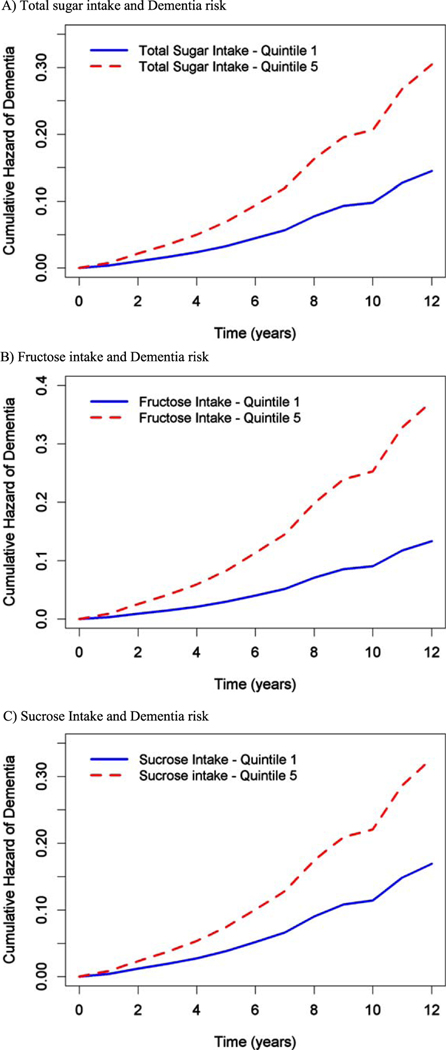
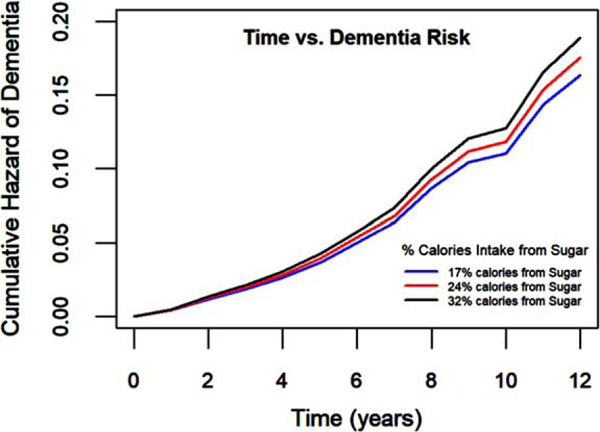
118 participants developed dementia during 7.3±3.8 years of follow-up. Those in the highest quintile of total sugar intake were twice as likely to develop dementia than those in the lowest quintile (Q5 versus Q1:HR=2.10 (95% CI: 1.05, 4.19) when adjusted for age, sex, education, APOEɛ4 allele, calories from sources other than sugar, physical activity, and diet score. Higher percent calories from sugar were positively associated with dementia risk (β=0.042, p = 0.0009). In exploratory analyses, the highest versus lowest quintile of fructose and sucrose in the diet had higher dementia risk by 2.8 (95% CI: 1.38, 5.67) and 1.93 (95% CI: 1.05, 3.54) times, respectively.
A higher intake of total sugar or total calories from sugar is associated with increased dementia risk in older adults. Among simple sugars, fructose (e.g., sweetened beverages, snacks, packaged desserts) and sucrose (table sugar in juices, desserts, candies, and commercial cereals) are associated with higher dementia risk.
我们对于高糖摄入与痴呆风险之间的关系的证据有限。
确定高糖摄入是否与社区居住的老年人痴呆风险增加有关。
本研究纳入了 789 名 Rush 记忆与衰老项目(一项针对入组时无已知痴呆的老年人的社区纵向队列研究)的参与者,每年进行临床评估和完整的营养数据(通过验证的食物频率问卷获得)。痴呆的临床诊断基于国家神经病学和中风研究所与阿尔茨海默病和相关疾病协会联合工作组的标准。我们使用 Cox 比例风险模型。
在 7.3±3.8 年的随访期间,有 118 名参与者患上了痴呆。与最低五分位组相比,总糖摄入量最高五分位组发生痴呆的可能性是前者的两倍(Q5 与 Q1:调整年龄、性别、教育程度、APOEɛ4 等位基因、糖以外的热量来源、体力活动和饮食评分后,HR=2.10(95%CI:1.05,4.19))。较高的卡路里百分比来自糖与痴呆风险呈正相关(β=0.042,p=0.0009)。在探索性分析中,饮食中果糖和蔗糖的最高五分位与最低五分位相比,痴呆风险分别高出 2.8(95%CI:1.38,5.67)和 1.93(95%CI:1.05,3.54)倍。
较高的总糖或总糖卡路里摄入量与老年人痴呆风险增加有关。在单糖中,果糖(如甜饮料、零食、包装甜点)和蔗糖(果汁、甜点、糖果和商业麦片中的白砂糖)与更高的痴呆风险相关。