Faculty of Medicine, University of Toronto, Toronto, Canada.
Institute for Clinical Evaluative Sciences McMaster, Hamilton, Canada.
BMC Geriatr. 2023 Sep 11;23(1):550. doi: 10.1186/s12877-023-04192-7.
Functional decline is common following acute hospitalization and is associated with hospital readmission, institutionalization, and mortality. People with functional decline may have difficulty accessing post-discharge medical care, even though early physician follow-up has the potential to prevent poor outcomes and is integral to high-quality transitional care. We sought to determine whether recent functional decline was associated with lower rates of post-discharge physician follow-up, and whether this association changed during the COVID-19 pandemic, given that both functional decline and COVID-19 may affect access to post-discharge care.
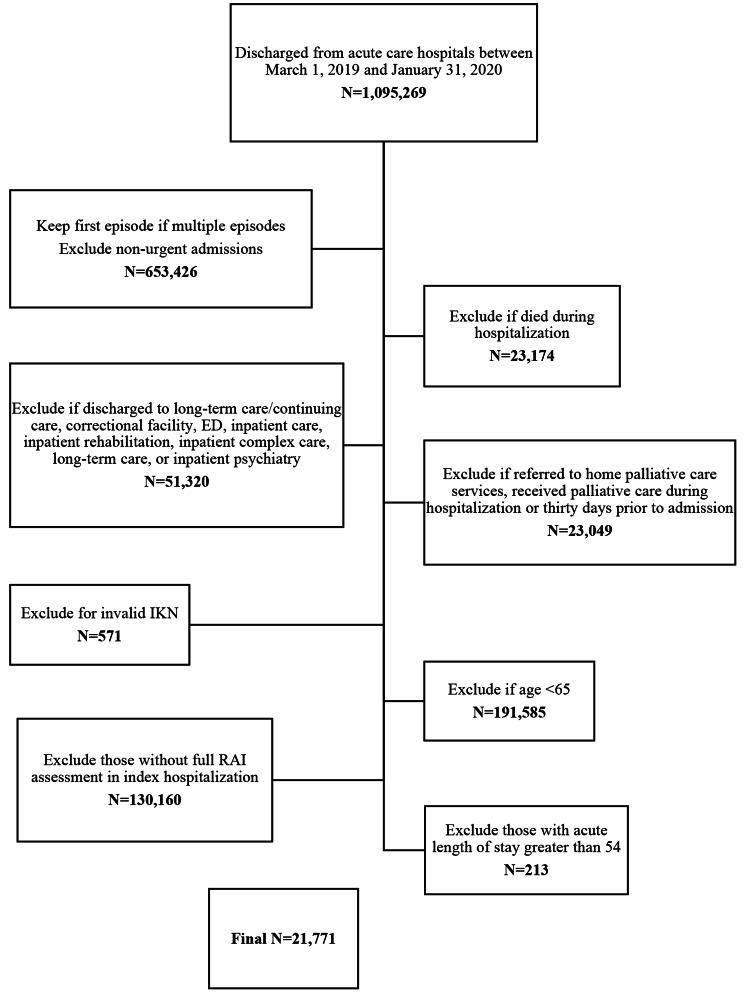
We conducted a retrospective cohort study using health administrative data from Ontario, Canada. We included patients over 65 who were discharged from an acute care facility during March 1st, 2019 - January 31st, 2020 (pre-COVID-19 period), and March 1st, 2020 - January 31st, 2021 (COVID-19 period), and who were assessed for home care while in hospital. Patients with and without functional decline were compared. Our primary outcome was any physician follow-up visit within 7 days of discharge. We used propensity score weighting to compare outcomes between those with and without functional decline.
Our study included 21,771 (pre-COVID) and 17,248 (COVID) hospitalized patients, of whom 15,637 (71.8%) and 12,965 (75.2%) had recent functional decline. Pre-COVID, there was no difference in physician follow-up within 7 days of discharge (Functional decline 45.0% vs. No functional decline 44.0%; RR = 1.02, 95% CI 0.98-1.06). These results did not change in the COVID-19 period (Functional decline 51.1% vs. No functional decline 49.4%; RR = 1.03, 95% CI 0.99-1.08, Z-test for interaction p = 0.72). In the COVID-19 cohort, functional decline was associated with having a 7-day physician virtual visit (RR 1.15; 95% CI 1.08-1.24) and a 7-day physician home visit (RR 1.64; 95% CI 1.10-2.43).
Functional decline was not associated with reduced 7-day post-discharge physician follow-up in either the pre-COVID-19 or COVID-19 periods. In the COVID-19 period, functional decline was positively associated with 7-day virtual and home-visit follow-up.
急性住院后功能下降很常见,与住院再入院、住院和死亡有关。功能下降的人可能难以获得出院后的医疗护理,尽管早期医生随访有可能预防不良后果,并且是高质量过渡性护理的重要组成部分。我们试图确定近期功能下降是否与出院后医生随访率较低有关,以及在 COVID-19 大流行期间,这种关联是否发生了变化,因为功能下降和 COVID-19 都可能影响出院后的护理。
我们使用来自加拿大安大略省的健康管理数据进行了回顾性队列研究。我们纳入了在 2019 年 3 月 1 日至 2020 年 1 月 31 日(COVID-19 前)和 2020 年 3 月 1 日至 2021 年 1 月 31 日(COVID-19 期间)期间从急性护理机构出院且在住院期间接受家庭护理评估的 65 岁以上患者。比较有和没有功能下降的患者。我们的主要结局是出院后 7 天内任何医生随访就诊。我们使用倾向评分加权比较有和没有功能下降的患者之间的结局。
我们的研究纳入了 21771 名(COVID-19 前)和 17248 名(COVID-19)住院患者,其中 15637 名(71.8%)和 12965 名(75.2%)有近期功能下降。在 COVID-19 前,出院后 7 天内医生随访没有差异(功能下降 45.0% vs. 无功能下降 44.0%;RR=1.02,95%CI 0.98-1.06)。在 COVID-19 期间,这些结果并没有改变(功能下降 51.1% vs. 无功能下降 49.4%;RR=1.03,95%CI 0.99-1.08,Z 检验交互作用 p=0.72)。在 COVID-19 队列中,功能下降与 7 天内医生虚拟就诊(RR 1.15;95%CI 1.08-1.24)和 7 天内医生上门就诊(RR 1.64;95%CI 1.10-2.43)相关。
在 COVID-19 前和 COVID-19 期间,功能下降与出院后 7 天内医生随访率降低无关。在 COVID-19 期间,功能下降与 7 天内虚拟和上门就诊随访呈正相关。