From the Department of Epidemiology and Prevention, Wake Forest University School of Medicine, Winston-Salem, NC.
Department of Quantitative Health Sciences, Mayo Clinic, Rochester, MN.
Menopause. 2023 Nov 1;30(11):1090-1097. doi: 10.1097/GME.0000000000002254. Epub 2023 Sep 11.
We examined the long-term effects of premenopausal bilateral oophorectomy (PBO) with or without concurrent or preceding hysterectomy on physical and cognitive function and on odds of chronic conditions.
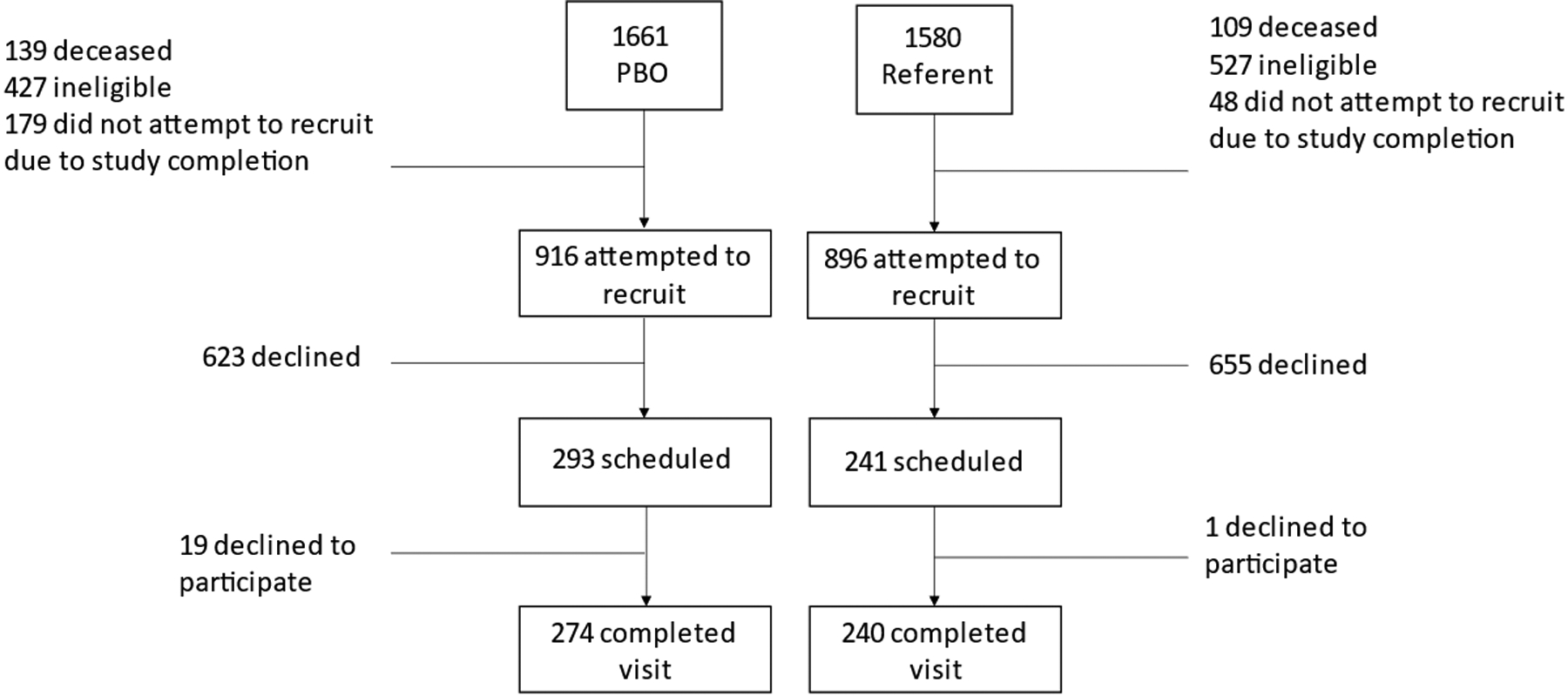
We enrolled 274 women with PBO with or without concurrent or preceding hysterectomy and 240 referents aged 55 years and older who were residents of Olmsted County, MN as of the PBO or index date. Chronic conditions were assessed via medical record abstraction. Cognitive diagnoses were based on neurocognitive testing. A physical function assessment included measures of strength and mobility. Multivariable regression models compared characteristics for women with PBO <46 years, PBO 46-49 years, and referent women with adjustments for age and other confounders.
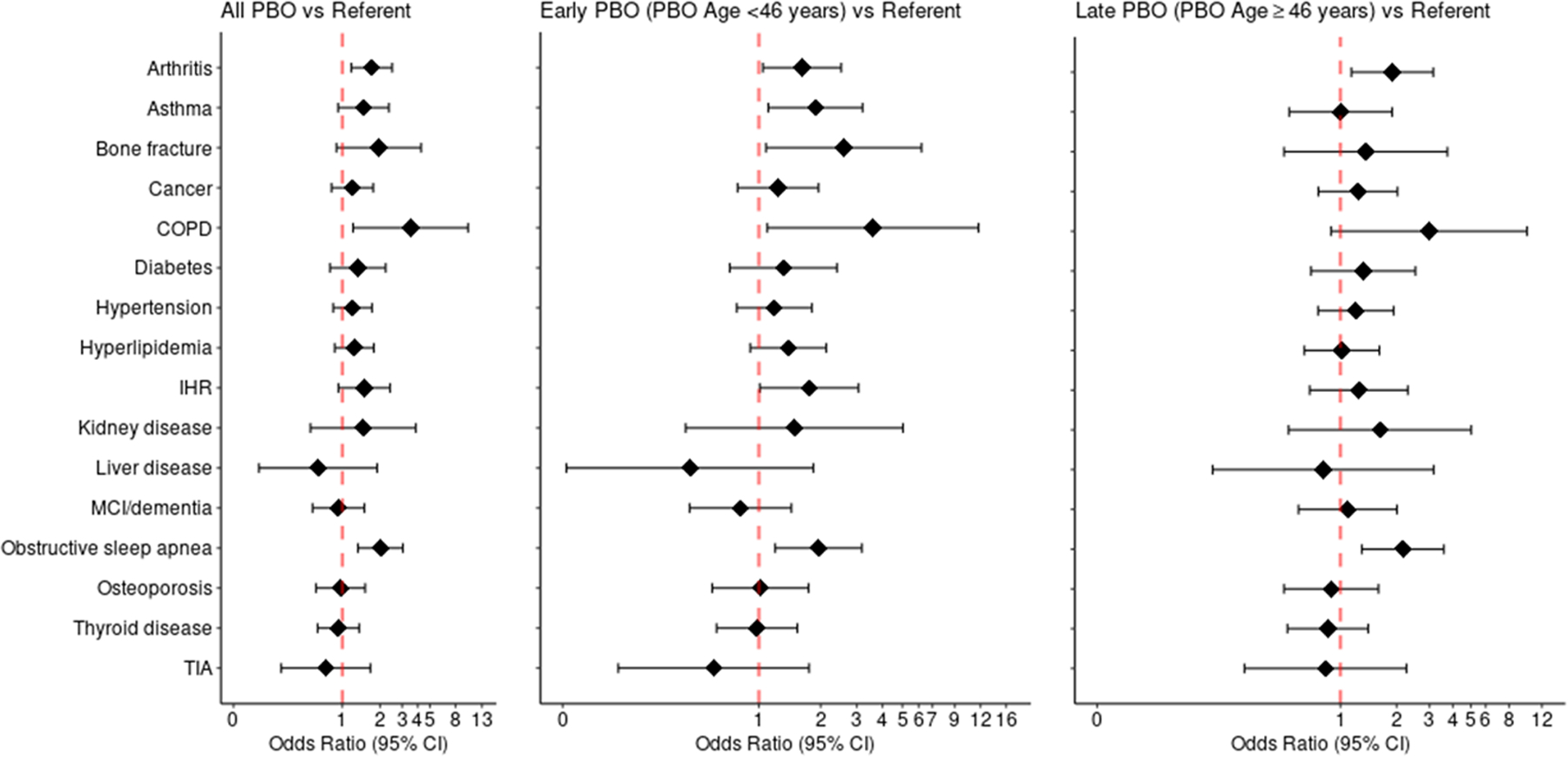
The clinical visits (median age, 67 years) were a median of 22 years after the PBO or index date. Of 274 women with PBO, 161 (59%) were <46 years at PBO and 113 (41%) were 46-49 years. Compared with referents, women with a history of PBO <46 years had increased odds of arthritis (odds ratio [OR], 1.64; 95% confidence interval [CI], 1.06-2.55), asthma (OR, 1.74; 95% CI, 1.03-2.93), obstructive sleep apnea (OR, 2.00; 95% CI, 1.23-3.26), and bone fractures (OR, 2.86; 95% CI, 1.17-6.98), and walked a shorter mean distance on a 6-minute walk test ( b = -18.43; P = 0.034). Compared with referents, women with a history of PBO at age 46-49 years had increased odds of arthritis (OR, 1.92; 95% CI, 1.16-3.18) and obstructive sleep apnea (OR, 2.21; 95% CI, 1.33-3.66). There were no significant differences in cognitive status in women with PBO compared with referents.
Women with a history of PBO with or without concurrent or preceding hysterectomy, especially at age <46 years, have more chronic conditions in late mid-life compared with referents.
我们研究了绝经前双侧卵巢切除术(PBO)伴或不伴同期或前期子宫切除术对身体和认知功能以及慢性病发病几率的长期影响。
我们纳入了 274 名 PBO 伴或不伴同期或前期子宫切除术的患者和 240 名年龄在 55 岁及以上、作为 PBO 或索引日期时居住在明尼苏达州奥姆斯特德县的对照者。通过病历摘录评估慢性病。认知诊断基于神经认知测试。身体功能评估包括力量和移动性的测量。多变量回归模型比较了 PBO<46 岁、PBO 46-49 岁和对照者的特征,调整了年龄和其他混杂因素。
临床访视(中位年龄,67 岁)是在 PBO 或索引日期后中位数 22 年进行的。在 274 名 PBO 患者中,161 名(59%)在 PBO 时<46 岁,113 名(41%)为 46-49 岁。与对照者相比,PBO<46 岁的患者发生关节炎的几率更高(比值比 [OR],1.64;95%置信区间 [CI],1.06-2.55)、哮喘(OR,1.74;95% CI,1.03-2.93)、阻塞性睡眠呼吸暂停(OR,2.00;95% CI,1.23-3.26)和骨折(OR,2.86;95% CI,1.17-6.98),6 分钟步行试验中行走的平均距离更短(b=-18.43;P=0.034)。与对照者相比,PBO 在 46-49 岁时的患者发生关节炎(OR,1.92;95% CI,1.16-3.18)和阻塞性睡眠呼吸暂停(OR,2.21;95% CI,1.33-3.66)的几率更高。与对照者相比,PBO 患者的认知状况没有显著差异。
与对照者相比,PBO 伴或不伴同期或前期子宫切除术的患者,尤其是<46 岁的患者,在中年后期患有更多的慢性病。