Department of Radiation Oncology and Proton & Radiation Therapy Center, Kaohsiung Chang Gung Memorial Hospital, Chang Gung University College of Medicine, No. 129, Dapi Road, Niaosong District, Kaohsiung, Taiwan.
Institute of Computer Science and Engineering, National Yang Ming Chiao Tung University, No. 1001 University Road, Hsinchu, Taiwan.
Cancer Imaging. 2023 Sep 12;23(1):84. doi: 10.1186/s40644-023-00601-7.
Extranodal extension (ENE) in head and neck squamous cell carcinoma (HNSCC) correlates to poor prognoses and influences treatment strategies. Deep learning may yield promising performance of predicting ENE in HNSCC but lack of transparency and interpretability. This work proposes an evolutionary learning method, called EL-ENE, to establish a more interpretable ENE prediction model for aiding clinical diagnosis.
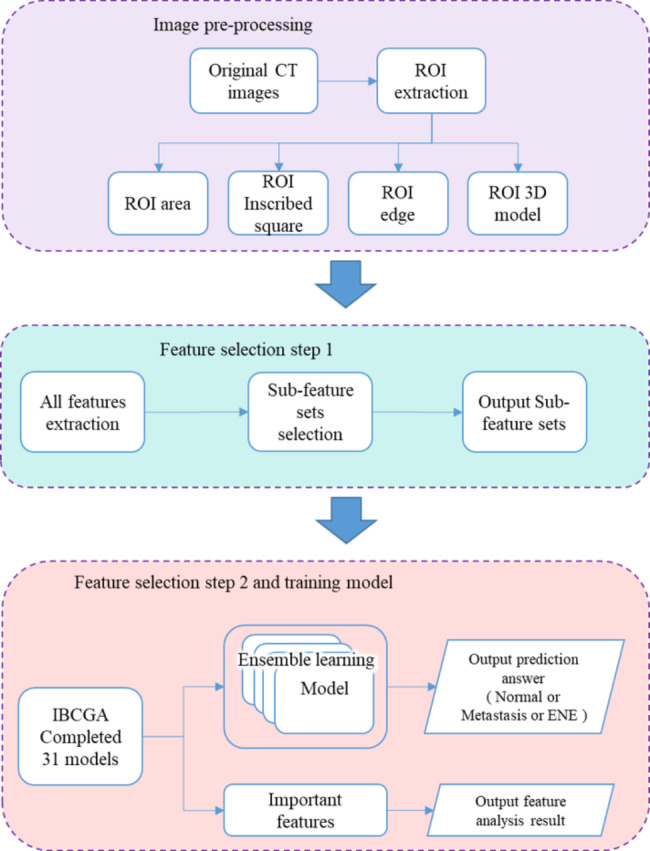
There were 364 HNSCC patients who underwent neck lymph node (LN) dissection with pre-operative contrast-enhanced computerized tomography images. All the 778 LNs were divided into training and test sets with the ratio 8:2. EL-ENE uses an inheritable bi-objective combinatorial genetic algorithm for optimal feature selection and parameter setting of support vector machine. The diagnostic performances of the ENE prediction model and radiologists were compared using independent test datasets.
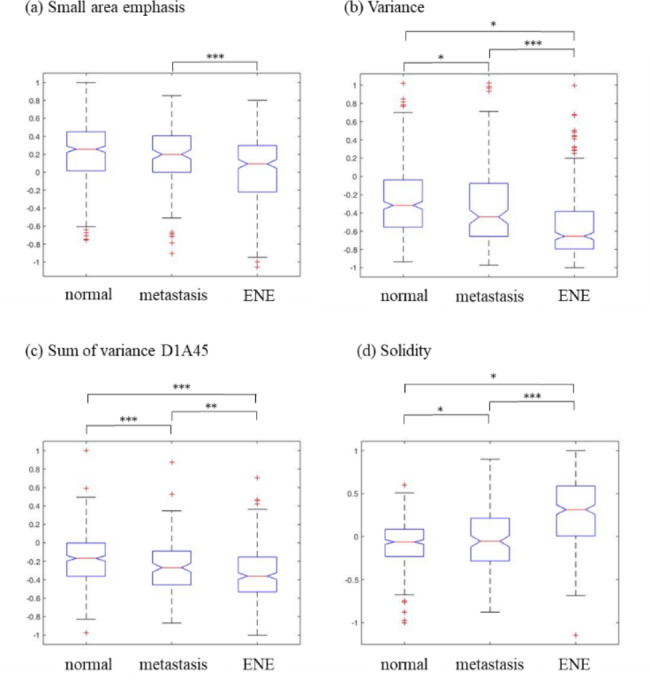
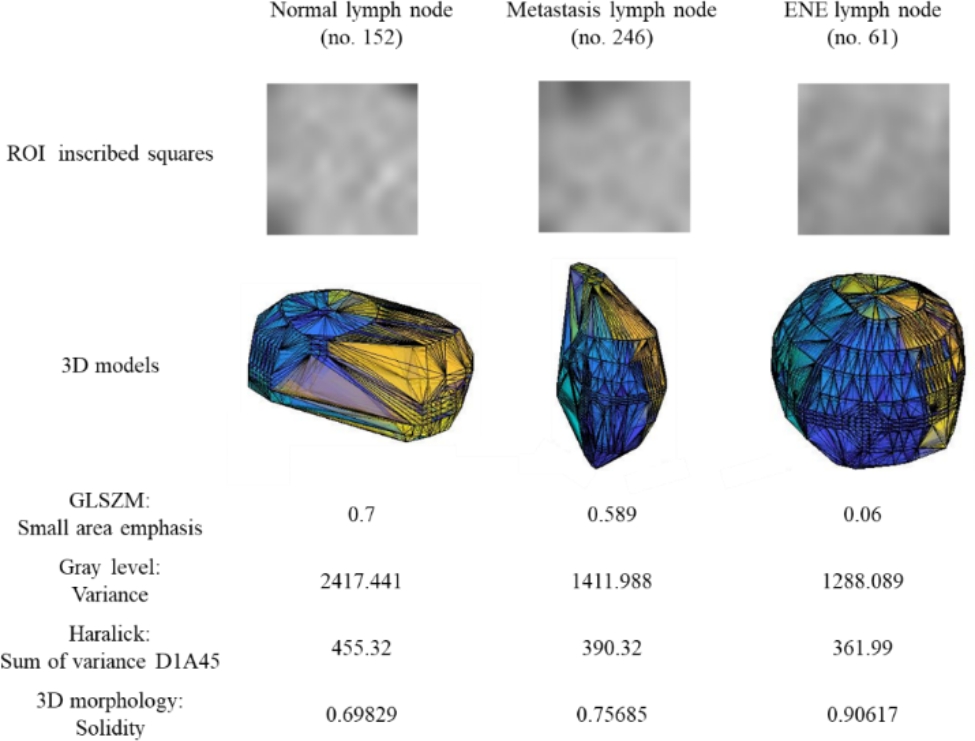
The EL-ENE model achieved the test accuracy of 80.00%, sensitivity of 81.13%, and specificity of 79.44% for ENE detection. The three radiologists achieved the mean diagnostic accuracy of 70.4%, sensitivity of 75.6%, and specificity of 67.9%. The features of gray-level texture and 3D morphology of LNs played essential roles in predicting ENE.
The EL-ENE method provided an accurate, comprehensible, and robust model to predict ENE in HNSCC with interpretable radiomic features for expanding clinical knowledge. The proposed transparent prediction models are more trustworthy and may increase their acceptance in daily clinical practice.
头颈部鳞状细胞癌(HNSCC)的结外扩展(ENE)与不良预后相关,并影响治疗策略。深度学习在预测 HNSCC 的 ENE 方面可能具有良好的性能,但缺乏透明度和可解释性。本研究提出了一种名为 EL-ENE 的进化学习方法,以建立一种更具解释性的 HNSCC ENE 预测模型,辅助临床诊断。
对 364 例接受颈淋巴结清扫术的 HNSCC 患者进行了术前增强 CT 检查。778 枚 LN 分为训练集和测试集,比例为 8:2。EL-ENE 使用可遗传的双目标组合遗传算法进行最优特征选择和支持向量机的参数设置。使用独立测试数据集比较了 ENE 预测模型和放射科医生的诊断性能。
EL-ENE 模型对头颈部鳞状细胞癌 ENE 检测的测试准确率为 80.00%,敏感度为 81.13%,特异度为 79.44%。三位放射科医生的平均诊断准确率为 70.4%,敏感度为 75.6%,特异度为 67.9%。LN 的灰度纹理和 3D 形态特征在预测 ENE 中起重要作用。
EL-ENE 方法提供了一种准确、可理解和稳健的模型,用于预测 HNSCC 的 ENE,并提供了可解释的放射组学特征,以扩展临床知识。提出的透明预测模型更值得信赖,并可能增加其在日常临床实践中的接受度。