Academy of Integrative Medicine, Fujian University of Traditional Chinese Medicine, Fuzhou, Fujian, People's Republic of China.
Fujian Key Laboratory of Integrative Medicine on Geriatrics, Fujian University of Traditional Chinese Medicine, Fuzhou, Fujian, People's Republic of China.
Drug Des Devel Ther. 2023 Sep 7;17:2749-2762. doi: 10.2147/DDDT.S414179. eCollection 2023.
This study aimed to investigate the molecular mechanisms of isoliensinine, a kind of bibenzyl isoquinoline alkaloid which isolated from a TCM named Lotus Plumule (), in treating renal interstitial fibrosis (RIF) by using RNA sequencing, KEGG analysis and in vivo experimental approaches.
Spontaneous hypertension rats (SHRs) were randomly assigned into five groups, consisting of SHR, SHR+Isoliensinine-L (2.5 mg/kg/day), SHR+Isoliensinine-M (5 mg/kg/day), SHR+Isoliensinine-H (10 mg/kg/day), and SHR+Valsartan (10 mg/kg/day) groups (n = 6 for each group). A control group of Wistar Kyoto rats (n = 6) was also included. Rats were treated intragastrically with isoliensinine, valsartan, or double-distilled water of equal volume for 10 weeks. To examine the therapeutic impact on hypertensive renal injury, fibrosis, and its underlying mechanisms, multiple techniques were employed, including hematoxylin and eosin staining, Masson trichrome staining, RNA sequencing, gene ontology (GO) function and pathway enrichment analysis and immunohistochemistry.
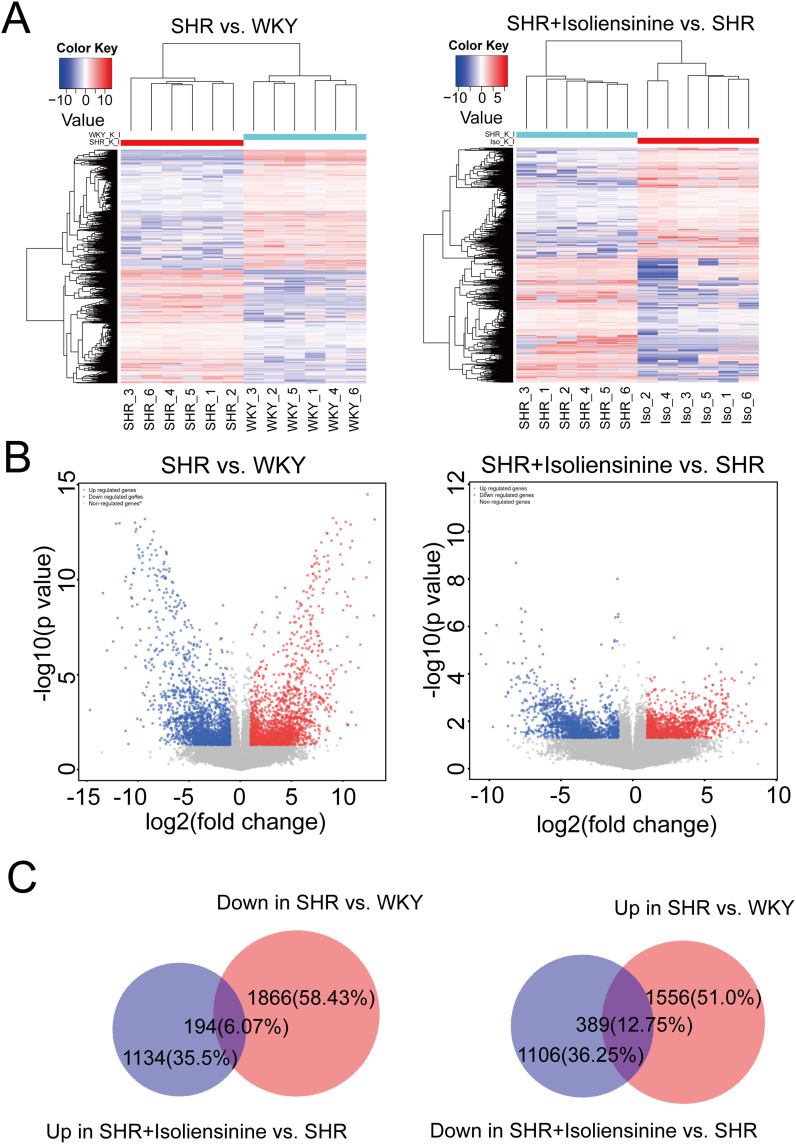
Resultantly, the use of isoliensinine at different concentrations or valsartan showed significant improvement in renal pathological injury in SHRs. RNA sequencing and KEGG analysis uncovered 583 differentially expressed transcripts and pathways enriched in collagen formation and ECM-receptor interaction after treatment with isoliensinine. There was also a reduction in the increase of collagen and upregulation of collagen I & III, TGF-β1, p-Smad2, and p-Smad3 in the renal tissue of SHRs. Thus, isoliensinine ameliorated renal injury and collagen deposition in hypertensive rats, and inhibiting the activation of the TGF-β1/Smad2/3 pathway might be one of the underlying mechanisms.
This study showed that treatment with isoliensinine effectively reduced the renal injury and fibrosis in SHRs. In addition, isoliensinine inhibited the TGF-β1/Smad2/3 signaling in-vivo. These findings provided strong evidence for the therapeutic benefits of isoliensinine in combating renal injury and fibrosis.
本研究旨在通过 RNA 测序、KEGG 分析和体内实验方法,探讨从中药莲子心中分离得到的一种双苄基异喹啉生物碱异莲心碱治疗肾间质纤维化(RIF)的分子机制。
自发性高血压大鼠(SHR)随机分为五组,分别为 SHR 组、SHR+异莲心碱低剂量(2.5mg/kg/天)组、SHR+异莲心碱中剂量(5mg/kg/天)组、SHR+异莲心碱高剂量(10mg/kg/天)组和 SHR+缬沙坦(10mg/kg/天)组(每组 6 只)。还包括一组 Wistar Kyoto 大鼠作为对照组(n=6)。大鼠用异莲心碱、缬沙坦或等体积双蒸水灌胃 10 周。为了研究异莲心碱对高血压肾损伤、纤维化及其潜在机制的治疗作用,采用了多种技术,包括苏木精和伊红染色、Masson 三色染色、RNA 测序、基因本体(GO)功能和通路富集分析以及免疫组织化学。
结果表明,异莲心碱在不同浓度或缬沙坦的作用下,均可显著改善 SHR 的肾脏病理损伤。RNA 测序和 KEGG 分析显示,异莲心碱处理后,胶原形成和 ECM-受体相互作用相关的 583 个差异表达转录本和通路被富集。同时,还观察到胶原的增加减少,以及 SHR 肾组织中胶原 I 和 III、TGF-β1、p-Smad2 和 p-Smad3 的上调减少。因此,异莲心碱可改善高血压大鼠的肾脏损伤和胶原沉积,抑制 TGF-β1/Smad2/3 通路的激活可能是其作用机制之一。
本研究表明,异莲心碱治疗可有效减轻 SHR 的肾脏损伤和纤维化。此外,异莲心碱在体内抑制 TGF-β1/Smad2/3 信号通路。这些发现为异莲心碱在治疗肾脏损伤和纤维化方面的疗效提供了有力证据。