Wyrich Martine, Ohlig Henning, Wessolly Michael, Mairinger Elena, Steinborn Julia, Brcic Luka, Hegedus Balazs, Hager Thomas, Greimelmaier Kristina, Wohlschlaeger Jeremias, Mairinger Fabian D, Borchert Sabrina
Institute of Pathology, University Hospital Essen, University of Duisburg-Essen, Essen, Germany.
German Cancer Consortium (DKTK), Partner Site University Hospital Essen, Essen, Germany.
Transl Cancer Res. 2023 Aug 31;12(8):1929-1936. doi: 10.21037/tcr-22-2651. Epub 2023 Jul 21.
Malignant pleural mesothelioma (MPM) is an aggressive tumor with a dismal prognosis. Currently, multimodality treatment including chemotherapy with cisplatin or carboplatin in combination with pemetrexed offers the best options. Detoxification of heavy metals in the cell by metallothioneins (MT) is associated with early failure to platin-based chemotherapy. The induction of MTs gene expression or its enzyme results in saturation by exposure to metal ions such as zinc or cadmium. Its therapeutically effect is still not analyzed in depth.
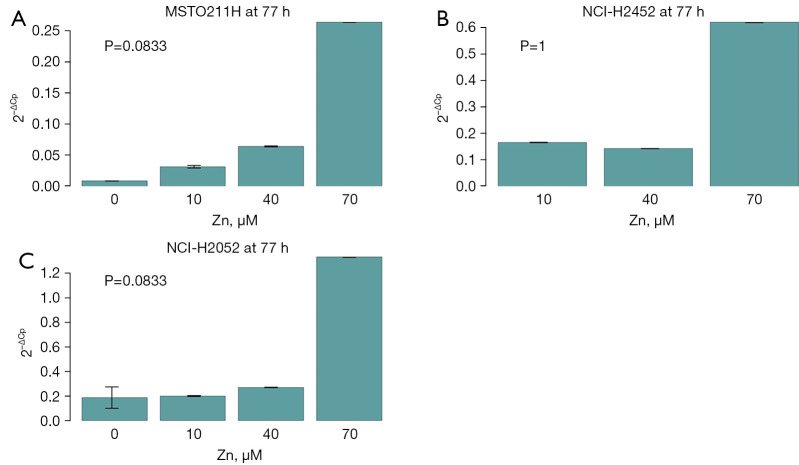
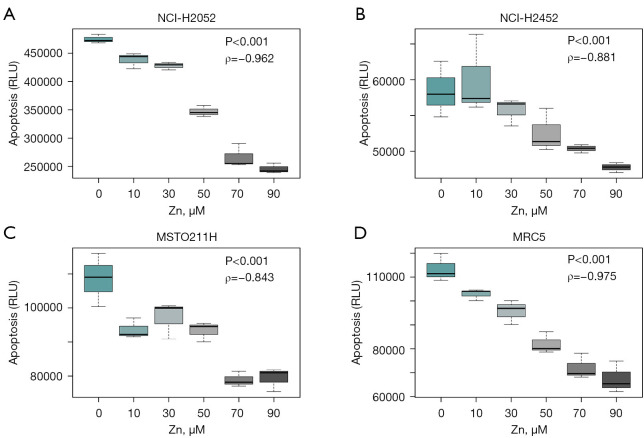
In our study, we investigated three MPM cell lines and one fibroblast cell line in the course of cisplatin treatment and supplementation of zinc. Cell state analyses via an enzyme-activity based assay were performed. With this, we were able to analyze apoptosis, necrosis and viability of cells. Additionally, we tested treated cells for changes in metallothionein IIA (MT2A) expression by using quantitative realtime polymerase chain reaction.
Zinc supplementation induces gene expression of MT2A. Overall, a zinc dose-dependent induction of apoptosis under platin-based treatment could be observed. This effect could be verified in all analyzed cell lines in varying intensity.
MT expression is induced by zinc in a dose-dependent manner and inhibits a successful cisplatin therapy. Therefore, heavy metal exposure during cisplatin therapy, e.g., via cigarette smoke, might be an important factor. This should be considered in further therapeutic approaches.
恶性胸膜间皮瘤(MPM)是一种侵袭性肿瘤,预后不佳。目前,多模式治疗,包括顺铂或卡铂联合培美曲塞化疗,提供了最佳选择。金属硫蛋白(MT)对细胞中重金属的解毒作用与铂类化疗的早期失败有关。MTs基因表达或其酶的诱导会因暴露于锌或镉等金属离子而饱和。其治疗效果仍未得到深入分析。
在我们的研究中,我们在顺铂治疗和补充锌的过程中研究了三种MPM细胞系和一种成纤维细胞系。通过基于酶活性的分析进行细胞状态分析。由此,我们能够分析细胞的凋亡、坏死和活力。此外,我们通过定量实时聚合酶链反应检测处理后的细胞中金属硫蛋白IIA(MT2A)表达的变化。
补充锌可诱导MT2A的基因表达。总体而言,在铂类治疗下可观察到锌剂量依赖性的凋亡诱导。这种效应在所有分析的细胞系中均可在不同强度下得到验证。
锌以剂量依赖的方式诱导MT表达并抑制顺铂治疗的成功。因此,顺铂治疗期间的重金属暴露,例如通过香烟烟雾,可能是一个重要因素。在进一步的治疗方法中应考虑这一点。