Institute of Pathology, University Hospital Essen, University of Duisburg-Essen, Essen, Germany.
German Cancer Consortium (DKTK), Partner Site University Hospital Essen, Hufelandstrasse 55, 45122, Essen, Germany.
Sci Rep. 2020 Oct 29;10(1):18677. doi: 10.1038/s41598-020-75807-x.
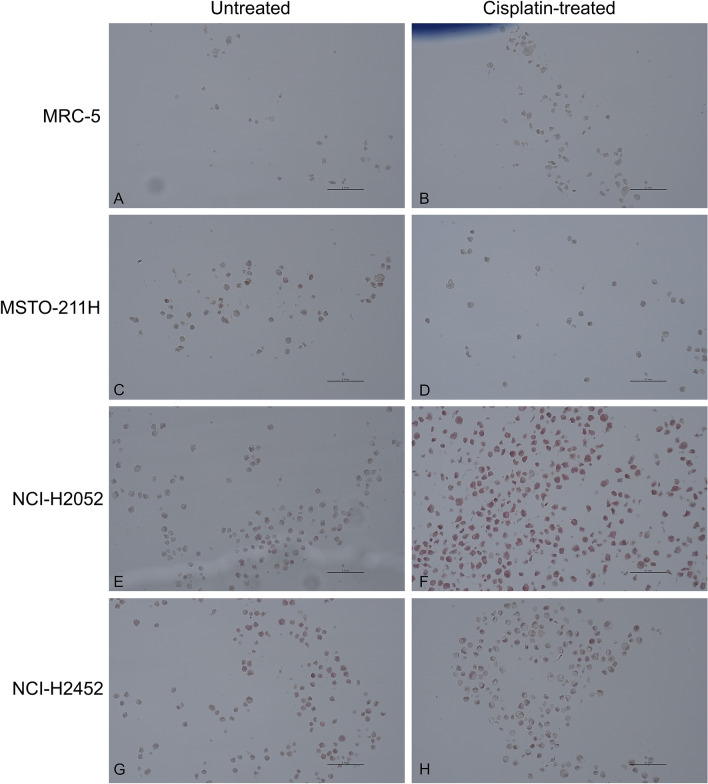
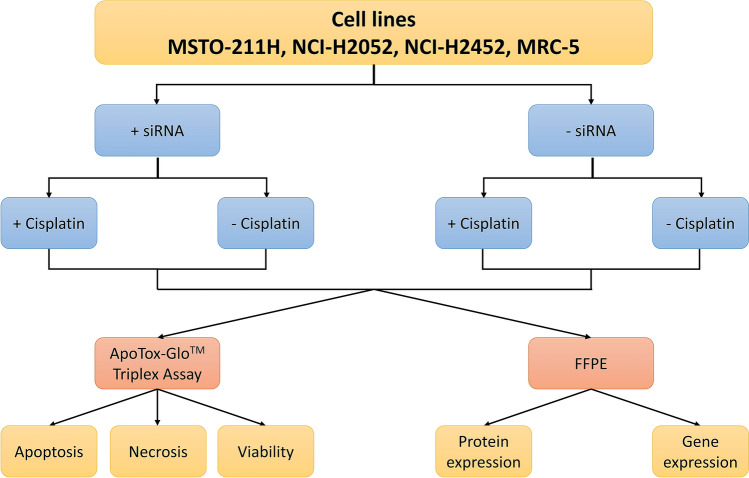
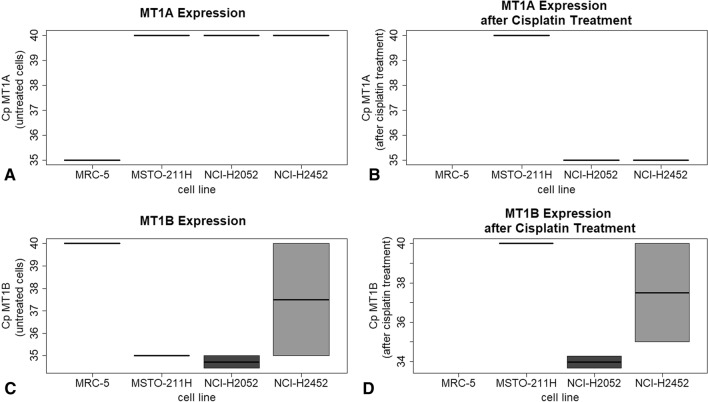
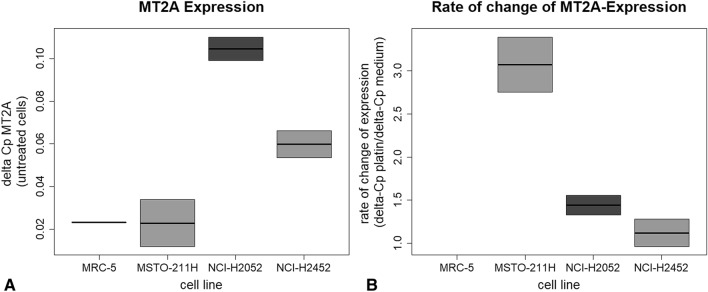
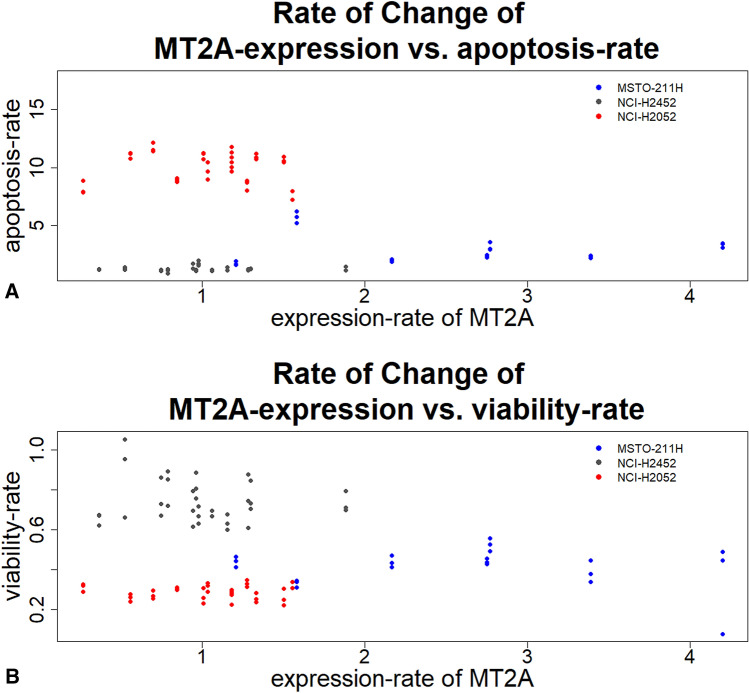
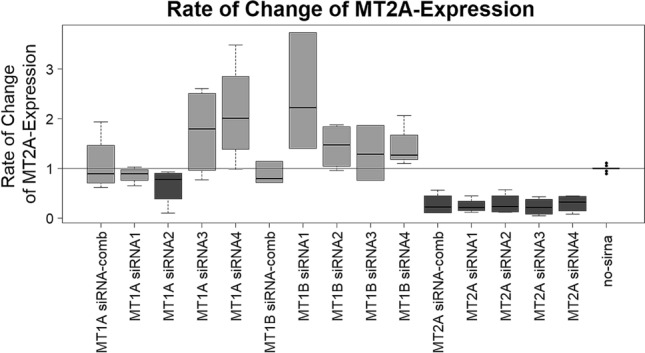
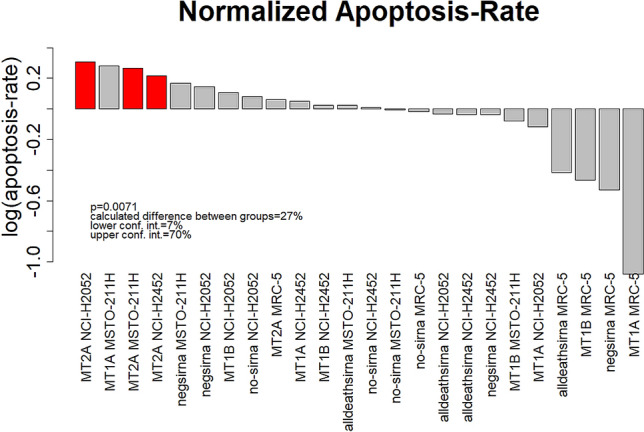
Malignant pleural mesothelioma (MPM) is a rare, but aggressive tumor with dismal prognosis. Platinum-based chemotherapy is regularly used as part of multimodality therapy. The expression of metallothioneins (MT) has been identified as a reason for cisplatin resistance, which often leads to early therapy failure or relapse. Thus, knockdown of MT expression may improve response to cisplatin treatment. The MT gene- and protein expression of the MPM-cell lines MSTO-211H, NCI-H2052 and NCI-H2452 and the human fibroblast cell line MRC-5, as well as their sensitivity to cisplatin treatment have been evaluated. Knockdown of MT1A, 1B and 2A expression was induced by RNA interference. MT expression was measured using quantitative real-time PCR. An in vitro Assay based on enzyme activity was used to detect cell viability, necrosis and apoptosis before and after incubation with cisplatin. MT2A gene expression could be detected in all MPM cell lines, showing the highest expression in NCI-H2452 and NCI-H2052, whereas gene expression levels of MT1A and MT1B were low or absent. The immunohistochemically protein expression of MT-I/II reflect MT2A gene expression levels. Especially for MSTO-211H cell presenting low initial MT2A levels, a strong induction of MT2A expression could be observed during cisplatin treatment, indicating a cell line-specific and platin-dependent adaption mechanism. Additionally, a MT2A-dependent cellular evasion of apoptosis during cisplatin could be observed, leading to three different MT based phenotypes. MSTO-211H cells showed lower apoptosis rates at an increased expression level of MT2A after cisplatin treatment (from sixfold to fourfold). NCI-H2052 cells showed no changes in MT2A expression, while apoptosis rate is the highest (8-12-fold). NCI-H2452 cells showed neither changes in alteration rate of MT2A expression nor changes in apoptosis rates, indicating an MT2A-independent resistance mechanism. Knockdown of MT2A expression levels resulted in significantly induced apoptotic rates during cisplatin treatment with strongest induction of apoptosis in each of the MPM cell lines, but in different markedness. A therapeutic meaningful effect of MT2A knockdown and subsequent cisplatin treatment could be observed in MSTO-211H cells. The present study showed MT2A to be part of the underlying mechanism of cisplatin resistance in MPM. Especially in MSTO-211H cells we could demonstrate major effects by knockdown of MT2A expression, verifying our hypothesis of an MT driven resistance mechanism. We could prove the inhibition of MT2A as a powerful tool to boost response rates to cisplatin-based therapy in vitro. These data carry the potential to enhance the clinical outcome and management of MPM in the future.
恶性胸膜间皮瘤(MPM)是一种罕见但侵袭性强、预后不良的肿瘤。顺铂为基础的化疗常被用于多模式治疗的一部分。金属硫蛋白(MT)的表达被认为是顺铂耐药的原因之一,这往往导致早期治疗失败或复发。因此,降低 MT 表达可能会改善顺铂治疗的反应。评估了 MPM 细胞系 MSTO-211H、NCI-H2052 和 NCI-H2452 以及人成纤维细胞系 MRC-5 的 MT 基因和蛋白表达及其对顺铂治疗的敏感性。通过 RNA 干扰诱导 MT1A、1B 和 2A 表达的下调。使用定量实时 PCR 测量 MT 表达。基于酶活性的体外测定用于检测顺铂孵育前后细胞活力、坏死和凋亡。所有 MPM 细胞系均可检测到 MT2A 基因表达,其中 NCI-H2452 和 NCI-H2052 表达最高,而 MT1A 和 MT1B 的基因表达水平较低或缺失。MT-I/II 的免疫组化蛋白表达反映了 MT2A 基因表达水平。特别是对于 MSTO-211H 细胞,其初始 MT2A 水平较低,在顺铂治疗期间可观察到 MT2A 表达的强烈诱导,表明存在细胞系特异性和铂依赖性适应机制。此外,在顺铂作用下还观察到 MT2A 依赖性细胞逃避凋亡,导致三种不同的基于 MT 的表型。MSTO-211H 细胞在顺铂处理后 MT2A 表达水平升高(从六倍增加到四倍)时,凋亡率较低。NCI-H2052 细胞中 MT2A 表达无变化,而凋亡率最高(8-12 倍)。NCI-H2452 细胞中 MT2A 表达变化率和凋亡率均无变化,表明存在 MT2A 不依赖的耐药机制。下调 MT2A 表达水平可导致顺铂治疗期间凋亡率显著诱导,在每种 MPM 细胞系中均有最强的诱导凋亡,但程度不同。在 MSTO-211H 细胞中观察到 MT2A 敲低和随后顺铂治疗的治疗意义显著。本研究表明 MT2A 是 MPM 中顺铂耐药潜在机制的一部分。特别是在 MSTO-211H 细胞中,我们可以通过下调 MT2A 表达来证明其主要作用,验证了我们关于 MT 驱动的耐药机制的假设。我们可以证明抑制 MT2A 作为提高体外顺铂治疗反应率的有力工具。这些数据有可能提高未来 MPM 的临床结果和管理。