Yonezawa Kengo, Tani Hideaki, Nakajima Shinichiro, Uchida Hiroyuki
Department of Neuropsychiatry, Keio University School of Medicine, Tokyo, Japan.
Neuropsychopharmacol Rep. 2024 Mar;44(1):280-284. doi: 10.1002/npr2.12377. Epub 2023 Sep 13.
Psychedelics have garnered increased attention as potential therapeutic options for various mental illnesses. Previous studies reported that psychedelics cause psychoactive effects through mystical experiences induced by these substances, including an altered state of consciousness. While this phenomenon is commonly assessed by the Mystical Experiences Questionnaire (MEQ30), a Japanese version of the MEQ30 has not been available. The aim of this study was to develop the Japanese version of the MEQ30.
We adhered to the "Principles of Good Practice for the Translation and Cultural Adaptation Process for Patient-Reported Outcomes (PRO) Measures: Report of the ISPOR Task Force for Translation and Cultural Adaptation" in our translation process. Two Japanese psychiatrists independently performed forward translations, from which a unified version was derived through reconciliation. This version was subsequently back-translated into English and reviewed by the original authors for equivalency. The iterative revision process was carried out through ongoing discussions with the original authors until they approved the final back-translated version.
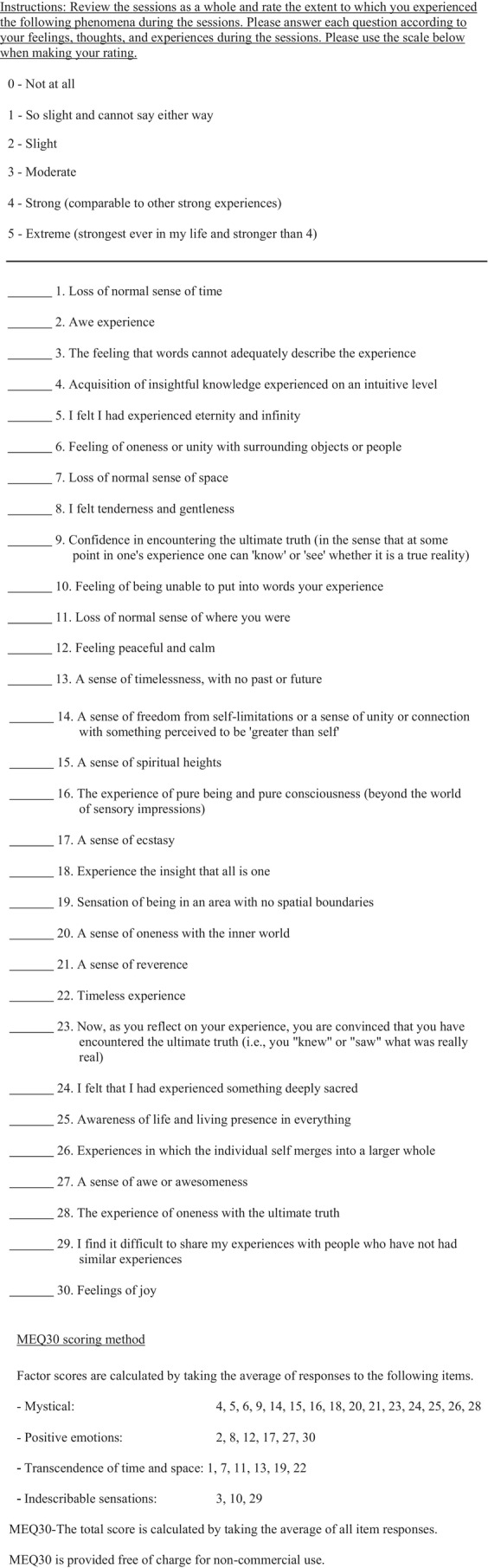
The final, approved back-translated version of the MEQ30 is presented in the accompanying figure. Additionally, the authorized Japanese version of the MEQ30 is included in the Appendix A.
In this study, we successfully developed a Japanese version of the MEQ30. This scale will facilitate the assessment of mystical experiences associated with psychedelic-assisted therapy among Japanese speakers. Further research is warranted to evaluate the reliability and validity of this newly translated scale.
迷幻剂作为各种精神疾病的潜在治疗选择,已受到越来越多的关注。先前的研究报告称,迷幻剂通过这些物质引发的神秘体验产生精神活性作用,包括意识状态的改变。虽然这种现象通常通过《神秘体验问卷》(MEQ30)进行评估,但尚未有该问卷的日语版本。本研究的目的是开发MEQ30的日语版本。
我们在翻译过程中遵循了“患者报告结局(PRO)测量翻译和文化调适过程的良好实践原则:ISPOR翻译和文化调适特别工作组报告”。两位日本精神科医生独立进行正向翻译,通过核对得出统一版本。该版本随后被反向翻译成英语,并由原作者进行等效性审查。通过与原作者持续讨论进行迭代修订过程,直至他们批准最终的反向翻译版本。
MEQ30最终经批准的反向翻译版本见附图。此外,MEQ30的授权日语版本包含在附录A中。
在本研究中,我们成功开发了MEQ30的日语版本。该量表将有助于评估说日语人群中与迷幻剂辅助治疗相关的神秘体验。有必要进行进一步研究以评估这个新翻译量表的信度和效度。