Erroi Andrea, Mecca Sara, Zaffalon Matteo L, Frank Isabel, Carulli Francesco, Cemmi Alessia, Di Sarcina Ilaria, Debellis Doriana, Rossi Francesca, Cova Francesca, Pauwels Kristof, Mauri Michele, Perego Jacopo, Pinchetti Valerio, Comotti Angiolina, Meinardi Francesco, Vedda Anna, Auffray Etiennette, Beverina Luca, Brovelli Sergio
Dipartimento di Scienza dei Materiali, Università degli Studi Milano - Bicocca, via R. Cozzi 55, 20126 Milan, Italy.
CERN, Esplanade des Particules 1, 1211 Meyrin, Switzerland.
ACS Energy Lett. 2023 Aug 28;8(9):3883-3894. doi: 10.1021/acsenergylett.3c01396. eCollection 2023 Sep 8.
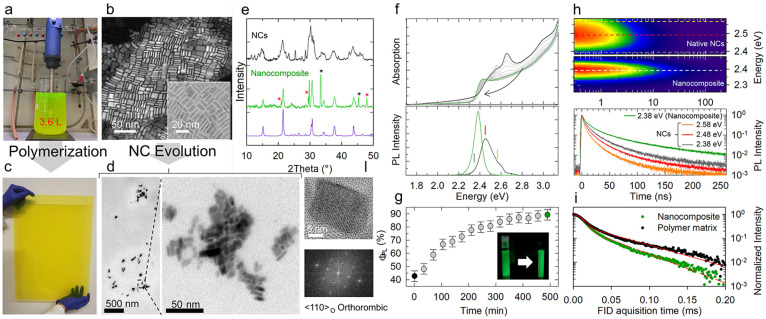
The use of scintillators for the detection of ionizing radiation is a critical aspect in many fields, including medicine, nuclear monitoring, and homeland security. Recently, lead halide perovskite nanocrystals (LHP-NCs) have emerged as promising scintillator materials. However, the difficulty of affordably upscaling synthesis to the multigram level and embedding NCs in optical-grade nanocomposites without compromising their optical properties still limits their widespread use. In addition, fundamental aspects of the scintillation mechanisms are not fully understood, leaving the scientific community without suitable fabrication protocols and rational guidelines for the full exploitation of their potential. In this work, we realize large polyacrylate nanocomposite scintillators based on CsPbBr NCs, which are synthesized via a novel room temperature, low waste turbo-emulsification approach, followed by their in situ transformation during the mass polymerization process. The interaction between NCs and polymer chains strengthens the scintillator structure, homogenizes the particle size distribution and passivates NC defects, resulting in nanocomposite prototypes with luminescence efficiency >90%, exceptional radiation hardness, 4800 ph/MeV scintillation yield even at low NC loading, and ultrafast response time, with over 30% of scintillation occurring in the first 80 ps, promising for fast-time applications in precision medicine and high-energy physics. Ultrafast radioluminescence and optical spectroscopy experiments using pulsed synchrotron light further disambiguate the origin of the scintillation kinetics as the result of charged-exciton and multiexciton recombination formed under ionizing excitation. This highlights the role of nonradiative Auger decay, whose potential impact on fast timing applications we anticipate via a kinetic model.
闪烁体用于检测电离辐射在许多领域都是一个关键方面,包括医学、核监测和国土安全。最近,卤化铅钙钛矿纳米晶体(LHP-NCs)已成为有前景的闪烁体材料。然而,以经济可行的方式将合成规模扩大到克级,并将纳米晶体嵌入光学级纳米复合材料中而不损害其光学性能,这一困难仍然限制了它们的广泛应用。此外,闪烁机制的基本方面尚未完全理解,这使得科学界缺乏合适的制造方案和合理的指导方针来充分发挥其潜力。在这项工作中,我们基于CsPbBr纳米晶体实现了大型聚丙烯酸酯纳米复合闪烁体,这些纳米晶体通过一种新颖的室温、低浪费涡轮乳化方法合成,随后在本体聚合过程中进行原位转化。纳米晶体与聚合物链之间的相互作用增强了闪烁体结构,使粒径分布均匀并钝化纳米晶体缺陷,从而得到发光效率>90%、具有出色辐射硬度、即使在低纳米晶体负载量下闪烁产率也达到4800 ph/MeV以及超快响应时间的纳米复合原型,其中超过30%的闪烁发生在前80 ps内,这对于精密医学和高能物理中的快速时间应用很有前景。使用脉冲同步加速器光进行的超快辐射发光和光谱实验进一步明确了闪烁动力学的起源是电离激发下形成的带电激子和多激子复合的结果。这突出了非辐射俄歇衰变的作用,我们通过动力学模型预测了其对快速定时应用的潜在影响。