Ministry of Education Key Laboratory of Metabolism and Molecular Medicine, Department of Endocrinology and Metabolism, Zhongshan Hospital, Fudan University, Shanghai, China.
State Key Laboratory of Networking and Switching Technology, Beijing University of Posts and Telecommunications, Beijing, China.
Nat Med. 2023 Oct;29(10):2633-2642. doi: 10.1038/s41591-023-02552-9. Epub 2023 Sep 14.
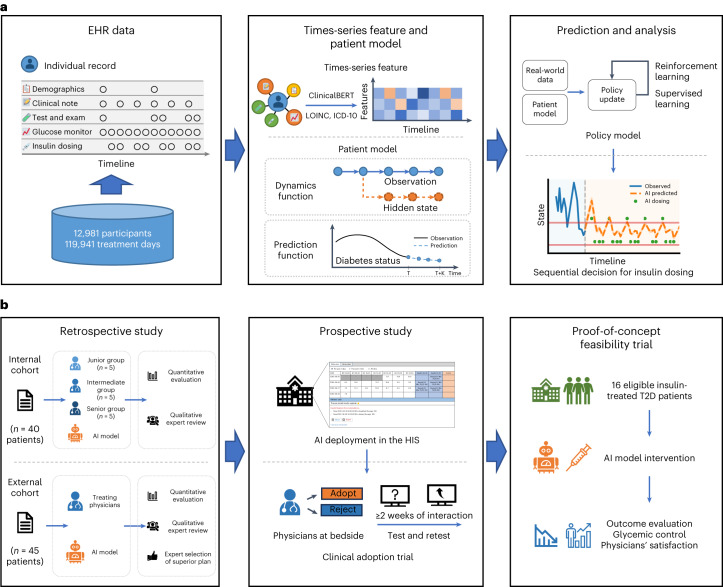
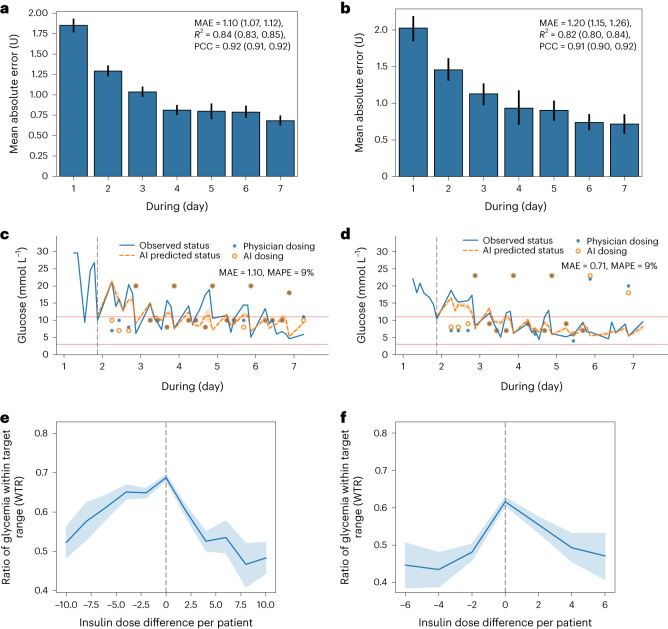
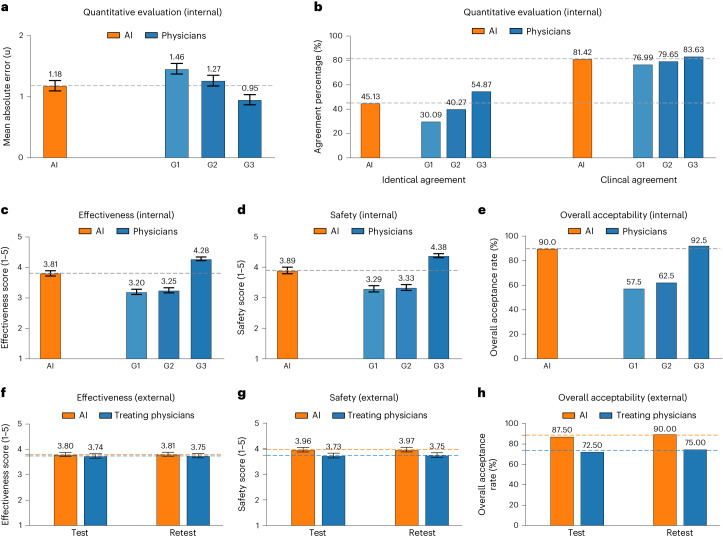
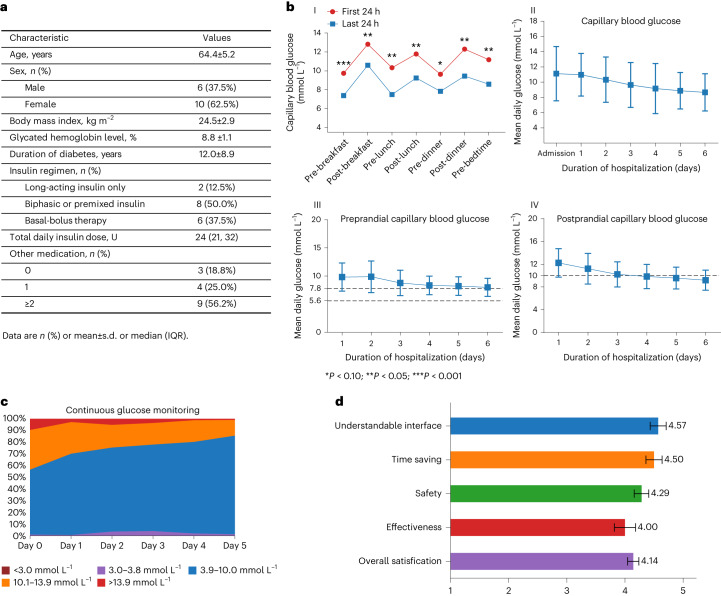
The personalized titration and optimization of insulin regimens for treatment of type 2 diabetes (T2D) are resource-demanding healthcare tasks. Here we propose a model-based reinforcement learning (RL) framework (called RL-DITR), which learns the optimal insulin regimen by analyzing glycemic state rewards through patient model interactions. When evaluated during the development phase for managing hospitalized patients with T2D, RL-DITR achieved superior insulin titration optimization (mean absolute error (MAE) of 1.10 ± 0.03 U) compared to other deep learning models and standard clinical methods. We performed a stepwise clinical validation of the artificial intelligence system from simulation to deployment, demonstrating better performance in glycemic control in inpatients compared to junior and intermediate-level physicians through quantitative (MAE of 1.18 ± 0.09 U) and qualitative metrics from a blinded review. Additionally, we conducted a single-arm, patient-blinded, proof-of-concept feasibility trial in 16 patients with T2D. The primary outcome was difference in mean daily capillary blood glucose during the trial, which decreased from 11.1 (±3.6) to 8.6 (±2.4) mmol L (P < 0.01), meeting the pre-specified endpoint. No episodes of severe hypoglycemia or hyperglycemia with ketosis occurred. These preliminary results warrant further investigation in larger, more diverse clinical studies. ClinicalTrials.gov registration: NCT05409391 .
针对 2 型糖尿病(T2D)的胰岛素个体化滴定和优化是一项资源密集型的医疗任务。在这里,我们提出了一种基于模型的强化学习(RL)框架(称为 RL-DITR),该框架通过分析患者模型交互作用中的血糖状态奖励来学习最佳的胰岛素方案。在对 T2D 住院患者进行管理的开发阶段进行评估时,与其他深度学习模型和标准临床方法相比,RL-DITR 实现了卓越的胰岛素滴定优化(平均绝对误差(MAE)为 1.10±0.03 U)。我们通过从模拟到部署的逐步临床验证,证明了人工智能系统在住院患者中的血糖控制性能优于初级和中级医生,通过盲审的定量(MAE 为 1.18±0.09 U)和定性指标进行评估。此外,我们还在 16 名 T2D 患者中进行了一项单臂、患者盲法、概念验证可行性试验。主要结局是试验期间平均每日毛细血管血糖的差异,从 11.1(±3.6)mmol/L 降至 8.6(±2.4)mmol/L(P<0.01),达到了预设的终点。没有出现严重低血糖或伴有酮症的高血糖事件。这些初步结果值得在更大、更多样化的临床研究中进一步调查。临床试验.gov 注册:NCT05409391。