
1990 - 2019年不同老龄化率国家阿尔茨海默病负担的时间模式及其与社会人口指数的关联
Temporal patterns of the burden of Alzheimer's disease and their association with Sociodemographic Index in countries with varying rates of aging 1990-2019.
作者信息
Ramadan Majed
机构信息
King Abdullah International Medical Research Center (KAIMRC), Population Health Research Section King Saud Bin Abdulaziz University for Health Sciences, Ministry of National Guard - Health Affairs Jeddah Saudi Arabia.
出版信息
Aging Med (Milton). 2023 Jul 12;6(3):281-289. doi: 10.1002/agm2.12260. eCollection 2023 Sep.
OBJECTIVE
To we examine the temporal patterns of the burden of Alzheimer's disease and their association with Sociodemographic Index in countries with varying rates of aging.
METHOD
Data were obtained from Global Burden of Diseases studies (GBD) 2019 and were used to compare countries with different rates of change in aging population from 1990 to 2019. We collected the data of the age-standardized rates per 100,000 of disability-adjusted life years (DALYs), incidence, prevalence of Alzheimer's disease and other dementias, and the age-specific population rates per 100,000.
RESULTS
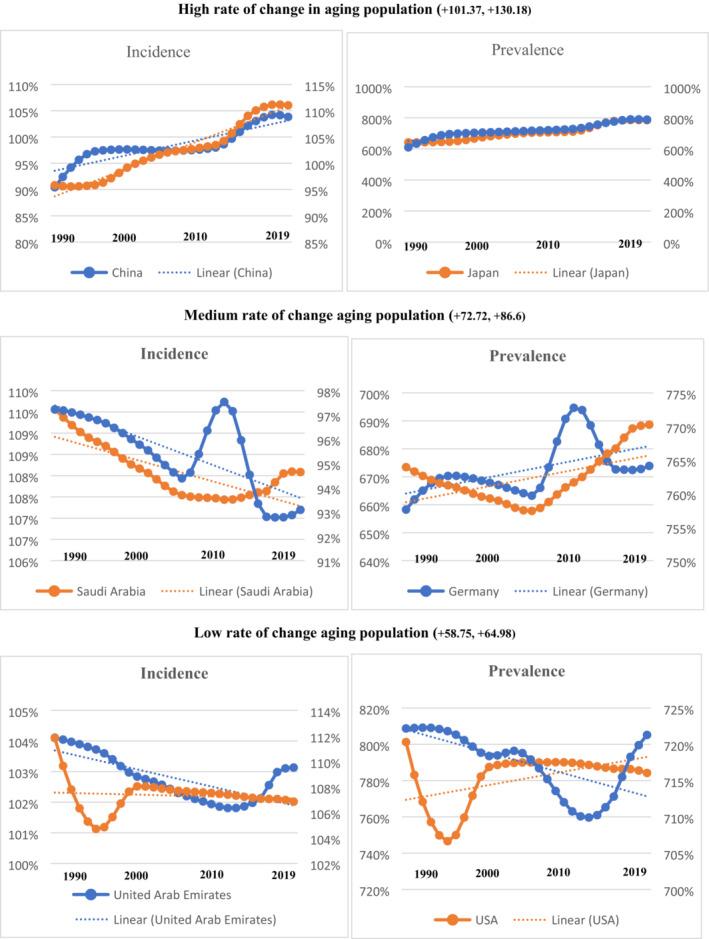
Countries with high rates of change in their aging populations had an increase in DALYs, incidence, and prevalence of Alzheimer's disease and other dementias over the last 30 years. Countries with a high rate of change in aging population had a significantly positive association among DALYs, incidence, and prevalence of Alzheimer's disease and other dementias. In contrast, countries with a medium and low rate of change in aging population had negative associations between DALYs and incidence of Alzheimer's disease and other dementias.
CONCLUSION
This study highlights the significant impact of demographic changes on the burden, prevalence, and incidence of Alzheimer's disease and other dementia. The study also found that robust health care and social systems, as reflected by a higher Sociodemographic Index, can contribute to reducing the burden of Alzheimer's disease and other dementias in medium to low rates of aging populations. The findings underscore the importance of investing in health care and social systems to address the growing burden of these conditions, especially in countries with a high rate of change in the aging population.
目的
我们研究了老龄化率不同的国家中阿尔茨海默病负担的时间模式及其与社会人口学指数的关联。
方法
数据取自《2019年全球疾病负担研究》,用于比较1990年至2019年老龄化人口变化率不同的国家。我们收集了每10万人的年龄标准化残疾调整生命年(DALY)、阿尔茨海默病及其他痴呆症的发病率、患病率以及每10万人的特定年龄人口率数据。
结果
在过去30年里,老龄化人口变化率高的国家,其阿尔茨海默病及其他痴呆症的DALY、发病率和患病率均有所上升。老龄化人口变化率高的国家,阿尔茨海默病及其他痴呆症的DALY、发病率和患病率之间存在显著正相关。相比之下,老龄化人口变化率中等和低的国家,DALY与阿尔茨海默病及其他痴呆症的发病率之间存在负相关。
结论
本研究强调了人口结构变化对阿尔茨海默病及其他痴呆症负担、患病率和发病率的重大影响。研究还发现,较高的社会人口学指数所反映的强大医疗保健和社会系统,有助于减轻老龄化人口变化率中等至低的国家中阿尔茨海默病及其他痴呆症的负担。这些发现强调了投资于医疗保健和社会系统以应对这些疾病日益加重的负担的重要性,尤其是在老龄化人口变化率高的国家。

 Zotero 插件