MacDonald Blair J, Virani Sean A, Zieroth Shelley, Turgeon Ricky
University of British Columbia, Vancouver, British Columbia, Canada.
University of Manitoba, Winnipeg, Manitoba, Canada.
CJC Open. 2023 May 26;5(8):629-640. doi: 10.1016/j.cjco.2023.05.008. eCollection 2023 Aug.
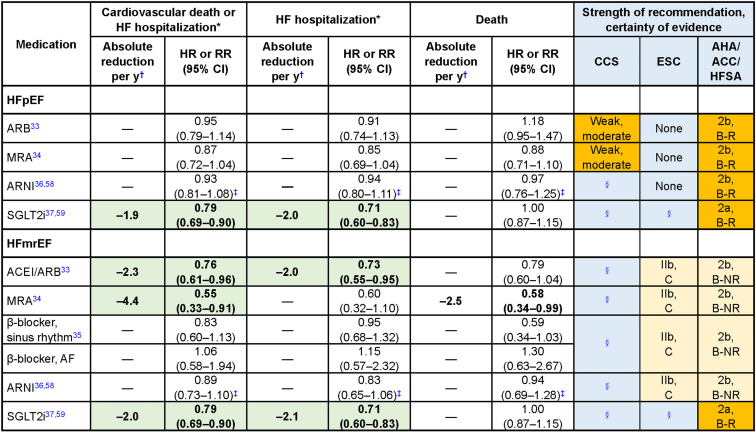
This review examines the pharmacotherapy and lifestyle recommendations of the most recent iterations of the Canadian Cardiovascular Society (CCS) / Canadian Heart Failure Society (CHFS), the European Society of Cardiology (ESC), and the American Heart Association (AHA) / American College of Cardiology (ACC) / Heart Failure Society of America (HFSA) heart failure (HF) guidelines, which all have been updated in response to therapeutic developments across the spectrum of left ventricular ejection fraction. Identified areas of unanimity across these guidelines include the following: recommending quadruple therapy for patients with HF with reduced ejection fraction (HFrEF; although no guideline proposed an ideal sequence of initiation); intravenous iron administration for patients with HFrEF and iron deficiency; and sodium restriction for patients with HF. Recent evidence regarding the harms of HFrEF medication withdrawal in patients with HF with improved ejection fraction has prompted subsequent guidelines to recommend against withdrawal. Due to the lower quality of evidence, there are disagreements regarding management of HF with preserved ejection fraction and uncertainty regarding management of HF with mildly reduced ejection fraction. Practical guidance is provided to clinicians navigating these challenging areas. In addition to these clinically focused comparisons, we describe opportunities for guideline improvement and harmonization. Specifically, these include opportunities regarding HFrEF sequencing, the need for timely updates, shared decision-making, Grading of Recommendations, Assessment, Development and Evaluations (GRADE) framework adoption, and the creation of recommendations where high-quality evidence is lacking. Although these guidelines have broad agreement, key areas of controversy remain that may be addressed by emerging evidence and changes in guideline methodology.
本综述探讨了加拿大心血管学会(CCS)/加拿大心力衰竭学会(CHFS)、欧洲心脏病学会(ESC)以及美国心脏协会(AHA)/美国心脏病学会(ACC)/美国心力衰竭学会(HFSA)最新版心力衰竭(HF)指南中的药物治疗和生活方式建议,这些指南均因左心室射血分数范围内的治疗进展而更新。这些指南中确定的一致领域包括:为射血分数降低的心力衰竭(HFrEF)患者推荐四联疗法(尽管没有指南提出理想的起始顺序);为HFrEF和缺铁患者静脉注射铁剂;以及对HF患者进行钠限制。关于射血分数改善的HF患者停用HFrEF药物危害的最新证据促使后续指南建议不要停药。由于证据质量较低,对于射血分数保留的HF管理存在分歧,对于射血分数轻度降低的HF管理存在不确定性。为在这些具有挑战性的领域中进行临床实践的医生提供了实用指导。除了这些以临床为重点的比较之外,我们还描述了指南改进和协调的机会。具体而言,这些机会包括HFrEF治疗顺序、及时更新的必要性、共同决策、推荐分级、评估、制定和评价(GRADE)框架的采用,以及在缺乏高质量证据时制定建议。尽管这些指南有广泛的共识,但仍存在关键争议领域,可能需要新出现的证据和指南方法的变化来解决。