Kim Chang-Hee, Kim Hahn Young, Nah Seung-Yeol, Choi Yoon Kyung
Department of Otorhinolaryngology-Head and Neck Surgery, Konkuk University Medical Center, Konkuk University School of Medicine, Republic of Korea.
Department of Neurology, Research Institute of Medical Science, Konkuk University School of Medicine, Seoul, Republic of Korea.
J Ginseng Res. 2023 Sep;47(5):615-621. doi: 10.1016/j.jgr.2023.04.001. Epub 2023 Apr 8.
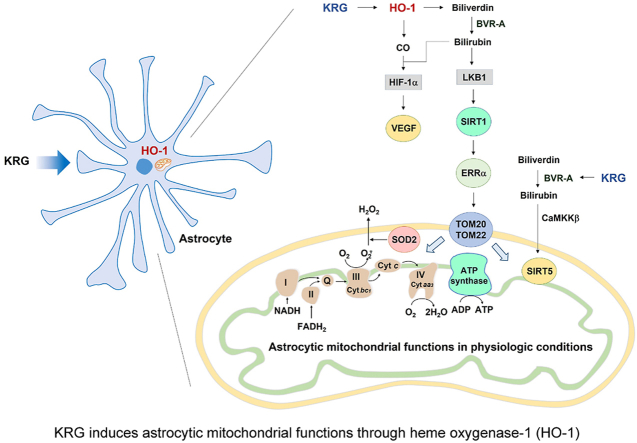
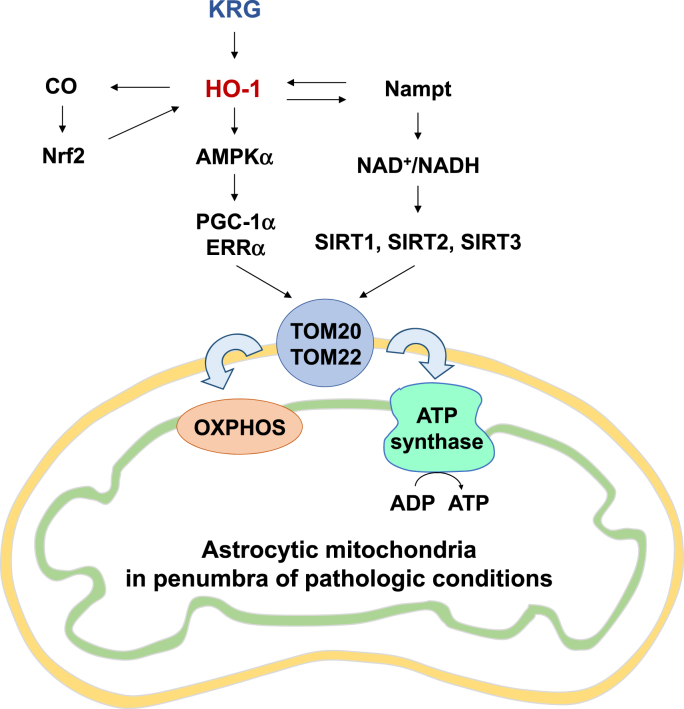
Korean Red Ginseng (KRG) plays a key role in heme oxygenase (HO)-1 induction under physical and moderate oxidative stress conditions. The transient and mild induction of HO-1 is beneficial for cell protection, mitochondrial function, regeneration, and intercellular communication. However, chronic HO-1 overexpression is detrimental in severely injured regions. Thus, in a chronic pathological state, diminishing HO-1-mediated ferroptosis is beneficial for a therapeutic approach. The molecular mechanisms by which KRG protects various cell types in the central nervous system have not yet been established, especially in terms of HO-1-mediated mitochondrial functions. Therefore, in this review, we discuss the multiple roles of KRG in the regulation of astrocytic HO-1 under pathophysiological conditions. More specifically, we discuss the role of the KRG-mediated astrocytic HO-1 pathway in regulating mitochondrial functions in acute and chronic neurodegenerative diseases as well as physiological conditions.
韩国红参(KRG)在生理和适度氧化应激条件下血红素加氧酶(HO)-1的诱导中起关键作用。HO-1的短暂和轻度诱导有利于细胞保护、线粒体功能、再生和细胞间通讯。然而,HO-1的慢性过表达在严重受损区域是有害的。因此,在慢性病理状态下,减少HO-1介导的铁死亡有利于治疗。KRG保护中枢神经系统中各种细胞类型的分子机制尚未明确,特别是在HO-1介导的线粒体功能方面。因此,在本综述中,我们讨论了KRG在病理生理条件下调节星形胶质细胞HO-1的多种作用。更具体地说,我们讨论了KRG介导的星形胶质细胞HO-1途径在急性和慢性神经退行性疾病以及生理条件下调节线粒体功能中的作用。