Nigussie Kabtamu, Negash Abraham, Sertsu Addisu, Mulugeta Abiy, Tamire Aklilu, Kassa Obsan, Abdeta Tilahun, Dereje Jerman
Department of Psychiatry, School of Nursing and Midwifery, College of Health and Medical Science, Haramaya University, Harar, Ethiopia.
Department of Midwifery, School of Nursing and Midwifery, College of Health and Medical Science, Haramaya University, Harar, Ethiopia.
Front Psychiatry. 2023 Aug 29;14:1198851. doi: 10.3389/fpsyt.2023.1198851. eCollection 2023.
Khat is a huge, evergreen tree that grows at high altitudes throughout the Arabian Peninsula and in the region stretching from eastern to southern Africa. Cathinone, cathine, and norephedrine are psychoactive ingredients contained in khat. Ethiopian teenagers, especially those in secondary school, frequently use khat. This use of khat may lead to students frequently missing class and experiencing subpar academic performance. However, the study area lacks information regarding the prevalence of khat use and the factors associated with it.
This study's primary goal is to determine the prevalence of khat chewing and related factors among secondary school students in public schools in Harar, Eastern Ethiopia, in 2022.
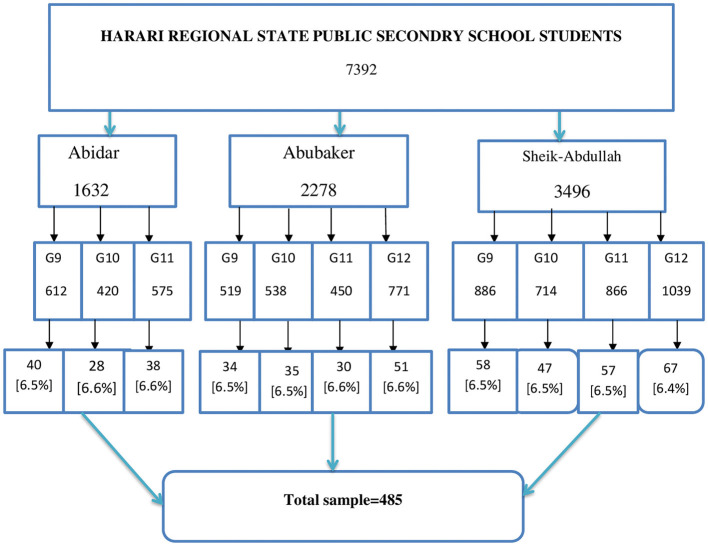
A multicenter cross-sectional study design was employed from June 01-June 30, 2022, in three public secondary schools in Harar town in a sample of 485 students. Systematic random sampling was used to choose the study sample. Data were gathered using self-administered questionnaires, and the Alcohol, Smoking, and Substance Involvement Screening Test (ASSIST) was used to assess khat chewing. Epidata version 4.6 was used to enter the data, while STATA version 14 was used to analyze them. To determine the factors related to khat chewing, bivariate and multivariate logistic regression analysis was conducted, and statistical significance was determined at a 95% confidence level with a -value under 0.05.
Out of 485 eligible participants, 455 responded to this survey, giving a response rate of 93.8%. Overall, 33.2% (95% CI: 29.2%-37.6%) of the sample's participants reported currently chewing khat. Age ranged from 20 to 25 years (AOR = 2.04; 95% CI: 1.19-3.48), male students (AOR = 7.03; 95% CI: 4.35-12.57), current alcohol user (AOR 6.48; 95% CI: 2.30-18.28), presence of chewer friends (AOR 3.86; 95% CI: 2.38-6.24), and depression (AOR 1.84, 95%CI: 1.02-3.30), were strongly associated with khat chewing at a -value of < 0.05.
Khat chewing was very common among students in Eastern Ethiopia's public secondary schools. Ages between 20 and 25 years, being a male, being current alcohol users, having chewer buddies, and depression are all significantly linked to khat use. Thus, schools should create and implement audience-specific behavioral change communication to deter and stop students from chewing khat. Additionally, it is important to ban the sale of khat to young adults and adolescents, promote medical care for khat users, and foster peer advocacy for support services.
巧茶是一种高大的常绿乔木,生长在整个阿拉伯半岛的高海拔地区以及从非洲东部延伸至南部的区域。卡西酮、去甲伪麻黄碱和去甲麻黄碱是巧茶中含有的精神活性成分。埃塞俄比亚青少年,尤其是中学生,经常食用巧茶。这种食用巧茶的行为可能导致学生频繁缺课并学业成绩不佳。然而,该研究地区缺乏关于巧茶使用 prevalence 及其相关因素的信息。
本研究的主要目标是确定2022年埃塞俄比亚东部哈勒尔公立中学学生中嚼食巧茶的 prevalence 及其相关因素。
2022年6月1日至6月30日,在哈勒尔镇的三所公立中学采用多中心横断面研究设计,样本为485名学生。采用系统随机抽样选择研究样本。通过自填问卷收集数据,并使用酒精、吸烟和物质使用筛查测试(ASSIST)评估嚼食巧茶情况。使用Epidata 4.6录入数据,用STATA 14进行分析。为确定与嚼食巧茶相关的因素,进行了双变量和多变量逻辑回归分析,在95%置信水平下,P值小于0.05时确定具有统计学意义。
在485名符合条件的参与者中,455人回应了此次调查,回应率为93.8%。总体而言,样本中有33.2%(95%CI:29.2%-37.6%)的参与者报告目前正在嚼食巧茶。年龄在20至25岁之间(调整后比值比[AOR]=2.04;95%CI:1.19-3.48)、男学生(AOR=7.03;95%CI:4.35-12.57)、当前饮酒者(AOR 6.48;95%CI:2.30-18.28)、有嚼食巧茶的朋友(AOR 3.86;95%CI:2.38-6.24)以及抑郁(AOR 1.84,95%CI:1.02-3.30),在P值<0.05时与嚼食巧茶密切相关。
嚼食巧茶在埃塞俄比亚东部公立中学学生中非常普遍。年龄在20至25岁之间、男性、当前饮酒者、有嚼食巧茶的伙伴以及抑郁均与巧茶使用显著相关。因此,学校应制定并实施针对特定受众的行为改变沟通措施,以阻止和防止学生嚼食巧茶。此外,禁止向年轻人和青少年销售巧茶、为巧茶使用者提供医疗护理以及促进同伴倡导支持服务也很重要。