Novick P, Schekman R
Proc Natl Acad Sci U S A. 1979 Apr;76(4):1858-62. doi: 10.1073/pnas.76.4.1858.
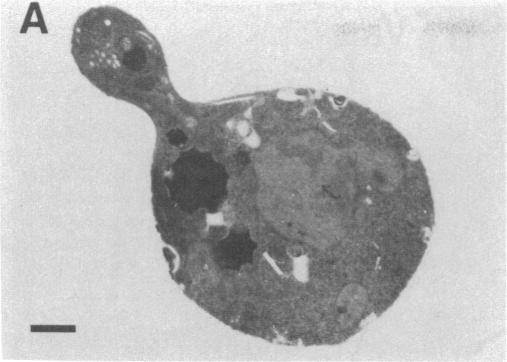
Saccharomyces cerevisiae cells contain a small internal pool of the secretory enzymes invertase and acid phosphatase. This pool increases up to 8-fold at 37 degrees C in a temperature-sensitive, secretion-defective mutant strain (sec 1-1). Cell division and incorporation of a sulfate permease activity stop abruptly at the restrictive temperature, while protein synthesis continues for several hours. Electron microscopy of mutant cells incubated at 37 degrees C reveals a large increase in the number of intracellular membrane-bound vesicles, which are shown by histochemical staining to contain the accumulated acid phosphatase. The vesicles are removed and the accumulated enzymes are secreted when cells are returned to a permissive temperature in the presence or absence of cycloheximide. These results are consistent with a vesicle intermediate in the yeast secretory pathway and suggest that exocytosis may contribute to cell-surface growth.
酿酒酵母细胞含有少量分泌酶(转化酶和酸性磷酸酶)的内部储备池。在温度敏感型、分泌缺陷型突变菌株(sec 1-1)中,该储备池在37℃时会增加至8倍。在限制温度下,细胞分裂和硫酸盐通透酶活性的掺入突然停止,而蛋白质合成会持续数小时。对在37℃孵育的突变细胞进行电子显微镜观察发现,细胞内膜结合囊泡的数量大幅增加,组织化学染色显示这些囊泡含有积累的酸性磷酸酶。当细胞在有或没有环己酰亚胺的情况下回到允许温度时,囊泡被清除,积累的酶被分泌。这些结果与酵母分泌途径中的囊泡中间体一致,并表明胞吐作用可能有助于细胞表面生长。