Thim Eric A, Kitelinger Lydia E, Rivera-Escalera Fátima, Mathew Alexander S, Elliott Michael R, Bullock Timothy N J, Price Richard J
Department of Biomedical Engineering, University of Virginia, Charlottesville, VA 22908.
Department of Pathology, University of Virginia, Charlottesville, VA 22908.
bioRxiv. 2024 Jan 5:2023.09.02.552844. doi: 10.1101/2023.09.02.552844.
Boiling histotripsy (BH), a mechanical focused ultrasound ablation strategy, can elicit intriguing signatures of anti-tumor immunity. However, the influence of BH on dendritic cell function is unknown, compromising our ability to optimally combine BH with immunotherapies to control metastatic disease.
BH was applied using a sparse scan (1 mm spacing between sonications) protocol to B16F10-ZsGreen melanoma in bilateral and unilateral settings. Ipsilateral and contralateral tumor growth was measured. Flow cytometry was used to track ZsGreen antigen and assess how BH drives dendritic cell behavior.
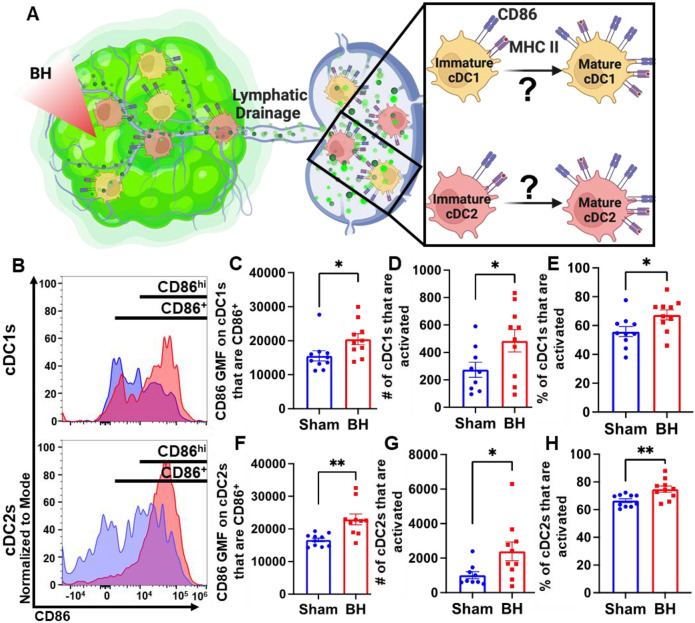
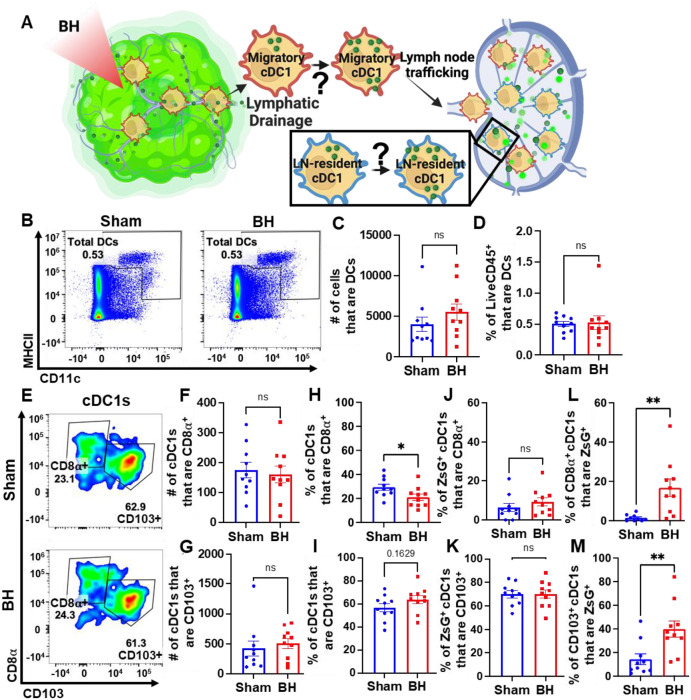
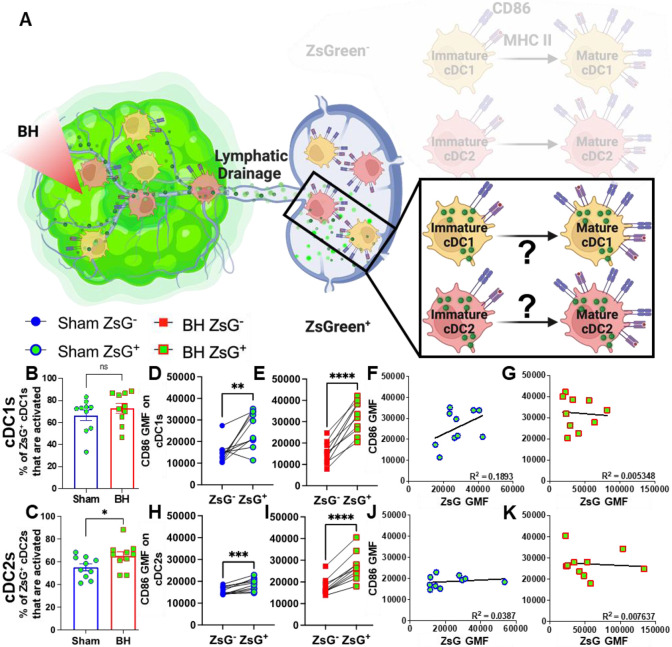
BH monotherapy elicited ipsilateral and abscopal tumor control in this highly aggressive model. Tumor antigen presence in immune cells in the tumor-draining lymph nodes (TDLNs) was ~3-fold greater at 24h after BH, but this abated by 96h. B cells, macrophages, monocytes, granulocytes, and both conventional dendritic cell subsets (i.e. cDC1s and cDC2s) acquired markedly more antigen with BH. BH drove activation of both cDC subsets, with activation being dependent upon tumor antigen acquisition. Our data also suggest that BH-liberated tumor antigen is complexed with damage-associated molecular patterns (DAMPs) and that cDCs do not traffic to the TDLN with antigen. Rather, they acquire antigen as it flows through afferent lymph vessels into the TDLN.
When applied with a sparse scan protocol, BH monotherapy elicits abscopal melanoma control and shapes dendritic cell function through several previously unappreciated mechanisms. These results offer new insight into how to best combine BH with immunotherapies for the treatment of metastatic melanoma.
沸腾组织超声消融术(BH)是一种机械聚焦超声消融策略,可引发有趣的抗肿瘤免疫信号。然而,BH对树突状细胞功能的影响尚不清楚,这削弱了我们将BH与免疫疗法优化结合以控制转移性疾病的能力。
采用稀疏扫描方案(每次超声处理之间间隔1mm)对双侧和单侧的B16F10-ZsGreen黑色素瘤进行BH治疗。测量同侧和对侧肿瘤的生长情况。使用流式细胞术追踪ZsGreen抗原,并评估BH如何驱动树突状细胞行为。
在这个高度侵袭性模型中,BH单一疗法可实现同侧和远隔肿瘤控制。BH治疗后24小时,肿瘤引流淋巴结(TDLN)中免疫细胞内的肿瘤抗原存在量增加了约3倍,但在96小时时减弱。B细胞、巨噬细胞、单核细胞、粒细胞以及两种传统树突状细胞亚群(即cDC1和cDC2)通过BH获得的抗原明显更多。BH驱动了两种cDC亚群的激活,且激活依赖于肿瘤抗原的获取。我们的数据还表明,BH释放的肿瘤抗原与损伤相关分子模式(DAMP)复合,并且cDCs不会携带抗原迁移至TDLN。相反,它们在抗原通过输入淋巴管流入TDLN时获取抗原。
采用稀疏扫描方案应用时,BH单一疗法可实现远隔黑色素瘤控制,并通过几种先前未被认识的机制塑造树突状细胞功能。这些结果为如何最佳地将BH与免疫疗法结合用于治疗转移性黑色素瘤提供了新的见解。