Treuman Katz Center for Pediatric Bioethics and Palliative Care, Seattle Children's Research Institute, 1900 Ninth Ave., M/S JMB-6, Seattle, WA, 98101, USA.
Department of Pediatrics, University of Washington School of Medicine, Seattle, Washington, USA.
BMC Med Ethics. 2023 Sep 21;24(1):73. doi: 10.1186/s12910-023-00954-5.
Standard interpretations of the ethical principle of respect for persons have not incorporated the views and values of patients, especially patients from groups underrepresented in research. This limits the ability of research ethics scholarship, guidance, and oversight to support inclusive, patient-centered research. This study aimed to identify the practical approaches that patients in community-based settings value most for conveying respect in genomics research.
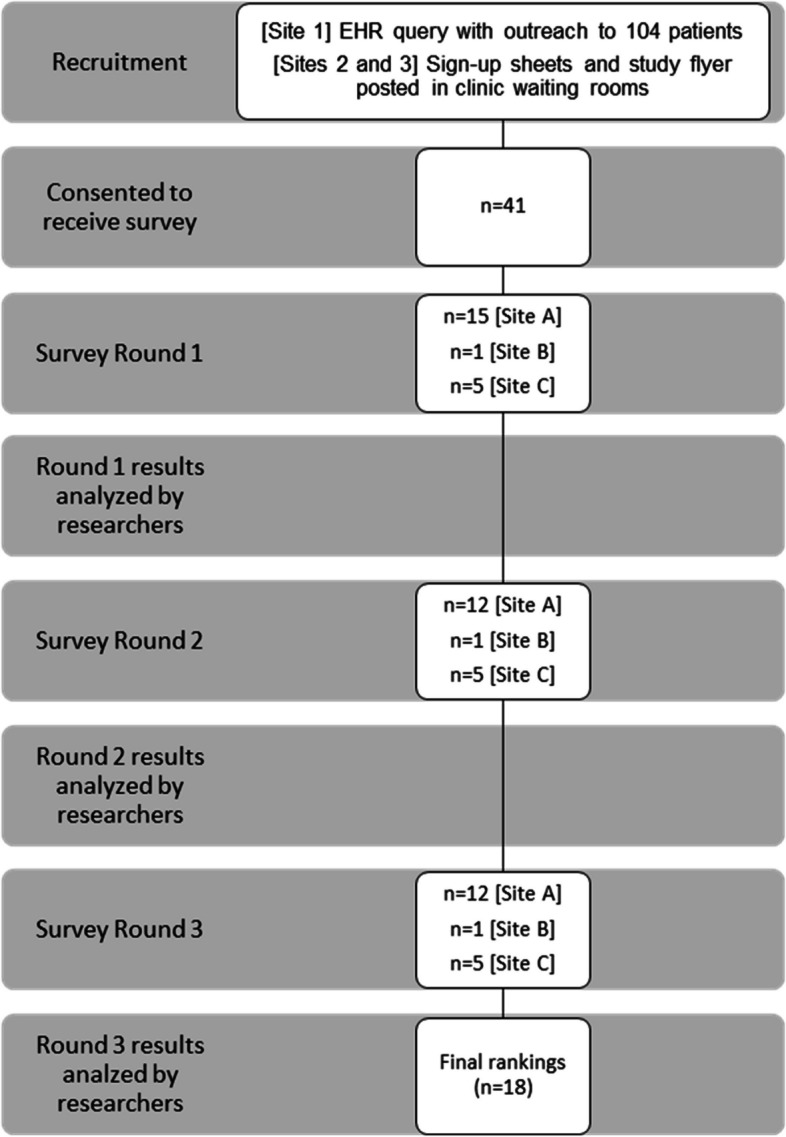
We conducted a 3-round, web-based survey using the modified Delphi technique to identify areas of agreement among English-speaking patients at primary care clinics in Washington State and Idaho who had a personal or family history of cancer. In Round 1, respondents rated the importance of 17 items, identified in prior qualitative work, for feeling respected. In Round 2, respondents re-rated each item after reviewing overall group ratings. In Round 3, respondents ranked a subset of the 8 most highly rated items. We calculated each item's mean and median rankings in Round 3 to identify which approaches were most important for feeling respected in research.
Forty-one patients consented to the survey, 21 (51%) completed Round 1, and 18 (86% of Round 1) completed each of Rounds 2 and 3. Two sets of rankings were excluded from analysis as speed of response suggested they had not completed the Round 3 ranking task. Respondents prioritized provision of study information to support decision-making (mean ranking 2.6 out of 8; median ranking 1.5) and interactions with research staff characterized by kindness, patience, and a lack of judgment (mean ranking 2.8; median ranking 2) as the most important approaches for conveying respect.
Informed consent and interpersonal interactions are key ways that research participants experience respect. These can be supported by other approaches to respecting participants, especially when consent and/or direct interactions are infeasible. Future work should continue to engage with patients in community-based settings to identify best practices for research without consent and examine unique perspectives across clinical and demographic groups in different types of research.
尊重人的伦理原则的标准解释并未纳入患者的观点和价值观,尤其是在研究中代表性不足的患者群体的观点和价值观。这限制了研究伦理学术研究、指导和监督的能力,无法支持包容和以患者为中心的研究。本研究旨在确定社区环境中的患者在基因组学研究中最看重的传达尊重的实用方法。
我们使用改良 Delphi 技术进行了三轮基于网络的调查,以确定华盛顿州和爱达荷州初级保健诊所中具有癌症个人或家族病史的英语患者在多大程度上对 17 项先前定性研究中确定的项目表示认同。在第 1 轮中,受访者对 17 项感到受尊重的重要性进行了评分,这些项目是在前瞻性定性工作中确定的。在第 2 轮中,受访者在查看了总体群体评分后重新对每个项目进行了评分。在第 3 轮中,受访者对 8 项评分最高的项目中的一部分进行了排名。我们计算了第 3 轮中每项的平均和中位数排名,以确定在研究中感到受尊重的最重要方法。
41 名患者同意参加调查,其中 21 名(51%)完成了第 1 轮,18 名(第 1 轮的 86%)完成了第 2 轮和第 3 轮。由于响应速度表明他们尚未完成第 3 轮排名任务,因此排除了两组排名进行分析。受访者优先考虑提供研究信息以支持决策(平均排名 8 分中的 2.6 分;中位数排名 1.5 分)和以友善、耐心和不评判为特征的与研究人员的互动(平均排名 2.8 分;中位数排名 2 分)作为传达尊重的最重要方法。
知情同意和人际互动是研究参与者体验尊重的关键方式。当同意和/或直接互动不可行时,这些方式可以通过其他尊重参与者的方法得到支持。未来的工作应继续与社区环境中的患者合作,确定无同意的研究最佳实践,并研究不同类型研究中不同临床和人口统计学群体的独特观点。