Department of Oncology Surgery, Tangshan People's Hospital, No.65 Shengli Road, Tangshan, 063000, China.
Department of Urology, Tianjin Institute of Urology, The Second Hospital of Tianjin Medical University, No.23 Pingjiang Road, Tianjin, 300211, China.
BMC Urol. 2023 Sep 22;23(1):150. doi: 10.1186/s12894-023-01324-4.
To investigate the association between metabolic syndrome (MetS) and its components and the risk of developing urologic cancers.
This study included 101,510 observation subjects from May 2006 to December 2007. The subjects received questionnaires and were subjected to clinical and laboratory examinations to collect data on baseline population characteristics, waist circumference (WC), blood pressure (BP), blood glucose, blood lipids, lifestyle, and past disease history. Finally, follow-up was conducted from the date of recruitment to December 31, 2019. Cox proportional hazards modelling was applied to analyze the association between MetS and its components and the risk of developing urologic cancers.
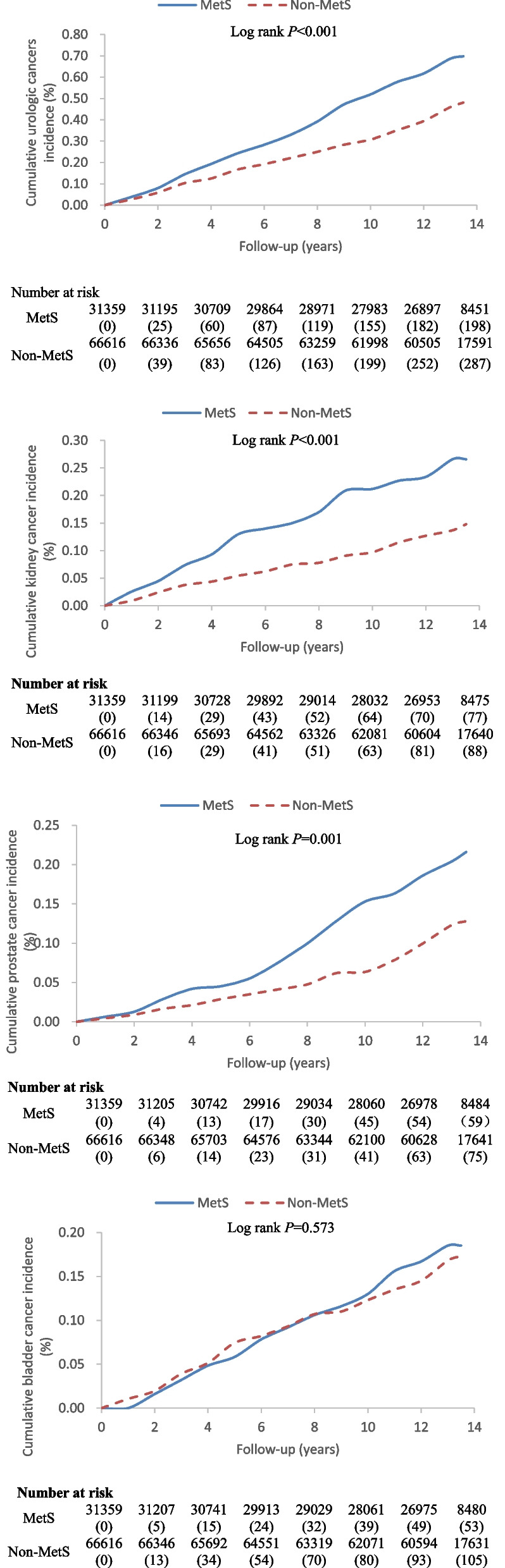
A total of 97,975 observation subjects met the inclusion criteria. The cumulative follow-up period included 1,209,178.65 person-years, and the median follow-up time was 13.03 years. During the follow-up period, 485 cases of urologic cancers (165 cases of kidney cancer, 134 cases of prostate cancer, 158 cases of bladder cancer, and 28 cases of other urologic cancers) were diagnosed. The log-rank test results for the cumulative incidences of urologic cancer, kidney cancer, and prostate cancer indicated significant (P < 0.01) differences between the MetS and non-MetS groups (0.70% vs. 0.48%, 0.27% vs. 0.15%, and 0.22% vs. 0.13%, respectively). Compared to the non-MetS group, the risk of developing urologic [HR (95% CI) = 1.29 (1.08-1.55)], kidney [HR (95% CI) = 1.74 (1.28-2.37)], and prostate [HR (95% CI) = 1.47 (1.04-2.07)] cancers was significantly higher in the MetS group. In the MetS group, elevated BP increased the risk of developing of urologic cancer [HRs (95% CI) = 1.35 (1.10-1.66)] and kidney cancer [HR (95% CI) = 1.74 (1.21-2.51)], while central obesity increased the risk of developing prostate cancer [HR (95% CI) = 1.68 (1.18-2.40)].
MetS increased the risk of developing urologic, kidney, and prostate cancers but had no association with the development of bladder cancer.
探讨代谢综合征(MetS)及其各组分与泌尿系统癌症发病风险之间的相关性。
本研究纳入了 2006 年 5 月至 2007 年 12 月间的 101510 名观察对象。这些对象接受了问卷调查,并进行了临床和实验室检查,以收集基线人群特征、腰围(WC)、血压(BP)、血糖、血脂、生活方式和既往病史等数据。最终,随访时间从招募日期持续至 2019 年 12 月 31 日。采用 Cox 比例风险模型分析 MetS 及其各组分与泌尿系统癌症发病风险之间的相关性。
共有 97975 名观察对象符合纳入标准。总的随访期间包括 1209178.65 人年,中位随访时间为 13.03 年。在随访期间,共诊断出 485 例泌尿系统癌症(165 例肾癌、134 例前列腺癌、158 例膀胱癌和 28 例其他泌尿系统癌症)。Log-rank 检验结果显示,MetS 组与非 MetS 组的泌尿系统癌症、肾癌和前列腺癌累积发生率存在显著差异(P<0.01)(0.70% vs. 0.48%、0.27% vs. 0.15%和 0.22% vs. 0.13%)。与非 MetS 组相比,MetS 组发生泌尿系统癌症[风险比(HR)(95%可信区间)=1.29(1.08-1.55)]、肾癌[HR(95%可信区间)=1.74(1.28-2.37)]和前列腺癌[HR(95%可信区间)=1.47(1.04-2.07)]的风险显著增加。在 MetS 组中,升高的血压会增加泌尿系统癌症[HRs(95%可信区间)=1.35(1.10-1.66)]和肾癌[HR(95%可信区间)=1.74(1.21-2.51)]的发病风险,而中心性肥胖会增加前列腺癌[HR(95%可信区间)=1.68(1.18-2.40)]的发病风险。
MetS 会增加泌尿系统癌症、肾癌和前列腺癌的发病风险,但与膀胱癌的发病无关。