Department of Cardiology, Xijing Hospital, Fourth Military Medical University, Xi'an, China.
Department of Otolaryngology, Xijing Hospital, Fourth Military Medical University, Xi'an, China.
Clin Transl Med. 2023 Sep;13(9):e1406. doi: 10.1002/ctm2.1406.
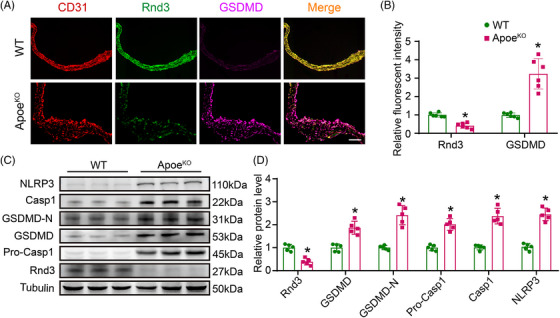
As the main pathological basis for various cardiovascular and cerebrovascular diseases, atherosclerosis has become one of the leading causes of death and disability worldwide. Emerging evidence has suggested that Rho GTPase Rnd3 plays an indisputable role in cardiovascular diseases, although its function in atherosclerosis remains unclear. Here, we found a significant correlation between Rnd3 and pyroptosis of aortic endothelial cells (ECs).
Apoe mice were utilized as a model for atherosclerosis. Endothelium-specific transgenic mice were employed to disrupt the expression level of Rnd3 in vivo. Mechanistic investigation of the impact of Rnd3 on endothelial cell pyroptosis was carried out using liquid chromatography tandem mass spectrometry (LC-MS/MS), co-immunoprecipitation (Co-IP) assays, and molecular docking.
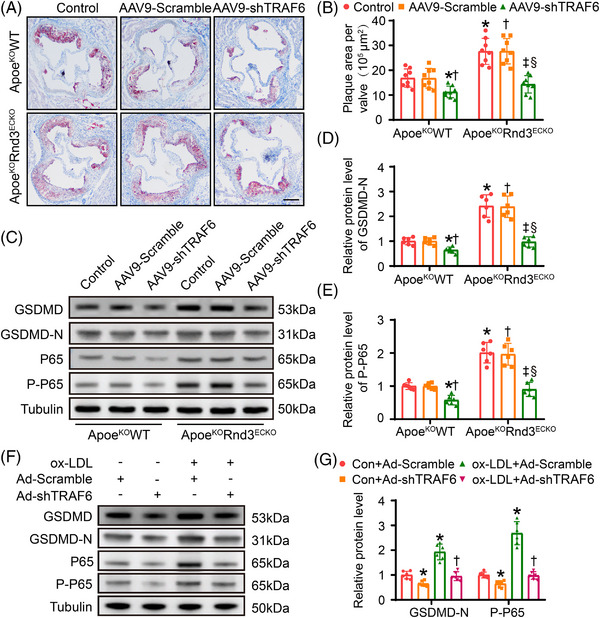
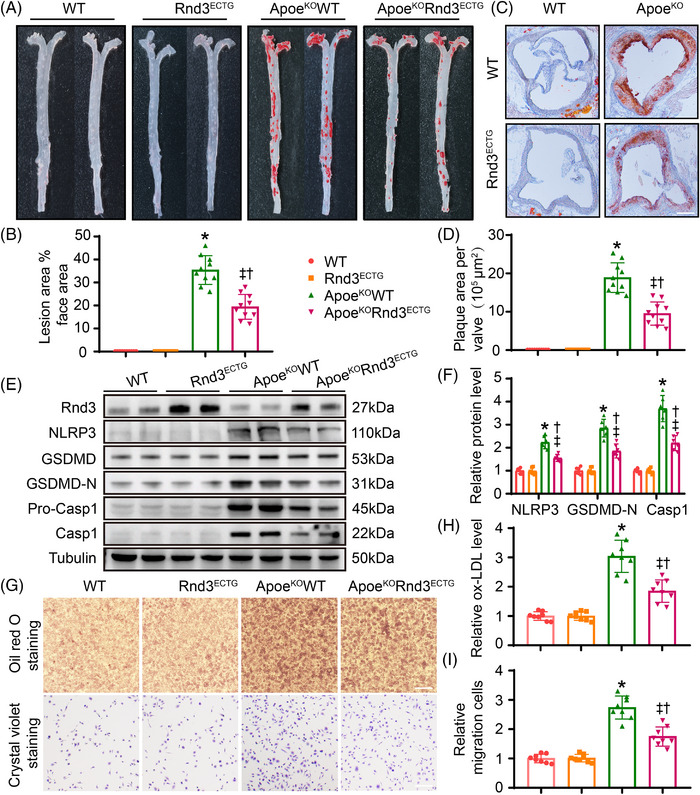
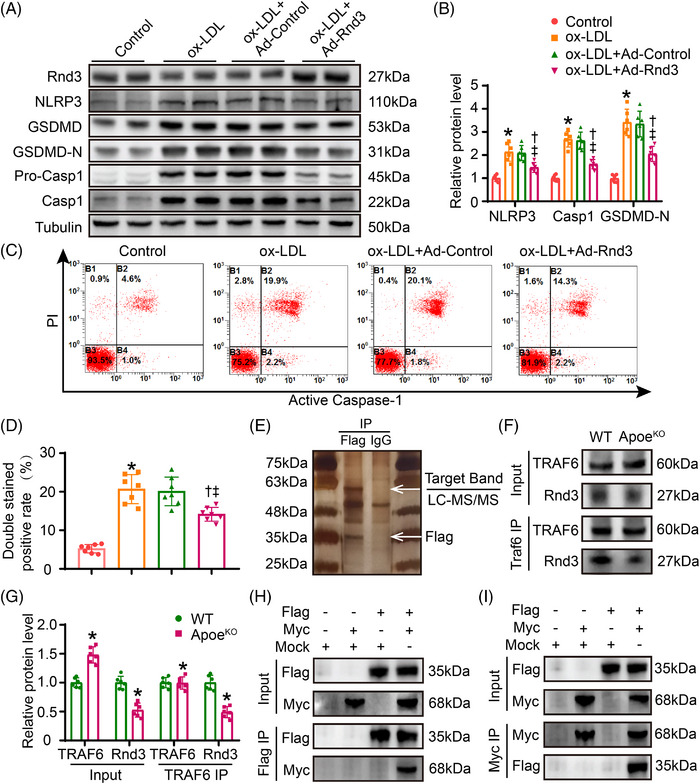
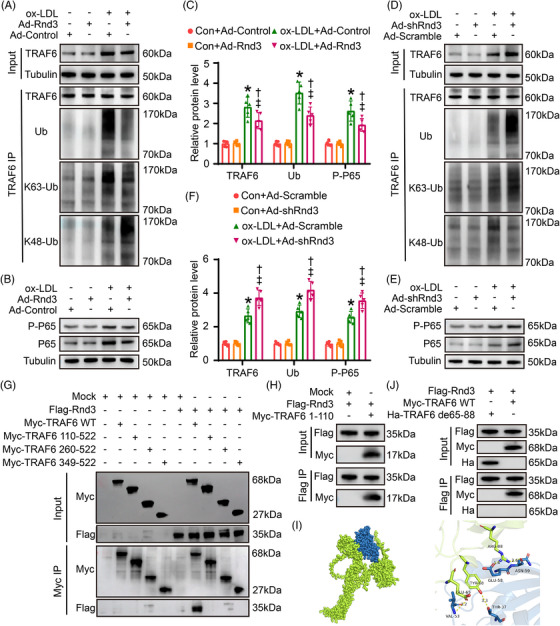
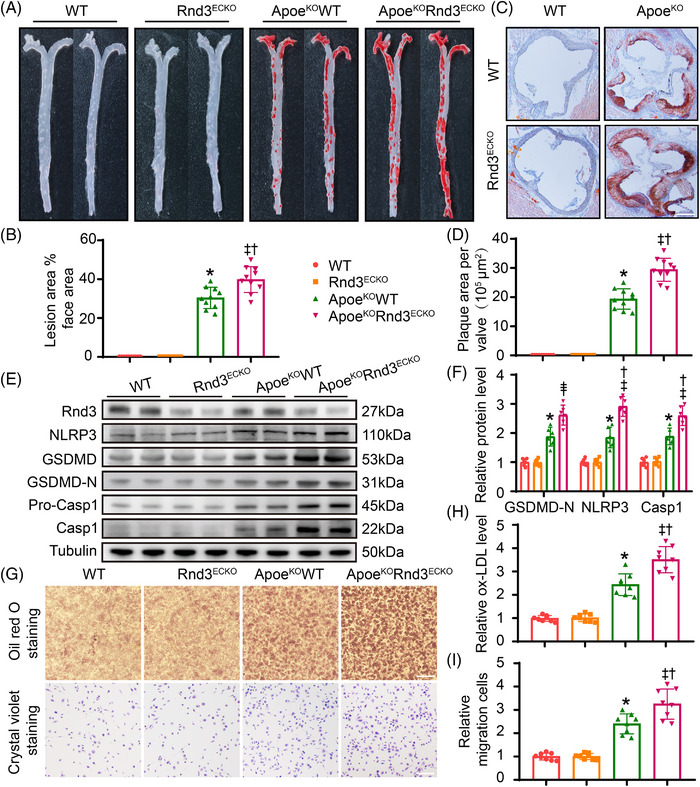
Evidence from gain-of-function and loss-of-function studies denoted a protective role for Rnd3 against ECs pyroptosis. Downregulation of Rnd3 sensitized ECs to pyroptosis under oxidized low density lipoprotein (oxLDL) challenge and exacerbated atherosclerosis, while overexpression of Rnd3 effectively prevented these effects. LC-MS/MS, Co-IP assay, and molecular docking revealed that Rnd3 negatively regulated pyroptosis signaling by direct interaction with the ring finger domain of tumor necrosis factor receptor-associated factor 6 (TRAF6). This leads to the suppression of K63-linked TRAF6 ubiquitination and the promotion of K48-linked TRAF6 ubiquitination, inhibiting the activation of NF-κB and promoting the degradation of TRAF6. Moreover, TRAF6 knockdown countered Rnd3 knockout-evoked exacerbation of EC pyroptosis in vivo and vitro.
These findings establish a critical functional connection between Rnd3 and the TRAF6/NF-κB/NLRP3 signaling pathway in ECs, indicating the essential role of Rnd3 in preventing pyroptosis of ECs.
动脉粥样硬化作为各种心脑血管疾病的主要病理基础,已成为全球范围内导致死亡和残疾的主要原因之一。新出现的证据表明,Rho GTPase Rnd3 在心血管疾病中发挥着不可争议的作用,尽管其在动脉粥样硬化中的作用尚不清楚。在这里,我们发现 Rnd3 与主动脉内皮细胞 (EC) 的细胞焦亡之间存在显著相关性。
使用载脂蛋白 E (Apoe)小鼠作为动脉粥样硬化模型。使用内皮细胞特异性转基因小鼠在体内破坏 Rnd3 的表达水平。使用液相色谱串联质谱(LC-MS/MS)、共免疫沉淀(Co-IP)实验和分子对接研究 Rnd3 对内皮细胞细胞焦亡的影响的机制。
功能获得和功能丧失研究的证据表明,Rnd3 对 EC 细胞焦亡具有保护作用。下调 Rnd3 使 EC 在氧化型低密度脂蛋白(oxLDL)刺激下易发生细胞焦亡,并加剧动脉粥样硬化,而过表达 Rnd3 则可有效预防这些作用。LC-MS/MS、Co-IP 实验和分子对接表明,Rnd3 通过与肿瘤坏死因子受体相关因子 6(TRAF6)的环指结构域直接相互作用,负调控细胞焦亡信号。这导致 K63 连接的 TRAF6 泛素化被抑制,而 K48 连接的 TRAF6 泛素化被促进,从而抑制 NF-κB 的激活并促进 TRAF6 的降解。此外,TRAF6 敲低可拮抗 Rnd3 敲除引起的体内和体外 EC 细胞焦亡加剧。
这些发现确立了 Rnd3 与内皮细胞中 TRAF6/NF-κB/NLRP3 信号通路之间的关键功能联系,表明 Rnd3 在防止内皮细胞细胞焦亡中具有重要作用。