Sikka Pilleriin, Gross James J
Department of Psychology, Stanford University, 450 Jane Stanford Way, Stanford, CA 94305 USA.
Department of Psychology, University of Turku, 20014 Turku, Finland.
Affect Sci. 2023 Aug 2;4(3):563-569. doi: 10.1007/s42761-023-00204-2. eCollection 2023 Sep.
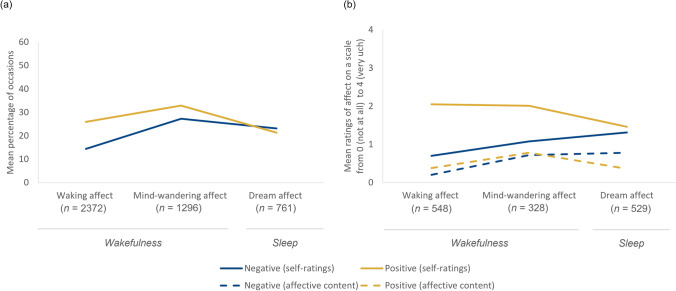
Affective scientists traditionally have focused on periods of active wakefulness when people are responding to external stimuli or engaging in specific tasks. However, we live much of our lives immersed in experiences not related to the current environment or tasks at hand-mind-wandering (or daydreaming) during wakefulness and dreaming during sleep. Despite being disconnected from the immediate environment, our brains still generate affect during such periods. Yet, research on stimulus-independent affect has remained largely separate from affective science. Here, we suggest that one key future direction for affective science will be to expand our field of view by integrating the wealth of findings from research on mind-wandering, sleep, and dreaming to provide a more comprehensive account of affect across the wake-sleep cycle. In developing our argument, we address two key issues: affect variation across the wake-sleep cycle, and the benefits of expanding the study of affect across the full wake-sleep cycle. In considering these issues, we highlight the methodological and clinical implications for affective science.
传统上,情感科学家一直专注于人们对外部刺激做出反应或从事特定任务时的清醒活跃期。然而,我们生活中的大部分时间都沉浸在与当前环境或手头任务无关的体验中——清醒时的走神(或白日梦)以及睡眠时的做梦。尽管与当下环境脱节,但我们的大脑在这些时期仍会产生情感。然而,关于与刺激无关的情感的研究在很大程度上仍与情感科学相分离。在此,我们认为情感科学未来的一个关键方向将是通过整合来自走神、睡眠和做梦研究的丰富发现来拓宽我们的视野,以便更全面地解释整个清醒 - 睡眠周期中的情感。在阐述我们的观点时,我们讨论两个关键问题:整个清醒 - 睡眠周期中的情感变化,以及在整个清醒 - 睡眠周期中扩展情感研究的益处。在考虑这些问题时,我们强调了情感科学在方法学和临床方面的意义。