Denis Dan, Poerio Giulia L
Department of Psychology, University of Sheffield, Sheffield, UK.
Department of Psychology, University of York, York, UK.
J Sleep Res. 2017 Feb;26(1):38-47. doi: 10.1111/jsr.12441. Epub 2016 Jul 27.
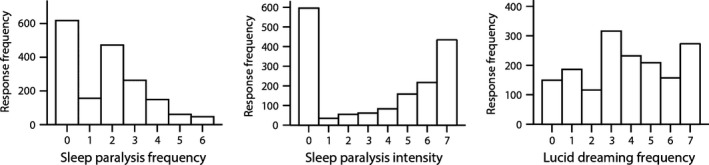
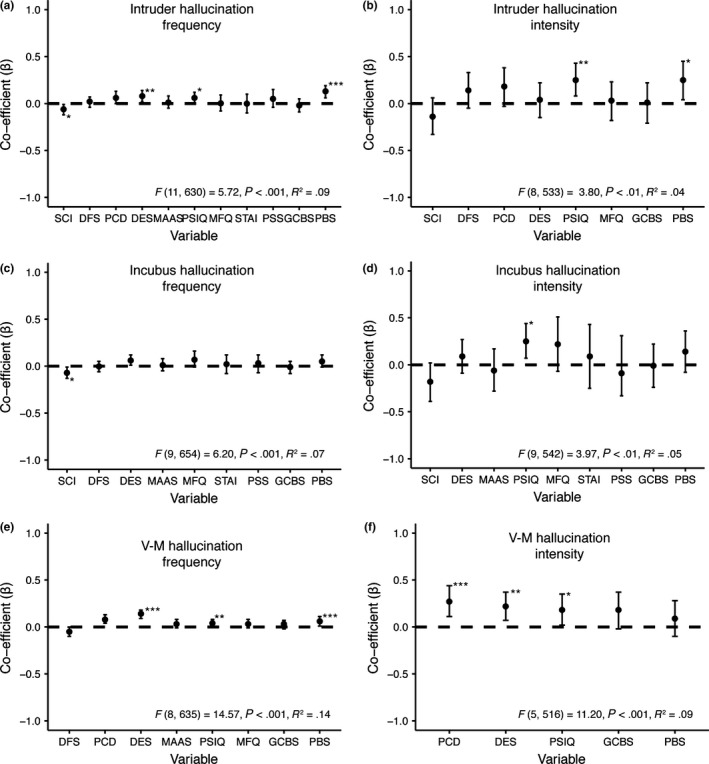
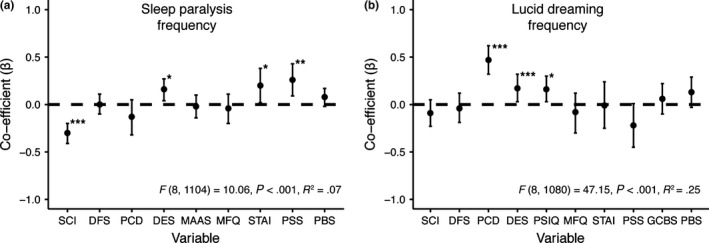
Sleep paralysis and lucid dreaming are both dissociated experiences related to rapid eye movement (REM) sleep. Anecdotal evidence suggests that episodes of sleep paralysis and lucid dreaming are related but different experiences. In this study we test this claim systematically for the first time in an online survey with 1928 participants (age range: 18-82 years; 53% female). Confirming anecdotal evidence, sleep paralysis and lucid dreaming frequency were related positively and this association was most apparent between lucid dreaming and sleep paralysis episodes featuring vestibular-motor hallucinations. Dissociative experiences were the only common (positive) predictor of both sleep paralysis and lucid dreaming. Both experiences showed different associations with other key variables of interest: sleep paralysis was predicted by sleep quality, anxiety and life stress, whereas lucid dreaming was predicted by a positive constructive daydreaming style and vividness of sensory imagery. Overall, results suggest that dissociative experiences during wakefulness are reflected in dissociative experiences during REM sleep; while sleep paralysis is related primarily to issues of sleep quality and wellbeing, lucid dreaming may reflect a continuation of greater imaginative capacity and positive imagery in waking states.
睡眠麻痹和清醒梦都是与快速眼动(REM)睡眠相关的分离性体验。轶事证据表明,睡眠麻痹发作和清醒梦是相关但不同的体验。在本研究中,我们首次在一项针对1928名参与者(年龄范围:18 - 82岁;53%为女性)的在线调查中系统地检验了这一说法。证实了轶事证据,睡眠麻痹和清醒梦的频率呈正相关,这种关联在清醒梦与具有前庭运动幻觉的睡眠麻痹发作之间最为明显。分离性体验是睡眠麻痹和清醒梦唯一共同的(正向)预测因素。这两种体验与其他感兴趣的关键变量表现出不同的关联:睡眠麻痹由睡眠质量、焦虑和生活压力预测,而清醒梦由积极建设性的白日梦风格和感觉意象的生动性预测。总体而言,结果表明清醒时的分离性体验反映在快速眼动睡眠期间的分离性体验中;虽然睡眠麻痹主要与睡眠质量和幸福感问题相关,但清醒梦可能反映了清醒状态下更大的想象力和积极意象的延续。