Xing Xiaoman, Huang Rui, Hao Liling, Jiang Chenyu, Dong Wen-Fei
School of Biomedical Engineering, Division of Life Sciences and Medicine, University of Science and Technology of China, Suzhou, China.
Suzhou Institute of Biomedical Engineering and Technology, Chinese Academy of Sciences, Suzhou, China.
Front Physiol. 2023 Aug 31;14:1187561. doi: 10.3389/fphys.2023.1187561. eCollection 2023.
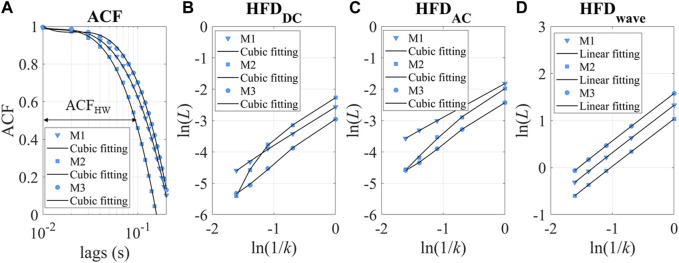
The temporal complexity of photoplethysmography (PPG) provides valuable information about blood pressure (BP). In this study, we aim to interpret the stochastic PPG patterns with a model-based simulation, which may help optimize the BP estimation algorithms. The classic four-element Windkessel model is adapted in this study to incorporate BP-dependent compliance profiles. Simulations are performed to generate PPG responses to pulse and continuous stimuli at various timescales, aiming to mimic sudden or gradual hemodynamic changes observed in real-life scenarios. To quantify the temporal complexity of PPG, we utilize the Higuchi fractal dimension (HFD) and autocorrelation function (ACF). These measures provide insights into the intricate temporal patterns exhibited by PPG. To validate the simulation results, continuous recordings of BP, PPG, and stroke volume from 40 healthy subjects were used. Pulse simulations showed that central vascular compliance variation during a cardiac cycle, peripheral resistance, and cardiac output (CO) collectively contributed to the time delay, amplitude overshoot, and phase shift of PPG responses. Continuous simulations showed that the PPG complexity could be generated by random stimuli, which were subsequently influenced by the autocorrelation patterns of the stimuli. Importantly, the relationship between complexity and hemodynamics as predicted by our model aligned well with the experimental analysis. HFD and ACF had significant contributions to BP, displaying stability even in the presence of high CO fluctuations. In contrast, morphological features exhibited reduced contribution in unstable hemodynamic conditions. Temporal complexity patterns are essential to single-site PPG-based BP estimation. Understanding the physiological implications of these patterns can aid in the development of algorithms with clear interpretability and optimal structures.
光电容积脉搏波描记法(PPG)的时间复杂性提供了有关血压(BP)的有价值信息。在本研究中,我们旨在通过基于模型的模拟来解释随机PPG模式,这可能有助于优化血压估计算法。本研究采用经典的四元件风箱模型,纳入依赖于血压的顺应性曲线。进行模拟以在不同时间尺度上生成对脉冲和连续刺激的PPG响应,旨在模拟现实生活场景中观察到的突然或逐渐的血流动力学变化。为了量化PPG的时间复杂性,我们使用了 Higuchi 分形维数(HFD)和自相关函数(ACF)。这些测量方法提供了对PPG呈现的复杂时间模式的见解。为了验证模拟结果,使用了40名健康受试者的血压、PPG和每搏输出量的连续记录。脉冲模拟表明,心动周期中的中心血管顺应性变化、外周阻力和心输出量(CO)共同导致了PPG响应的时间延迟、幅度过冲和相移。连续模拟表明,PPG复杂性可能由随机刺激产生,随后受到刺激自相关模式的影响。重要的是,我们模型预测的复杂性与血流动力学之间的关系与实验分析非常吻合。HFD和ACF对血压有显著贡献,即使在存在高CO波动的情况下也显示出稳定性。相比之下,形态特征在不稳定血流动力学条件下的贡献降低。时间复杂性模式对于基于单部位PPG的血压估计至关重要。理解这些模式的生理意义有助于开发具有清晰可解释性和最佳结构的算法。