Thornton Mackenzie, Sommer Nicole, McGonigle Mercedes, Ram Anil Kumar, Yerrathota Sireesha, Ehirim Henrietta, Chaturvedi Aakriti, Phan Johnny Dinh, Chakraborty Anubhav, Chakravarthi Praveen V, Gunewardena Sumedha, Tyagi Mudit, Talreja Jaya, Wang Tao, Singhal Pravin, Tran Pamela V, Fields Timothy A, Ray Patricio E, Dhillon Navneet K, Sharma Madhulika
Department of Internal Medicine, University of Kansas Medical Center, Kansas City, KS.
The Jared Grantham Kidney Institute, University of Kansas Medical Center, Kansas City, KS.
bioRxiv. 2024 Jun 25:2023.09.12.557484. doi: 10.1101/2023.09.12.557484.
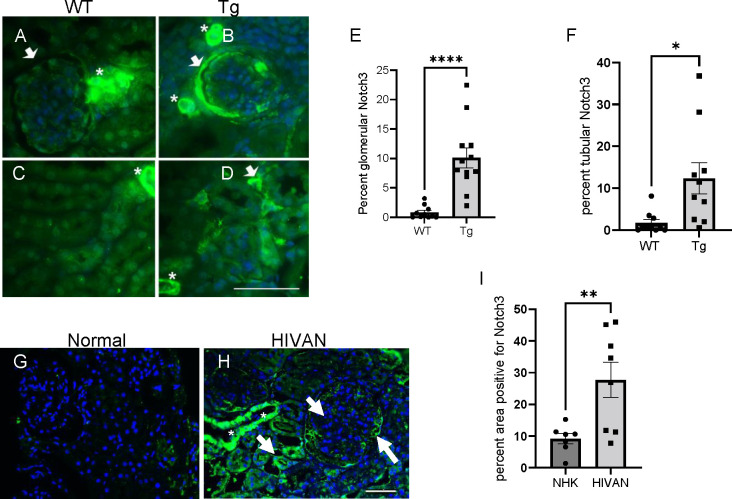
Antiretroviral therapy (ART) has decreased HIV-1 associated morbidity. However, despite ART, immune cells remain latently infected and slowly release viral proteins, leading to chronic inflammation and HIV-1 associated comorbidities. New strategies are needed to target viral proteins and inflammation. We found activation of Notch3 in several renal cells of the HIV-1 mouse model (HIV-Tg26) and in patients with HIV associated Nephropathy. We hypothesized that targeting Notch3 activation constitutes an effective therapy for HIV-related chronic kidney diseases (HIV-CKD). We generated HIV-Tg26 mice with Notch3 knocked out (Tg-N3KO). Compared to HIV-Tg26 mice at 3 months, HIV-Tg-N3KO mice showed a marked reduction in renal injury, skin lesions and mortality rate. Bulk RNA sequencing revealed that N3KO not only reduced renal infiltrating cells but significantly reduced the expression of HIV genes. Moreover, Notch3 activated the HIV- promoter and induction of HIV-1 resulted in increased Notch3 activation indicating a feedback mechanism. Further, bone marrow derived macrophages (BMDMs) from HIV-Tg26 mice showed activation of Notch3 indicating systemic effects. Consistent with that, systemic levels of TNF-α, MCP-1 and other inflammatory chemokines and cytokines were reduced in Tg-N3KO mice. Thus, Notch3 inhibition/deletion has a dual therapeutic effect in HIV-CKD and may extend to other HIV-related pathologies.
抗逆转录病毒疗法(ART)已降低了与HIV-1相关的发病率。然而,尽管采用了ART,免疫细胞仍处于潜伏感染状态,并缓慢释放病毒蛋白,导致慢性炎症和与HIV-1相关的合并症。需要新的策略来靶向病毒蛋白和炎症。我们发现在HIV-1小鼠模型(HIV-Tg26)的几种肾细胞以及HIV相关性肾病患者中Notch3被激活。我们假设靶向Notch3激活构成了一种针对HIV相关慢性肾脏病(HIV-CKD)的有效疗法。我们培育出了Notch3基因敲除的HIV-Tg26小鼠(Tg-N3KO)。与3个月大的HIV-Tg26小鼠相比,HIV-Tg-N3KO小鼠的肾损伤、皮肤病变和死亡率显著降低。大量RNA测序表明,N3KO不仅减少了肾浸润细胞,还显著降低了HIV基因的表达。此外,Notch3激活HIV启动子,HIV-1的诱导导致Notch3激活增加,表明存在反馈机制。此外,来自HIV-Tg26小鼠的骨髓来源巨噬细胞(BMDM)显示出Notch3激活,表明存在全身效应。与此一致的是,Tg-N3KO小鼠中TNF-α、MCP-1和其他炎性趋化因子及细胞因子的全身水平降低。因此,Notch3抑制/缺失在HIV-CKD中具有双重治疗作用,并且可能扩展到其他HIV相关病理状况。