Juárez-Montiel Margarita, Clark-Flores Daniel, Tesillo-Moreno Pedro, de la Vega-Camarillo Esaú, Andrade-Pavón Dulce, Hernández-García Juan Alfredo, Hernández-Rodríguez César, Villa-Tanaca Lourdes
Laboratorio de Biología Molecular de Bacterias y Levaduras, Departamento de Microbiología, Instituto Politécnico Nacional, Escuela Nacional de Ciencias Biológicas, Mexico City, Mexico.
Front Fungal Biol. 2022 Oct 26;3:948477. doi: 10.3389/ffunb.2022.948477. eCollection 2022.
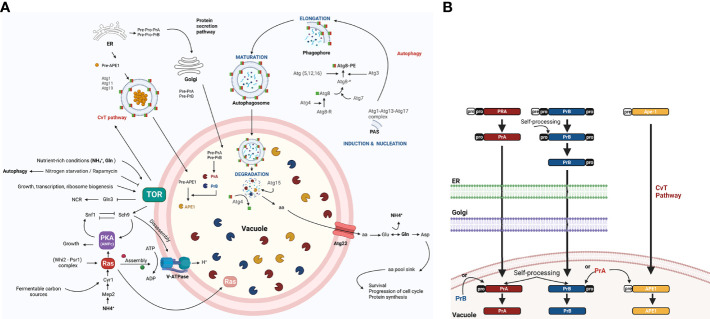
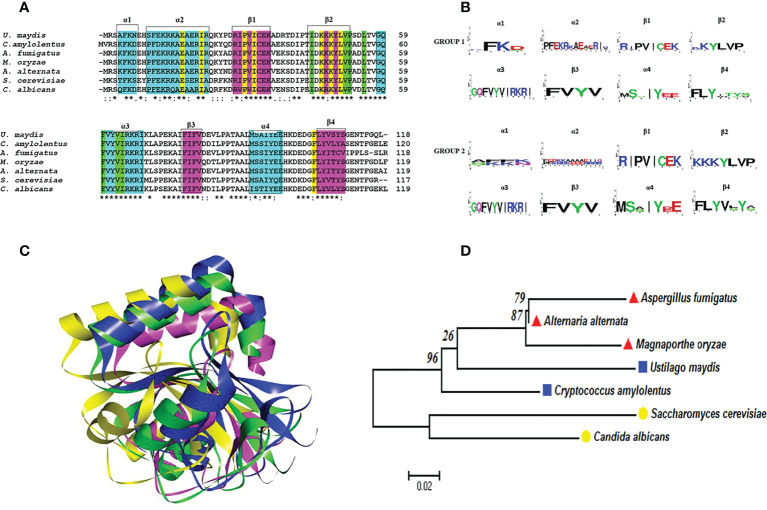
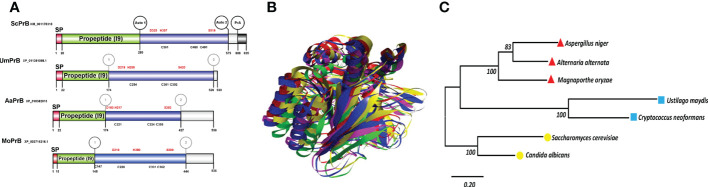
Autophagy (macroautophagy) is a survival and virulence mechanism of different eukaryotic pathogens. Autophagosomes sequester cytosolic material and organelles, then fuse with or enter into the vacuole or lysosome (the lytic compartment of most fungal/plant cells and many animal cells, respectively). Subsequent degradation of cargoes delivered to the vacuole autophagy and endocytosis maintains cellular homeostasis and survival in conditions of stress, cellular differentiation, and development. PrA and PrB are vacuolar aspartyl and serine endoproteases, respectively, that participate in the autophagy of fungi and contribute to the pathogenicity of phytopathogens. Whereas the levels of vacuolar proteases are regulated by the expression of the genes encoding them (e.g., for PrA and for PrB), their activity is governed by endogenous inhibitors. The aim of the current contribution is to review the main characteristics, regulation, and role of vacuolar soluble endoproteases and Atg proteins in the process of autophagy and the pathogenesis of three fungal phytopathogens: , , and . Aspartyl and serine proteases are known to participate in autophagy in these fungi by degrading autophagic bodies. However, the gene responsible for encoding the vacuolar serine protease of has yet to be identified. Based on analysis, this gene is proposed to be orthologous to the genes and , known to encode the principal protease involved in the degradation of autophagic bodies and its inhibitor, respectively. In fungi that interact with plants, whether phytopathogenic or mycorrhizal, autophagy is a conserved cellular degradation process regulated through the TOR, PKA, and SNF1 pathways by ATG proteins and vacuolar proteases. Autophagy plays a preponderant role in the recycling of cell components as well as in the fungus-plant interaction.
自噬(巨自噬)是不同真核病原体的一种生存和致病机制。自噬体隔离胞质物质和细胞器,然后与液泡或溶酶体融合或进入其中(分别是大多数真菌/植物细胞和许多动物细胞的裂解区室)。随后,输送到液泡的货物降解 自噬和内吞作用在应激、细胞分化和发育条件下维持细胞内稳态和生存。PrA和PrB分别是液泡天冬氨酸蛋白酶和丝氨酸内肽酶,它们参与真菌的自噬并有助于植物病原体的致病性。虽然液泡蛋白酶的水平由编码它们的基因的表达调控(例如,PrA的基因和PrB的基因),但其活性由内源性抑制剂控制。本文的目的是综述液泡可溶性内肽酶和Atg蛋白在自噬过程以及三种真菌植物病原体( 、 和 )的发病机制中的主要特征、调控和作用。已知天冬氨酸蛋白酶和丝氨酸蛋白酶通过降解自噬体参与这些真菌的自噬。然而,负责编码 的液泡丝氨酸蛋白酶的基因尚未确定。基于 分析,该 基因被认为与 基因 和 直系同源,已知这两个基因分别编码参与自噬体降解的主要蛋白酶及其抑制剂。在与植物相互作用的真菌中,无论是植物病原体还是菌根真菌,自噬都是一个保守的细胞降解过程,由ATG蛋白和液泡蛋白酶通过TOR、PKA和SNF1途径调控。自噬在细胞成分的循环利用以及真菌与植物的相互作用中起着重要作用。