Department of Medicine, Washington University School of Medicine, St. Louis, MO, 63110, USA.
Laboratory of Human Genetics of Infectious Diseases, Necker Branch, Institut National de la Santé et de la Recherche Médicale (INSERM) U1163, Necker Hospital for Sick Children, Paris, EU, 75015, France.
Nat Commun. 2023 Sep 25;14(1):5973. doi: 10.1038/s41467-023-41600-3.
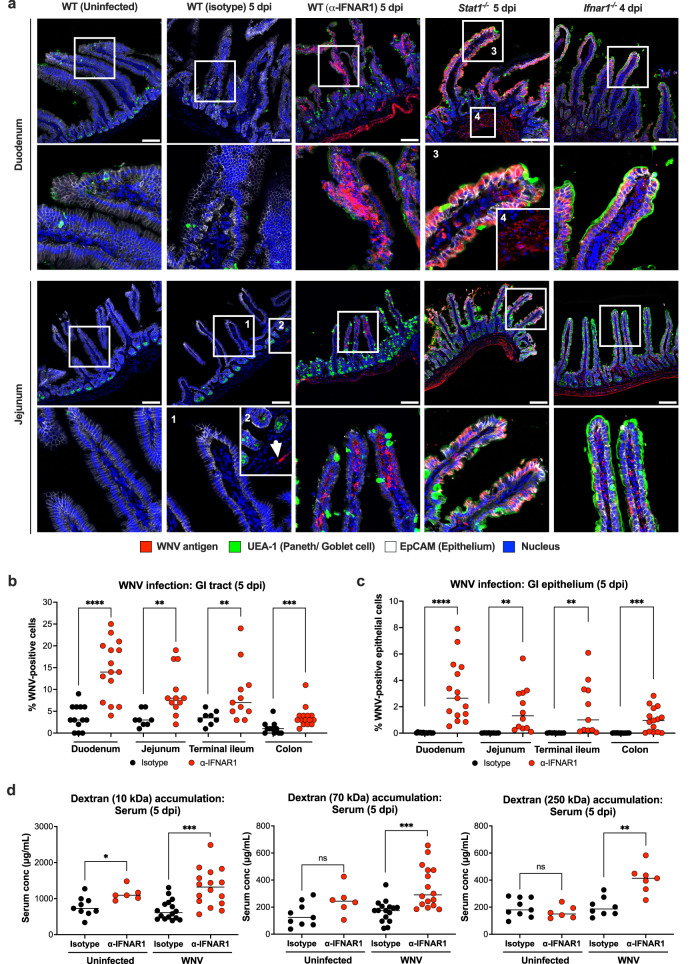
The determinants of severe disease caused by West Nile virus (WNV) and why only ~1% of individuals progress to encephalitis remain poorly understood. Here, we use human and mouse enteroids, and a mouse model of pathogenesis, to explore the capacity of WNV to directly infect gastrointestinal (GI) tract cells and contribute to disease severity. At baseline, WNV poorly infects human and mouse enteroid cultures and enterocytes in mice. However, when STAT1 or type I interferon (IFN) responses are absent, GI tract cells become infected, and this is associated with augmented GI tract and blood-brain barrier (BBB) permeability, accumulation of gut-derived molecules in the brain, and more severe WNV disease. The increased gut permeability requires TNF-α signaling, and is absent in WNV-infected IFN-deficient germ-free mice. To link these findings to human disease, we measured auto-antibodies against type I IFNs in serum from WNV-infected human cohorts. A greater frequency of auto- and neutralizing antibodies against IFN-α2 or IFN-ω is present in patients with severe WNV infection, whereas virtually no asymptomatic WNV-infected subjects have such antibodies (odds ratio 24 [95% confidence interval: 3.0 - 192.5; P = 0.003]). Overall, our experiments establish that blockade of type I IFN signaling extends WNV tropism to enterocytes, which correlates with increased gut and BBB permeability, and more severe disease.
西尼罗河病毒(WNV)引起严重疾病的决定因素以及为什么只有约 1%的个体进展为脑炎仍不清楚。在这里,我们使用人类和小鼠类肠上皮细胞,以及一种发病机制的小鼠模型,来探索 WNV 直接感染胃肠道(GI)细胞并导致疾病严重程度的能力。在基线水平,WNV 很难感染人类和小鼠类肠上皮细胞培养物和小鼠中的肠上皮细胞。然而,当 STAT1 或 I 型干扰素(IFN)反应缺失时,GI 细胞会被感染,这与 GI 道和血脑屏障(BBB)通透性增加、肠道来源的分子在大脑中积累以及更严重的 WNV 疾病有关。增加的肠道通透性需要 TNF-α信号转导,并且在感染 WNV 的 IFN 缺陷型无菌小鼠中不存在。为了将这些发现与人类疾病联系起来,我们测量了来自 WNV 感染的人类队列的血清中针对 I 型 IFNs 的自身抗体。在患有严重 WNV 感染的患者中,针对 IFN-α2 或 IFN-ω 的自身抗体和中和抗体的频率更高,而几乎没有无症状的 WNV 感染患者具有此类抗体(优势比 24 [95%置信区间:3.0-192.5;P = 0.003])。总体而言,我们的实验表明,I 型 IFN 信号通路的阻断可延长 WNV 对肠上皮细胞的嗜性,这与增加的肠道和 BBB 通透性以及更严重的疾病相关。