Department of Biomedical Engineering, University of Rochester, Rochester, NY, USA.
Department of Dermatology, University of Rochester Medical Center, Rochester, NY, USA.
Sci Rep. 2023 Sep 25;13(1):15992. doi: 10.1038/s41598-023-42797-5.
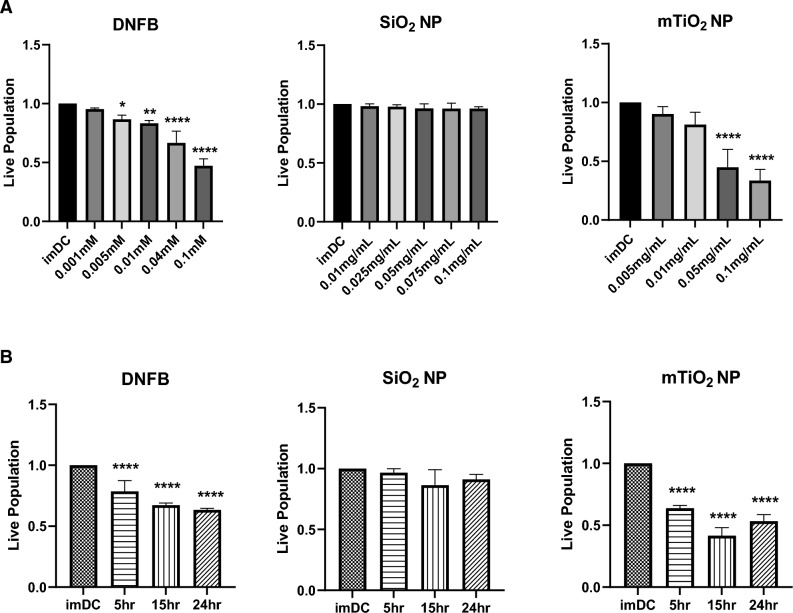
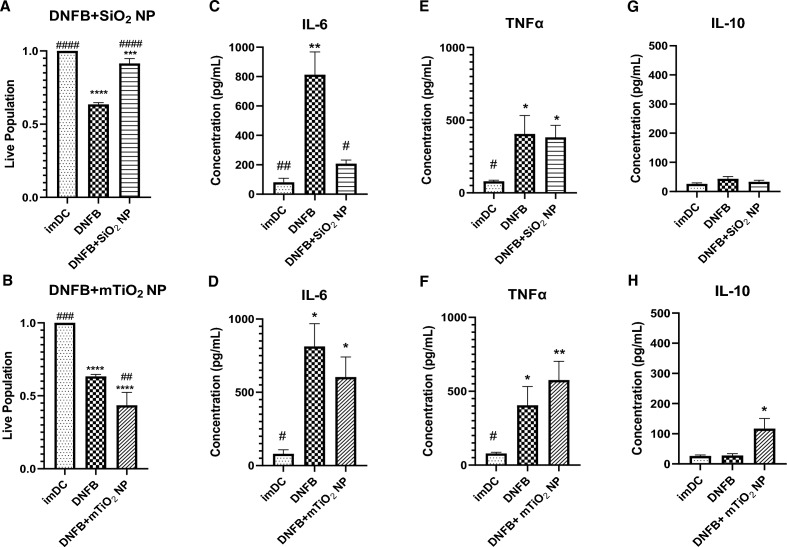
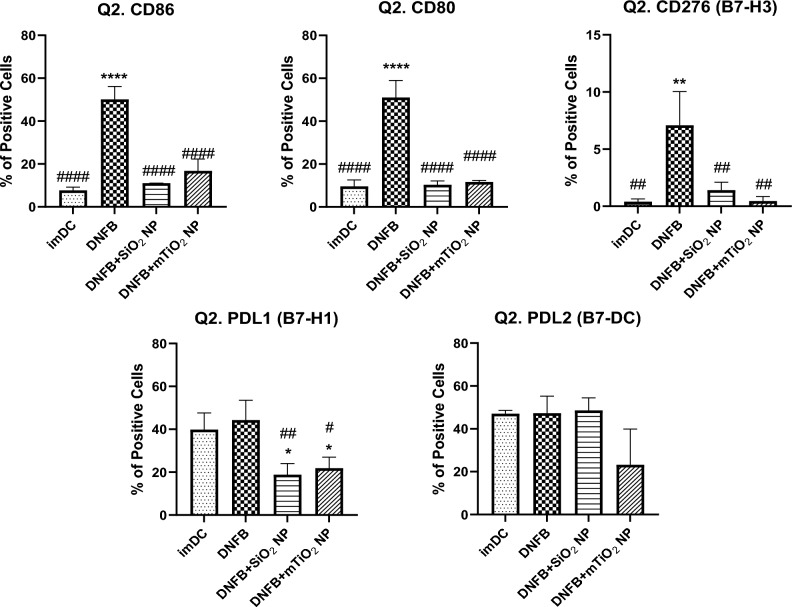
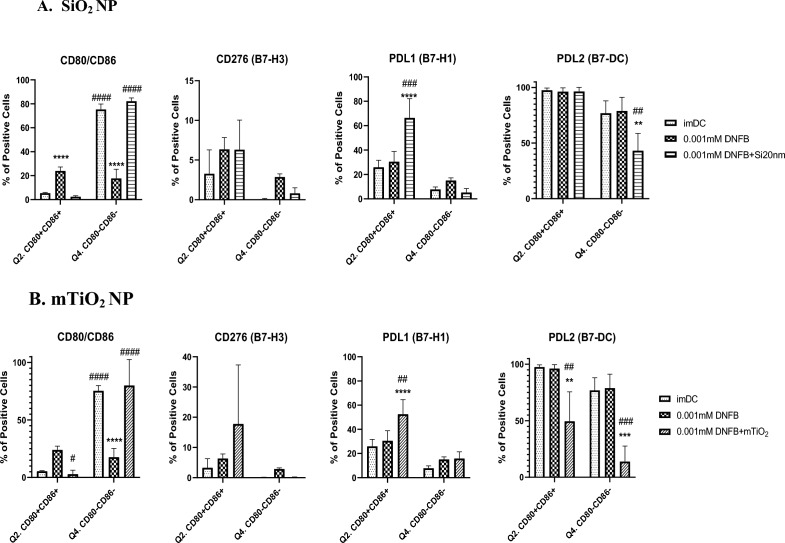
Nanoparticle (NP) skin exposure is linked to an increased prevalence of allergic contact dermatitis. In our prior studies using the mouse contact hypersensitivity (CHS) model, we reported that silica 20 nm (SiO) NPs suppressed the allergic response and titanium dioxide NPs doped with manganese (mTiO) exacerbated it. In this work, we conducted in vitro experiments using bone marrow-derived dendritic cells (BMDCs) to study the combinatorial effect of the potent 2,4-dinitrofluorobenzene (DNFB) hapten sensitizer with SiO and mTiO NPs on BMDC cytotoxicity, cytokine secretion and phenotype using the B7 family ligands. Results show that DNFB and mTiO behave similarly and exhibit proinflammatory characteristics while SiO promotes a naive phenotype. We observe that the B7-H3 (CD276) ligand is only expressed on CD80 + (B7-1) BMDCs. Results from adoptive transfer CHS studies, combined with BMDC phenotype analysis, point to the importance of PD-L2 expression in modulating the adaptive immune response. This work identifies metrics that can be used to predict the effects of NPs on contact allergy and to guide efforts to engineer cell-based therapies to induce hapten specific immune tolerance.
纳米颗粒(NP)皮肤暴露与过敏性接触性皮炎的患病率增加有关。在我们之前使用小鼠接触超敏反应(CHS)模型的研究中,我们报告了二氧化硅 20nm(SiO)NP 抑制了过敏反应,而掺杂锰的二氧化钛 NP(mTiO)则加剧了过敏反应。在这项工作中,我们使用骨髓来源的树突状细胞(BMDC)进行了体外实验,研究了强 2,4-二硝基氟苯(DNFB)半抗原敏化剂与 SiO 和 mTiO NPs 对 BMDC 细胞毒性、细胞因子分泌和表型的组合作用,使用 B7 家族配体。结果表明,DNFB 和 mTiO 的行为相似,表现出促炎特征,而 SiO 则促进幼稚表型。我们观察到 B7-H3(CD276)配体仅在 CD80+(B7-1)BMDC 上表达。过继转移 CHS 研究的结果与 BMDC 表型分析相结合,表明 PD-L2 表达在调节适应性免疫反应中的重要性。这项工作确定了可用于预测 NPs 对接触过敏影响的指标,并指导工程基于细胞的疗法以诱导半抗原特异性免疫耐受的努力。