Department of Biomedical Engineering, University of Rochester, Rochester, New York, USA.
Department of Toxicology, University of Rochester Medical Center, New York, USA.
Sci Rep. 2017 Jun 21;7(1):3979. doi: 10.1038/s41598-017-03729-2.
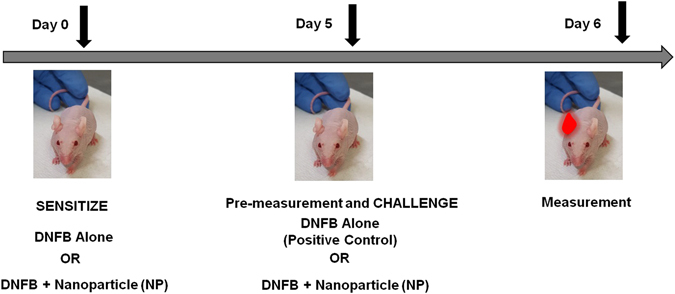
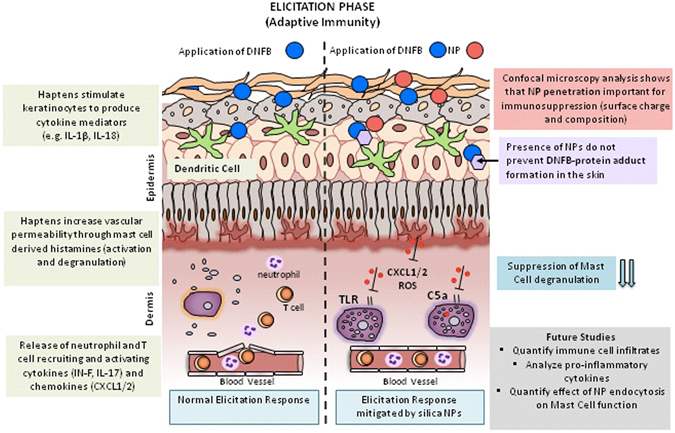
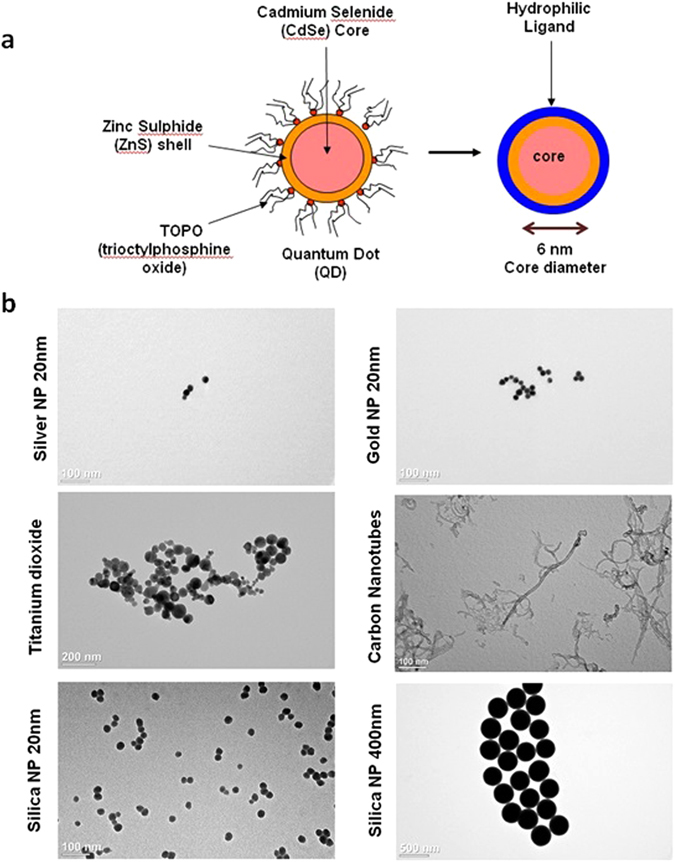
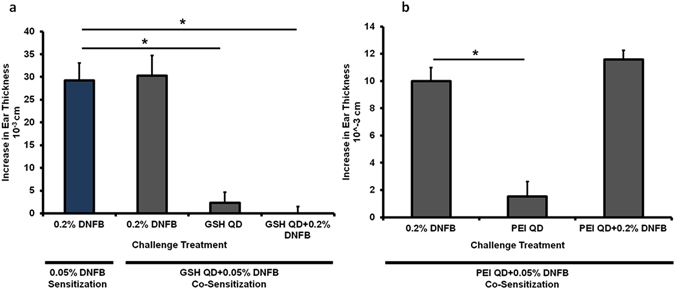
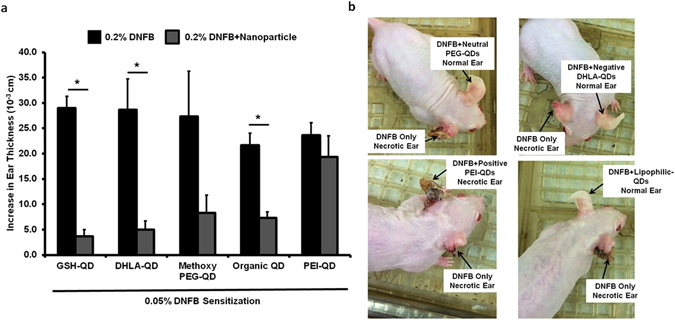
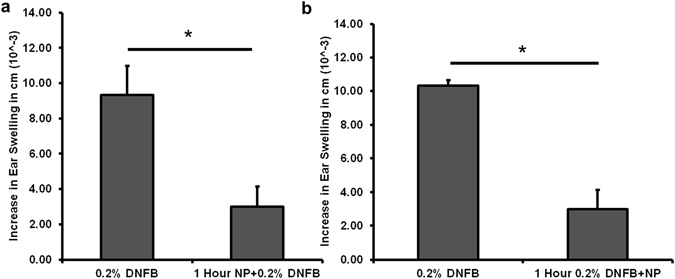
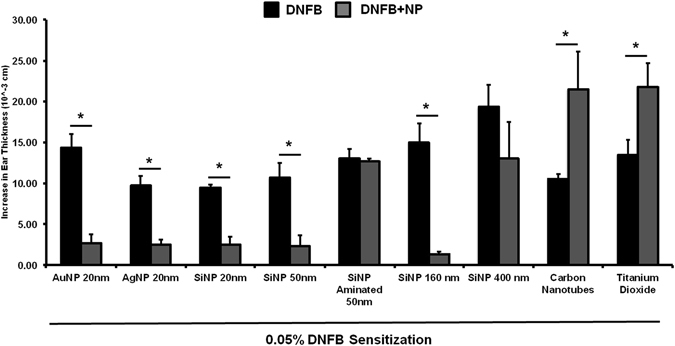
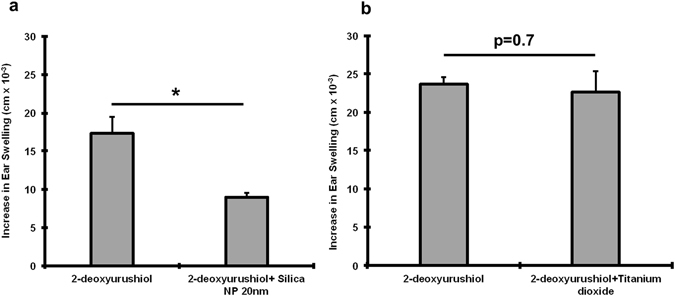
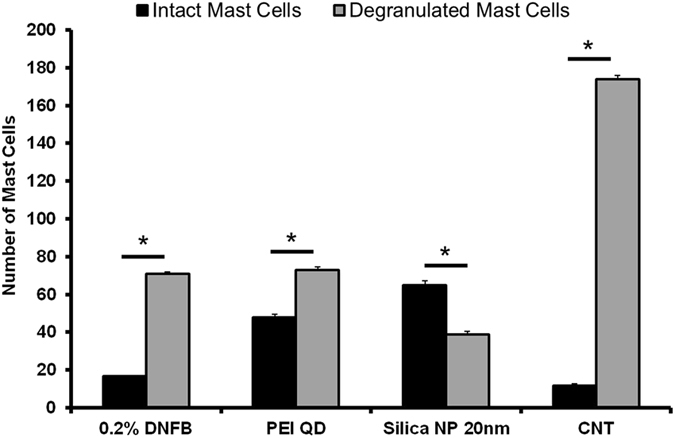
In recent years there has been considerable effort to understand the interaction of nanomaterials with the skin. In this study we use an in vivo mouse model of allergic contact dermatitis to investigate how nanoparticles (NPs) may alter allergic responses in skin. We investigate a variety of NPs that vary in size, charge and composition. Results show that small (<200 nm) negative and neutral charged NPs exhibit an immunosuppressive effect but that positively charged NPs do not. Confocal imaging suggests positively charged NPs may penetrate skin to a lesser extent and thereby are less able interact with and alter the local immune responses. Interestingly, negatively charged silica (20 nm) NPs suppress allergic response to two chemically distinct sensitizers; 1-fluoro-2, 4-dinitrobenzene and 2-deoxyurushiol. Skin wiping and NP application time studies suggest that the immunomodulatory mechanism is not due solely to the blocking of sensitizer adduct formation in skin. Results suggest that NPs modulate early immune events that impact mast cell degranulation. Our study shows for the first time the potential to modulate the elicitation phase of the allergic response which depends on the NP charge and composition. These finding can be used to inform the design topical therapeutics to mitigate allergic responses in skin.
近年来,人们在努力理解纳米材料与皮肤的相互作用。在这项研究中,我们使用过敏性接触性皮炎的体内小鼠模型来研究纳米颗粒(NPs)如何改变皮肤中的过敏反应。我们研究了各种在尺寸、电荷和组成上存在差异的 NPs。结果表明,小尺寸(<200nm)的带负电和不带电的 NPs 具有免疫抑制作用,但带正电的 NPs 没有。共聚焦成像表明,带正电的 NPs 可能穿透皮肤的程度较小,因此与局部免疫反应的相互作用和改变能力较弱。有趣的是,带负电的二氧化硅(20nm) NPs 抑制了两种化学上不同的敏化剂——1-氟-2,4-二硝基苯和 2-脱氧尿嘧啶醇的过敏反应。皮肤擦拭和 NP 应用时间研究表明,免疫调节机制不仅仅是由于阻止了敏化剂加合物在皮肤中的形成。结果表明, NPs 调节了影响肥大细胞脱粒的早期免疫事件。我们的研究首次表明,有可能调节过敏反应的激发阶段,这取决于 NP 的电荷和组成。这些发现可用于指导设计局部治疗药物,以减轻皮肤中的过敏反应。