Pang Xiaogang, Xu Yifan, Xie Shuoxin, Zhang Tianshu, Cong Lin, Qi Yuchen, Liu Lubing, Li Qingjun, Mo Mei, Wang Guimei, Du Xiuwei, Shen Hui, Li Yuanyuan
Innovative Institute of Chinese Medicine and Pharmacy, Shandong University of Traditional Chinese Medicine, Jinan 250355, China.
Experimental Center, Shandong University of Traditional Chinese Medicine, Jinan 250355, China.
Exp Neurobiol. 2023 Aug 31;32(4):285-301. doi: 10.5607/en23015.
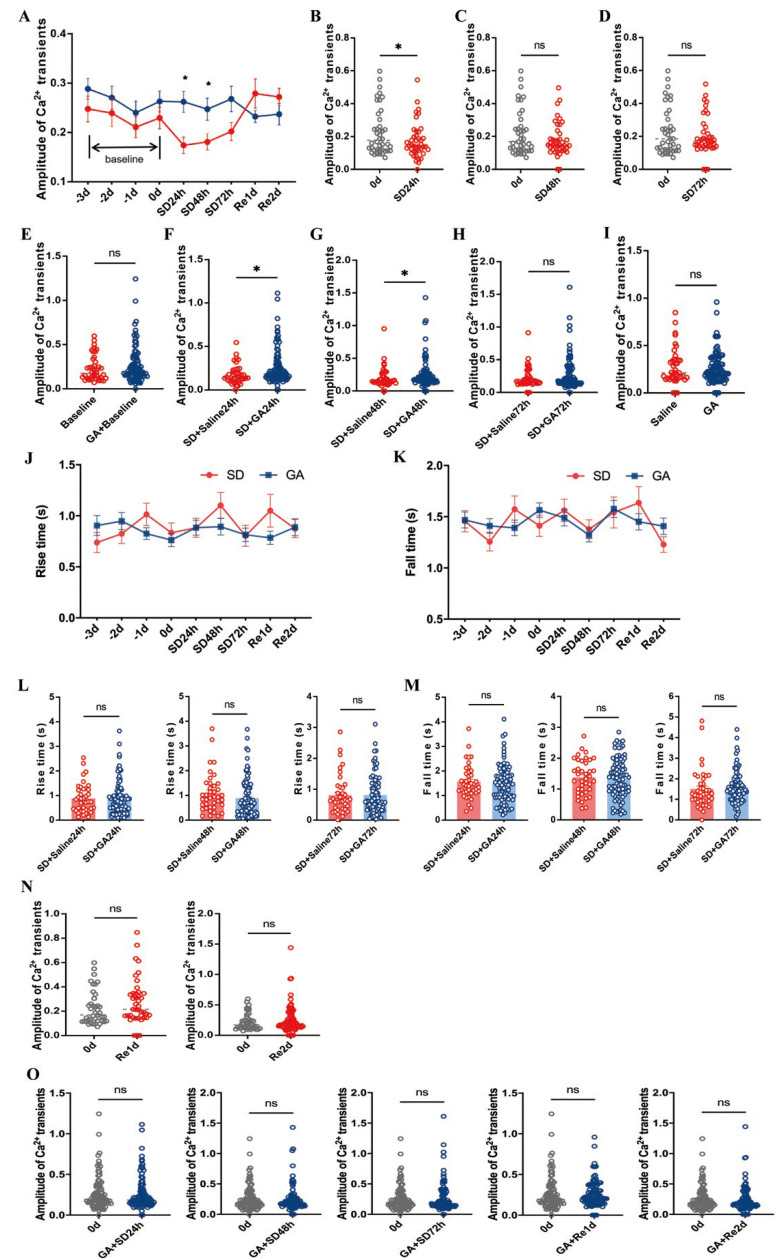
Sleep deprivation (SD) has a profound impact on the central nervous system, resulting in an array of mood disorders, including depression and anxiety. Despite this, the dynamic alterations in neuronal activity during sleep deprivation have not been extensively investigated. While some researchers propose that sleep deprivation diminishes neuronal activity, thereby leading to depression. Others argue that short-term sleep deprivation enhances neuronal activity and dendritic spine density, potentially yielding antidepressant effects. In this study, a two-photon microscope was utilized to examine the calcium transients of anterior cingulate cortex (ACC) neurons in awake SD mice in vivo at 24-hour intervals. It was observed that SD reduced the frequency and amplitude of Ca transients while increasing the proportions of inactive neurons. Following the cessation of sleep deprivation, neuronal calcium transients demonstrated a gradual recovery. Moreover, whole-cell patch-clamp recordings revealed a significant decrease in the frequency of spontaneous excitatory post-synaptic current (sEPSC) after SD. The investigation also assessed several oxidative stress parameters, finding that sleep deprivation substantially elevated the level of malondialdehyde (MDA), while simultaneously decreasing the expression of Nuclear Factor erythroid 2-Related Factor 2 (Nrf2) and activities of Superoxide dismutase (SOD) in the ACC. Importantly, the administration of gallic acid (GA) notably mitigated the decline of calcium transients in ACC neurons. GA was also shown to alleviate oxidative stress in the brain and improve cognitive impairment caused by sleep deprivation. These findings indicate that the calcium transients of ACC neurons experience a continuous decline during sleep deprivation, a process that is reversible. GA may serve as a potential candidate agent for the prevention and treatment of cognitive impairment induced by sleep deprivation.
睡眠剥夺(SD)对中枢神经系统有深远影响,会导致一系列情绪障碍,包括抑郁和焦虑。尽管如此,睡眠剥夺期间神经元活动的动态变化尚未得到广泛研究。一些研究人员提出,睡眠剥夺会降低神经元活动,从而导致抑郁。另一些人则认为,短期睡眠剥夺会增强神经元活动和树突棘密度,可能产生抗抑郁作用。在本研究中,使用双光子显微镜每隔24小时检测清醒的睡眠剥夺小鼠体内前扣带回皮质(ACC)神经元的钙瞬变。观察到睡眠剥夺降低了钙瞬变的频率和幅度,同时增加了不活跃神经元的比例。睡眠剥夺停止后,神经元钙瞬变显示出逐渐恢复。此外,全细胞膜片钳记录显示,睡眠剥夺后自发性兴奋性突触后电流(sEPSC)的频率显著降低。该研究还评估了几个氧化应激参数,发现睡眠剥夺显著提高了丙二醛(MDA)水平,同时降低了ACC中核因子红细胞2相关因子2(Nrf2)的表达和超氧化物歧化酶(SOD)的活性。重要的是,没食子酸(GA)的给药显著减轻了ACC神经元钙瞬变的下降。GA还被证明可以减轻大脑中的氧化应激,并改善睡眠剥夺引起的认知障碍。这些发现表明,在睡眠剥夺期间,ACC神经元的钙瞬变持续下降,这一过程是可逆的。GA可能是预防和治疗睡眠剥夺引起的认知障碍的潜在候选药物。